
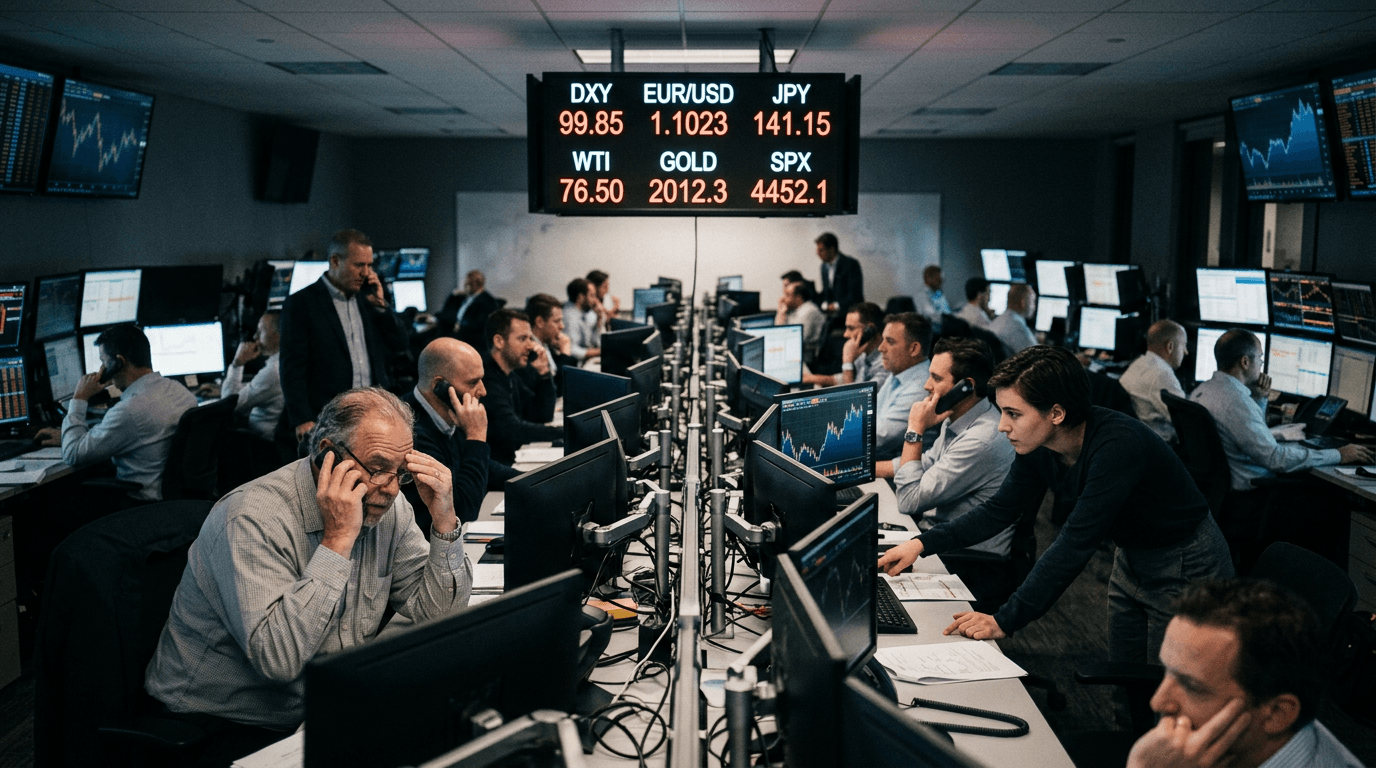
The US dollar index breaking below the 100 level in the wake of tariff headlines is more than a dramatic chart moment—it signals a broad repricing of FX, commodities, and risk assets as traders rethink the dollar’s central role in global portfolios[1]. A gap lower in futures and follow‑through selling has flipped what had been a “buy‑the‑dip” mindset in USD into a regime where weakness and volatility demand a different trading playbook[1].
Market Move In Context
To understand why this move matters, it helps to start with what the US dollar index (often referred to as DXY) actually measures. The index tracks the value of the dollar against a basket of major currencies, heavily weighted toward the euro, with the yen, pound, Canadian dollar, Swedish krona, and Swiss franc also included[3][5]. When DXY falls, it reflects a broad loss of dollar strength versus this basket—not just a single pair moving on idiosyncratic news[3][5].
The 100 level on the index carries psychological and historical significance. Over the past few decades, readings above 100 have typically aligned with phases of broad dollar strength, while deeper dips have marked weaker-dollar regimes where capital rotates into other currencies and real assets[4]. For the first time since mid‑2023, dollar index futures trading below 100 alongside a slide from the 110 region underscores that we may be transitioning out of a strong‑dollar environment into something more balanced—or outright dollar‑bearish[1].
For traders, that shift matters because the dollar is embedded in everything from FX pairs and commodities to equity indices and corporate earnings. A sustained move below 100 challenges assumptions built on a structurally strong USD and forces a reassessment of risk, hedging, and directional bias[1].
WHAT’S DRIVING DOLLAR WEAKNESS
The immediate catalyst has been tariff headlines that caught markets off guard, triggering a rapid reassessment of global growth, trade flows, and policy trajectories. When tariff risk rises, markets often price in slower trade, potential supply‑chain disruptions, and more uncertain earnings paths for multinational firms. That combination tends to dampen risk appetite and can weaken the dollar if investors expect the Federal Reserve to respond with a more cautious stance rather than aggressive tightening.
Layered on top of the tariff shock is an unwind of crowded dollar‑long positioning. The prior rally toward the 110 region left many portfolios tilted toward USD strength, whether in explicit FX trades or in more subtle exposures through dollar‑sensitive assets[1]. When a shock hits, investors frequently rush to reduce those one‑way bets, which accelerates moves in the underlying index as stops are triggered and leverage is cut.
Risk‑off flows are adding another dimension. In periods of uncertainty, capital often migrates into perceived safe havens such as the Japanese yen, Swiss franc, and gold, while also favoring high‑quality sovereign bonds. When those flows coincide with a reduction in dollar exposure, the impact on DXY can be outsized: the index falls not only because USD is being sold, but because key constituents in the basket are being bought aggressively at the same time[1][5].
How The Move Ripple Through Fx, Commodities, And Indices
Dollar weakness at the index level rarely stays contained; it spreads across major FX pairs, commodities, and equity indices. In the G10 space, pairs like EURUSD and GBPUSD typically see rallies as the base currency (USD) softens, particularly when policy paths between the US and Europe or the UK look more balanced[1]. High‑beta currencies such as AUD and NZD can also benefit, although they may be held back if tariff news is perceived as negative for global trade and commodities.
In emerging markets, the picture is more nuanced. A weaker dollar can ease pressure on countries with large USD‑denominated debt loads, potentially improving sentiment. However, if the driver is risk‑off tariff shock rather than benign policy easing, EM FX can still struggle as overall risk appetite deteriorates.
Commodities feel the shift as well. Because many raw materials are priced in dollars, a weaker USD often supports higher nominal commodity prices, all else equal[1]. Gold tends to attract renewed interest as both a dollar hedge and a safe‑haven asset, while industrial metals and energy markets may see more mixed reactions depending on how traders interpret the growth impact of new tariffs.
Equity indices are caught in the cross‑currents. Multinational exporters may benefit from a softer dollar that improves price competitiveness abroad, but tariff uncertainty and risk‑off sentiment can weigh on global equity benchmarks. The result is a complex mosaic where currency, commodity, and index moves must be read together rather than in isolation[1].
Practical Playbook For Active Traders
For discretionary and systematic traders alike, a break below 100 on the dollar index is a signal to revisit assumptions and sharpen execution. One immediate step is to review longer‑term charts across DXY and key USD pairs to identify where established dollar‑bull trends may be breaking or converting into ranges[1]. Identifying new resistance zones near the former highs and fresh support levels below 100 can help frame risk and reward.
Next, consider rebalancing exposure toward assets and currencies that historically benefit from a weaker dollar. That might mean shifting some focus toward EUR, GBP, gold, and select high‑beta FX where the macro backdrop still supports carry or growth stories, while reducing reliance on trades that only work in a strong‑USD regime[1]. Instead of treating USD dips as automatic buying opportunities, traders may need to adopt a more nuanced stance that respects the possibility of a prolonged soft‑dollar phase.
Another key takeaway is the value of relative‑value and cross‑currency trades. When the dollar’s trend becomes less one‑directional, opportunities often emerge in crosses where USD is not part of the pair—such as EURJPY or GBPCHF—allowing traders to express views on regional growth, central‑bank paths, and risk sentiment without being overly exposed to dollar swings[1]. This can diversify P&L drivers and reduce the impact of any single macro shock.
Simulated Finance: Turning Volatility Into A Training Ground
For SimFi traders, the dollar index slipping below 100 is a live case study in regime change that can be explored without real‑world capital at risk[1]. One practical approach is to build and compare two simulated strategies: one that assumes continued dollar softness (long EUR, GBP, gold, and selectively long high‑beta FX), and another that positions for a mean‑reversion bounce in the dollar driven by policy or data surprises[1]. Tracking the performance of both frameworks across different tariff headlines and risk‑off episodes can deepen understanding of how macro narratives interact with technicals.
It is also valuable to measure beta—the sensitivity of various assets to dollar moves. By monitoring how major FX pairs, equity indices, and metals respond day‑by‑day to shifts in DXY, traders can identify which instruments offer the cleanest expression of a dollar view and which are more influenced by local factors[1]. That insight helps refine instrument selection when volatility spikes.
Risk management is where simulated environments really shine. Traders can model how different stop‑loss placements, position sizes, and diversification choices would have affected outcomes during the slide from 110 to below 100[1]. Stress‑testing portfolios against further tariff shocks, surprise central‑bank communication, or abrupt reversals in risk sentiment can expose hidden vulnerabilities before they show up in live accounts.
Conclusion: From Headline Shock To Structured Edge
A break below 100 in the US dollar index amid tariff shock and risk‑off flows is the kind of event that can feel chaotic in the moment—but it also offers a powerful learning and trading opportunity. By framing the move in its broader macro context, recognizing how it ripples through FX, commodities, and indices, and systematically testing different strategic responses, traders can convert headline volatility into a structured edge[1].
Whether operating in live markets or a SimFi environment, the core disciplines are the same: stay aware of regime shifts, avoid over‑reliance on one‑way dollar narratives, focus on relative value, and embed robust risk management in every trade. In a world where the dollar’s dominance can no longer be taken for granted, that mindset is likely to be as valuable as any single trade built on this latest break below 100.