
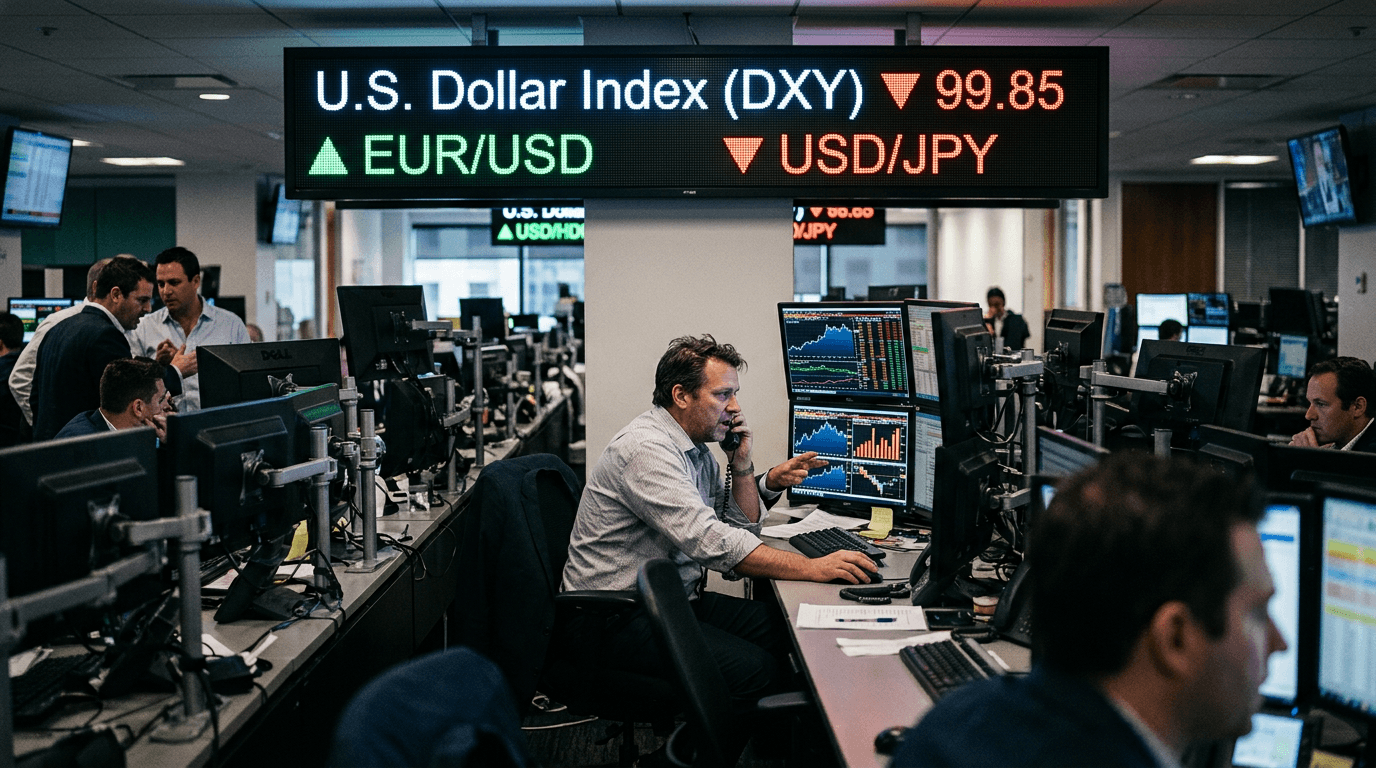
The sharp break in the U.S. dollar index below the 100 level has pulled FX traders’ attention firmly back to macro risk, reminding markets that policy headlines can hit currencies as hard as any data release. A fresh round of tariff announcements has rattled expectations for global trade, triggered a repricing of U.S. growth and inflation prospects, and amplified volatility across major USD pairs and safe‑haven currencies.
Tariff Shock Hits The Dollar
Tariffs are, at their core, a tax on cross‑border commerce, and markets quickly translate that into changes in growth and inflation expectations. When new or larger tariffs are announced, traders immediately start to reassess the outlook for corporate earnings, supply chains, and consumer prices in both the U.S. and its trading partners.
In this latest episode, the tariff shock has landed squarely on the U.S. dollar. The dollar index futures slipping below 100 for the first time since mid‑2023 signals that investors are no longer willing to pay a premium for dollar exposure at recent levels. Instead, they are rotating into other major currencies and traditional havens, looking for diversification as trade tensions escalate.
The move matters because it is not just a slow grind lower; it is a decisive break through a psychologically important threshold. Sub‑100 readings on the dollar index tend to coincide with periods of policy uncertainty, shifting central bank expectations, and larger swings in FX volatility. That combination is fertile ground for both trading opportunity and trading mistakes.
WHY A SUB‑100 DXY LEVEL MATTERS
The U.S. dollar index (often referred to as DXY) tracks the dollar’s value against a basket of major currencies, heavily weighted toward the euro, yen, and pound. A level of 100 roughly represents the average of the past couple of decades; when the index trades meaningfully above or below it, markets are sending a clear signal about relative confidence in the dollar.
Dropping below 100 after a tariff shock tells us two things. First, investors are questioning whether trade frictions will slow U.S. growth more than growth elsewhere, undermining one of the key pillars of dollar strength. Second, they are reassessing the Federal Reserve’s policy path: tariffs can be inflationary in the short term, but if they dent demand and investment, they may ultimately support a more cautious stance on rates.
From a volatility perspective, any decisive move through a widely watched level tends to pull in systematic and discretionary flows. Algorithmic strategies often react to trend breaks, while macro traders pivot around new narratives. That mix can lead to rapid price swings, widening bid‑ask spreads, and intraday reversals—conditions that reward disciplined strategy over emotional trading.
Winners And Losers Across Major Fx Pairs
A weaker dollar does not impact all currency pairs equally. The euro, as the largest component of the dollar index, is usually the first beneficiary when DXY sells off. If tariffs are perceived as primarily a U.S. story, EUR/USD can climb as investors rotate out of dollar assets and into European equities and bonds, even if the fundamental outlook for the eurozone is mixed.
The Japanese yen and Swiss franc often strengthen during tariff‑driven risk episodes as well. Both are seen as safe‑haven currencies, backed by deep capital markets and stable political environments. When the dollar falls on risk concerns rather than pure rate expectations, USD/JPY and USD/CHF can drop as investors unwind carry trades and seek lower‑volatility parking spots for capital.
Emerging market currencies face a more nuanced picture. On one hand, a weaker dollar can be supportive, easing pressure on countries that borrow in dollars and import dollar‑priced commodities. On the other hand, tariffs that directly target major EM exporters or disrupt global supply chains can offset that benefit. As a result, performance across EM FX is typically highly differentiated: exporters hit by tariffs may weaken, while more domestically driven economies can actually see their currencies stabilize or strengthen in the wake of a softer dollar.
Navigating Heightened Fx Volatility
For traders, tariff‑driven FX volatility calls for a clear framework rather than a reactive stance. The first step is to distinguish between narrative and numbers. Headlines move prices quickly, but the durability of the move depends on how tariffs feed into economic data, corporate earnings, and central bank communication over the following weeks and months.
Risk management becomes more important as volatility rises. Wider intraday ranges increase the chance of being stopped out on noise rather than genuine trend changes. Traders can adapt by reassessing position sizes, using more conservative leverage, and placing stops beyond obvious technical levels that are likely to be tested and flushed during fast markets.
It is also a useful environment to revisit correlation assumptions. In quiet periods, traders often rely on stable relationships between assets—such as “strong dollar equals weak commodities” or “risk‑off equals stronger yen.” Tariff shocks can temporarily scramble these relationships. For example, a weaker dollar might support commodity prices, but if tariffs simultaneously threaten demand from key buyers, the net impact becomes murkier. Active monitoring of correlations and volatility metrics is essential.
Practical Takeaways For Simulated Traders
For traders using simulated environments, a tariff‑driven break below 100 in the dollar index is an ideal case study for macro‑driven FX moves. It offers the chance to test strategies under conditions that combine policy uncertainty, trend breaks, and shifting correlations—without the emotional pressure that comes with real capital at risk.
One practical exercise is to build and test scenario maps. Start with a base case (tariffs remain, but no further escalation), then add upside and downside variants: escalation to broader sectors, partial rollback, or offsetting fiscal measures. For each scenario, outline potential paths for key pairs like EUR/USD, USD/JPY, and an EM currency basket, then simulate how different strategies—trend‑following, mean‑reversion, or options‑based approaches—would perform.
Another valuable skill to hone is event‑driven risk management. Practice adjusting position size, leverage, and stop placement before and after major tariff or trade headlines. Track how these adjustments impact simulated drawdowns and recovery times. Over multiple episodes, patterns emerge: some strategies weather volatility well with modest tweaks, while others require more fundamental redesign.
Ultimately, the dollar’s slide below 100 in response to tariff news is a reminder that currency markets sit at the crossroads of policy, economics, and sentiment. Traders who treat these episodes as learning laboratories—whether in live or simulated environments—can build playbooks that carry forward into future shocks, from trade disputes to central bank surprises and beyond.