
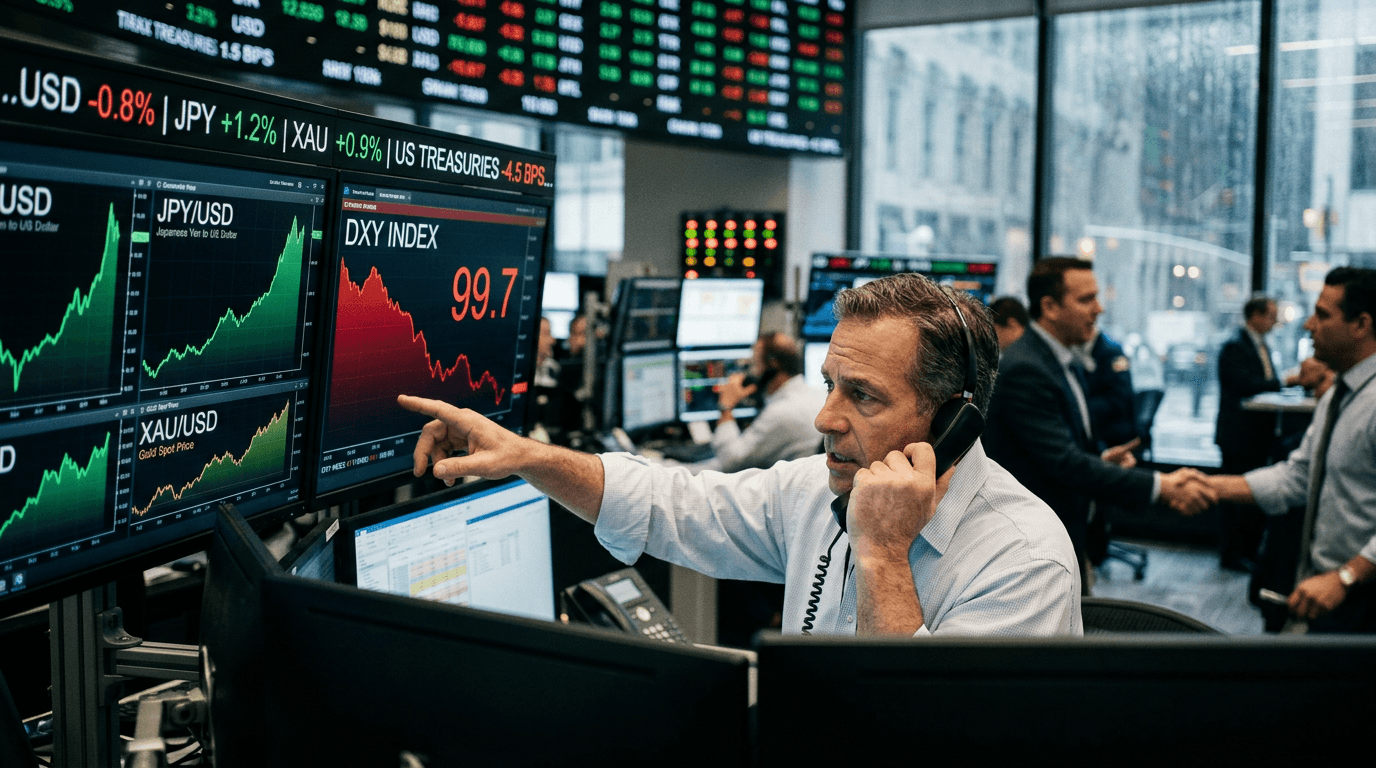
The U.S. dollar index sliding below the psychologically important 100 level is more than a headline—it’s a signal that global markets are rapidly repricing interest rate and trade policy risk, with ripple effects across every major currency pair and asset class.[1][6] For traders on both live and simulated platforms, this kind of regime shift is where positioning, risk management, and strategy discipline are tested most.
What The Dollar Index Breaking 100 Really Means
The U.S. Dollar Index (DXY) tracks the value of the dollar against a basket of major currencies, primarily the euro, yen, pound, Canadian dollar, Swedish krona, and Swiss franc.[6][7] A move below 100 marks a notable departure from the strong-dollar environment that dominated much of the post‑pandemic period.[1]
For the first time since mid‑2023, dollar index futures have traded decisively below 100, extending a retreat from the 110 region that had symbolized the peak of the dollar bull run.[1] The move began with a gap lower in Asian trade, then gathered momentum as liquidity deepened, confirming that this was not a single misprint but a broad-based repricing of the greenback.[1]
The 100 level matters because it is both a technical and psychological boundary. Technically, it has acted as a pivot in prior cycles, with sustained breaks often coinciding with shifts in macro narratives—such as transitions from “higher-for-longer” rate expectations to a more neutral or easing stance.[1] Psychologically, round numbers like 100 can trigger systematic flows: options barriers, hedge adjustments, and algorithmic responses that amplify the initial move.
In practical terms, a durable break below 100 tells traders that the market is no longer fully priced for a dominant dollar story. Instead, participants are beginning to discount a future where U.S. rates, tariffs, and growth are less supportive of continued dollar strength.
Tariffs, Rates, And Why The Dollar Sold Off
The catalyst for the latest leg lower has been a combination of shifting rate expectations and rising tariff risk. Recent U.S. data has been softer at the margin, encouraging investors to scale back expectations for further Federal Reserve rate hikes and to entertain the possibility of earlier or deeper cuts.[1][4] As the “higher-for-longer” narrative loses conviction, the yield advantage that supported the dollar versus other majors begins to erode.[1]
At the same time, renewed discussion of tariffs and trade barriers introduces an additional layer of uncertainty. Markets do not just care about whether tariffs are imposed; they care about the knock-on effects on inflation, growth, corporate margins, and global supply chains. Higher tariffs can be inflationary in the short term yet dampen growth and trade volumes over the medium term—an awkward mix for policymakers and investors.
For currency markets, that mix is important. If traders believe tariffs will complicate the Fed’s task, increase volatility, and potentially weaken the U.S. growth outlook, they may demand a higher risk premium for holding dollar assets. That reassessment can translate into broad dollar selling, especially when speculative positioning is already crowded on the long side.[1]
In this environment, each new headline about tariffs or forward guidance from the Fed acts as a catalyst for repositioning. The result is not just a directional move lower in the index, but a wholesale repricing of relative value across G10 and emerging market FX.
How Fx Pairs And Safe-haven Assets Reacted
A sharp move in the dollar rarely happens in isolation. As the index broke below 100, traders saw immediate knock-on effects across major FX pairs: euro and sterling pushed higher, commodity currencies like AUD and CAD found support, and emerging market currencies—long pressured by strong-dollar dynamics—caught a relief bid.[1][10]
Safe-haven flows also intensified. The Japanese yen, historically treated as a refuge during periods of uncertainty, strengthened as global investors reduced dollar exposure and sought shelter in lower-beta assets. Gold, another classic safe haven and a natural beneficiary of lower real rate expectations, attracted inflows as traders looked to hedge against both policy uncertainty and potential financial market volatility.
For macro traders, this move changes the relative attractiveness of carry trades and hedging strategies. A weaker dollar can:
- Support emerging market assets by easing funding pressures and improving terms of trade.[10]
- Reduce FX headwinds for non‑U.S. corporates with dollar liabilities, potentially improving earnings visibility.
- Reshape cross‑asset correlations, with equities, bonds, and commodities responding differently to the evolving rate and tariff landscape.[6]
For anyone trading simulated or live FX, the key takeaway is that a single macro shock can rewire multiple markets simultaneously. Understanding these linkages is critical to avoiding isolated, pair‑by‑pair thinking in a genuinely global repricing.
Implications For Traders: Risk, Regimes, And Playbooks
When a major index like DXY breaks a long‑standing level, the most important step is not to chase the move—it is to reassess your framework. Start by revisiting the longer‑term charts for the dollar index and your core USD pairs, looking for clear signs that the prior trend is breaking: failed supports, momentum reversals, and moving‑average crossovers.[1]
Next, map your exposure. Identify where your portfolio is implicitly short or long the dollar, even if you are not trading DXY directly. This includes:
- FX positions (spot and futures)
- Dollar‑denominated commodities, especially gold and oil
- U.S. and non‑U.S. equity indices with different sensitivities to the currency
- Global bond positions affected by rate differentials
In a SimFi environment, this is an ideal moment to stress‑test strategies. Use simulated accounts to run scenarios where the dollar continues to weaken, stabilizes in a range, or snaps back above 100. Examine how each scenario would impact P&L, margin usage, and risk metrics. Forward‑looking markets reward traders who plan for multiple outcomes rather than anchoring on a single narrative.[1]
Finally, tighten your risk controls. Elevated volatility around major macro inflection points can lead to slippage, wider spreads, and faster‑moving markets. Adjust position sizes, review stop‑loss placement, and be deliberate about leverage—especially on shorter‑term strategies that can be whipsawed by intraday headlines.
Practical Trading Takeaways In A Weaker-dollar Environment
To turn this macro event into actionable insight, consider a few concrete steps:
1. Refine your macro view Clarify your base case for U.S. rates and tariffs over the next 6–12 months. Are you expecting a gradual easing cycle, a pause, or a policy surprise? Align your FX and cross‑asset positioning with that macro thesis, and remain willing to update it as new data and guidance emerge.[1][4]
2. Focus on relative value, not just direction A weaker dollar is not uniformly bullish or bearish for all currencies. Some benefit more than others, depending on growth prospects, political stability, and their own central bank trajectories. Use the dollar break as a prompt to re‑examine relative value trades—such as long EUR vs. USD, or selective EM FX plays—rather than simply shorting the dollar broadly.[1][10]
3. Watch correlations and regime shifts Correlations between FX, equities, bonds, and commodities can change around major dollar turning points.[6] Monitor how these relationships evolve in real time. For example, if a weaker dollar is coinciding with stronger risk assets and firmer commodities, that may validate a “pro‑growth, lower‑rates” narrative. If instead you see risk aversion and safe‑haven buying, the story may be more about policy uncertainty than straightforward easing.
4. Use simulation to rehearse execution On platforms like E8 Markets, simulated environments allow traders to practice entering and exiting positions during volatile macro events without capital at risk. This is particularly valuable for testing order types, timing, and position scaling around key levels like DXY 100, where order flow can be dense and price action erratic.
Ultimately, the dollar’s break below 100 is a reminder that no macro regime lasts forever. Markets are constantly repricing the future, and when expectations around rates and tariffs shift, the adjustment can be fast and broad. Traders who adapt quickly—by updating their frameworks, respecting new technical realities, and rigorously managing risk—are best placed to navigate the next chapter of the FX playbook.