
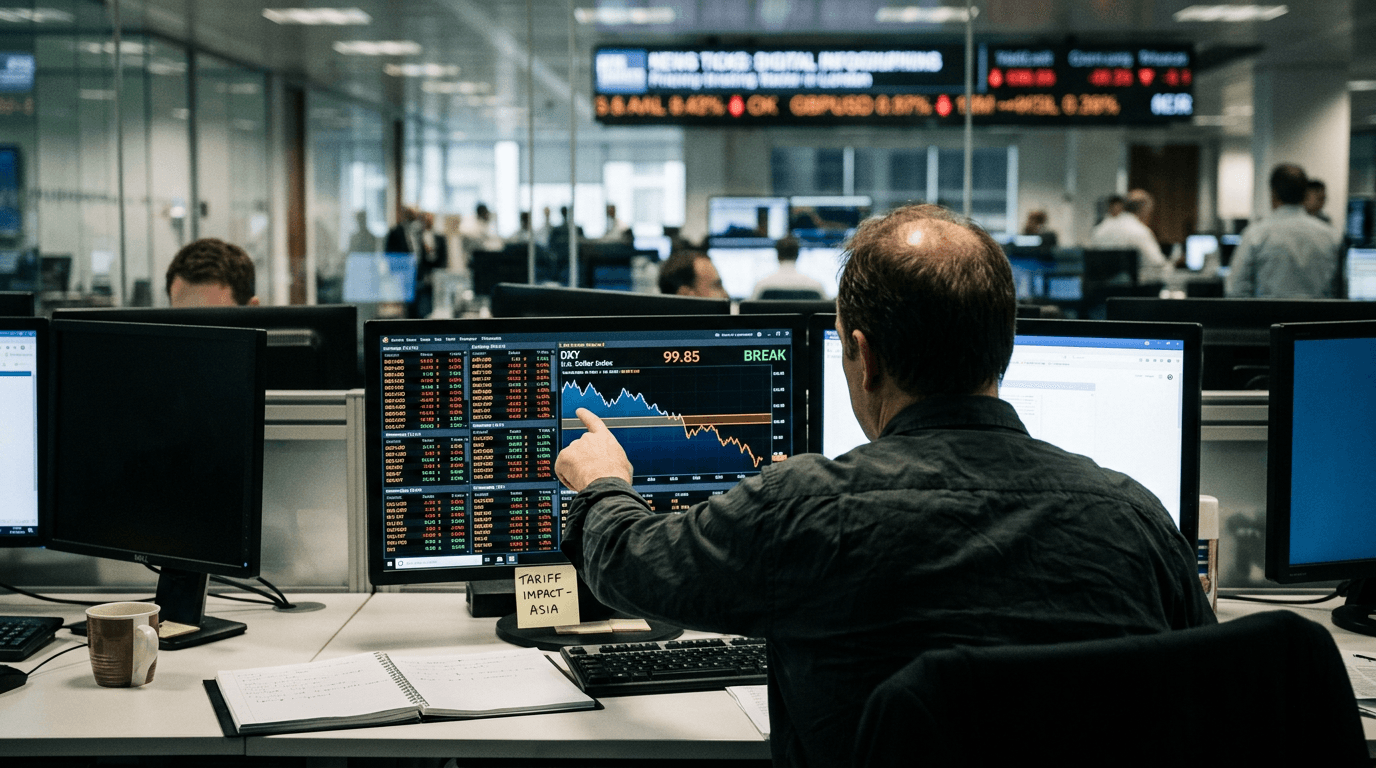
The U.S. dollar index breaking below the psychologically important 100 level has put currency markets on alert, signaling that broad-based dollar strength is giving way to a more fragile backdrop shaped by tariffs and mounting trade tensions.[7][8] For traders, this is more than a headline—it is a regime shift that can reprice risk across foreign exchange, commodities, and global equities.
Market Move In Context
The U.S. Dollar Index (DXY), which tracks the value of the dollar against a basket of major currencies, has traded near and above 100 for much of the past year, reflecting the dollar’s relative resilience amid higher U.S. interest rates and safe-haven demand.[3][5][6] The recent slide below 100 marks the first break of this threshold since mid-2023, and puts the index near multi‑year lows.[7][8]
From a technical standpoint, the 100 level is a key psychological pivot that many traders use as a line between “strong” and “neutral-to-weak” dollar regimes.[2][6] Once that line gives way, algorithms and discretionary traders alike often reassess positioning, unwind crowded long-dollar trades, and look for opportunities in currencies that stand to benefit from a softer greenback.
Fundamentally, the break comes at a time when renewed tariff threats and trade frictions are clouding the global growth outlook. Tariff uncertainty can dampen cross-border investment, complicate supply chains, and raise questions about future profit margins, all of which can weigh on the dollar if investors begin to prefer diversification into other major currencies rather than concentrating exposure in U.S. assets.
What The Dollar Index Measures
To understand why a move below 100 matters, it helps to know what the dollar index actually tracks. The DXY measures the value of the U.S. dollar relative to a basket of six major currencies: the euro, Japanese yen, British pound, Canadian dollar, Swedish krona, and Swiss franc.[4] The euro carries by far the largest weight, so EUR/USD tends to drive much of the index’s movement.[4]
This construction means DXY is a measure of broad dollar performance, not just bilateral moves against a single currency. A break below 100 typically indicates that the dollar is losing ground against multiple major counterparts at the same time, rather than simply reacting to idiosyncratic developments in one economy.[4] That breadth is why macro traders watch the index so closely.
For market participants, the takeaway is clear: tracking DXY offers a quick read on whether dollar strength or weakness is becoming a dominant global theme. When the index shifts from a strong regime (above 100) into a weaker one (below 100), it often corresponds with changes in capital flows, hedging costs, and relative performance across regions.
Tariff Pressure, Trade Tensions And Currency Flows
Historically, trade tensions and tariffs have been double-edged for the dollar. In the early phases of a trade dispute, uncertainty can drive investors into perceived safe havens, sometimes supporting the greenback. But as tariffs persist and start to erode corporate margins, slow trade volumes, and threaten global growth, sentiment can shift away from the U.S., especially if policy risks are viewed as originating there.
Tariffs raise import costs, disrupt supply chains, and can trigger retaliation from trading partners. Over time, this can reduce confidence in the stability of U.S. policy and the predictability of earnings for multinational firms, prompting global investors to diversify into other currencies and jurisdictions. That diversification can translate into lower demand for dollar-denominated assets and, by extension, a weaker DXY.
At the same time, trade tensions can influence expectations for central bank policy. If tariffs and uncertainty drag on growth, markets may price in earlier or deeper rate cuts from the Federal Reserve, narrowing the interest-rate advantage that has supported the dollar in recent years.[3][6] Lower relative yields make holding dollars less compelling compared with other currencies, further pressuring the index.
For traders, the key takeaway is that tariff headlines are not just political noise—they are macro inputs that can alter the dollar’s structural appeal. Paying attention to how trade news shifts growth and rate expectations is essential for understanding whether a weaker dollar trend has room to extend.
Implications For Traders And Investors
A DXY break below 100 reshapes the opportunity set across multiple markets. In foreign exchange, it can favor long positions in currencies with improving fundamentals or positive carry (higher interest rates) relative to the U.S., such as certain commodity or emerging market currencies, provided broader risk sentiment remains stable.
Technical traders will watch how the index behaves around key support and resistance levels identified near the high‑90s and low‑100s.[2][6] A sustained close below 100, followed by consolidation rather than an immediate snap-back, increases the probability that the move reflects a genuine trend shift rather than a brief overshoot. That informs whether to treat the move as a breakout to trade with, or a fadeable spike.
Beyond FX, a softer dollar often has knock‑on effects. Dollar weakness can be supportive for commodities priced in USD, such as gold and oil, by making them cheaper for non‑U.S. buyers. It can also ease pressure on emerging markets that borrow in dollars, improving risk sentiment toward EM equities and bonds. However, tariffs can partially offset this tailwind by dampening trade flows and corporate confidence, so the net impact needs to be assessed carefully in each sector.
For portfolio managers and active traders, the takeaway is to think in terms of scenarios: How does a prolonged period of sub‑100 DXY interact with your exposure to trade-sensitive sectors, global exporters, and USD funding costs? Aligning positioning with those scenarios, rather than reacting only to spot moves, can improve consistency.
Using Simulated Finance To Navigate Volatility
In an environment where macro headlines and policy surprises can push the dollar index through major levels, simulated finance (SimFi) platforms provide a valuable sandbox for strategy development and risk testing. Instead of experimenting with live capital during volatile conditions, traders can model how their systems perform in different regimes of dollar strength and weakness.
On a platform like E8 Markets, traders can build and test playbooks that explicitly reference DXY levels: trend-following systems that enter when the index breaks key thresholds, mean‑reversion approaches around overextended moves, or cross‑asset strategies that pair dollar signals with positions in commodities or indices. This allows traders to see, for example, how often a break below 100 precedes sustained weakness versus quick reversals, and how that interacts with tariff-driven volatility.
The practical takeaway is that SimFi environments are ideal for turning macro insights—such as “tariff risk is pressuring the dollar below 100”—into rules-based strategies. By stress‑testing those rules across different historical periods, traders can distinguish robust edges from ideas that only work in narrow, hindsight-driven windows.
Looking Ahead
The dollar’s move below 100 raises important questions for the months ahead. Will trade tensions escalate to the point of materially denting global growth, or will negotiations and policy adjustments stabilize sentiment? How will the Federal Reserve respond if tariffs and uncertainty weigh on activity while inflation dynamics evolve? The answers will shape whether sub‑100 DXY becomes the new normal or a temporary detour.[3][6]
For now, traders and investors should treat the break as a signal to revisit assumptions about dollar strength, re‑evaluate hedging strategies, and consider how tariff and trade risks fit into their broader macro framework. Using tools like the dollar index, scenario analysis, and simulated trading environments, market participants can move beyond the headline and build structured approaches to navigating a potentially weaker dollar regime.