
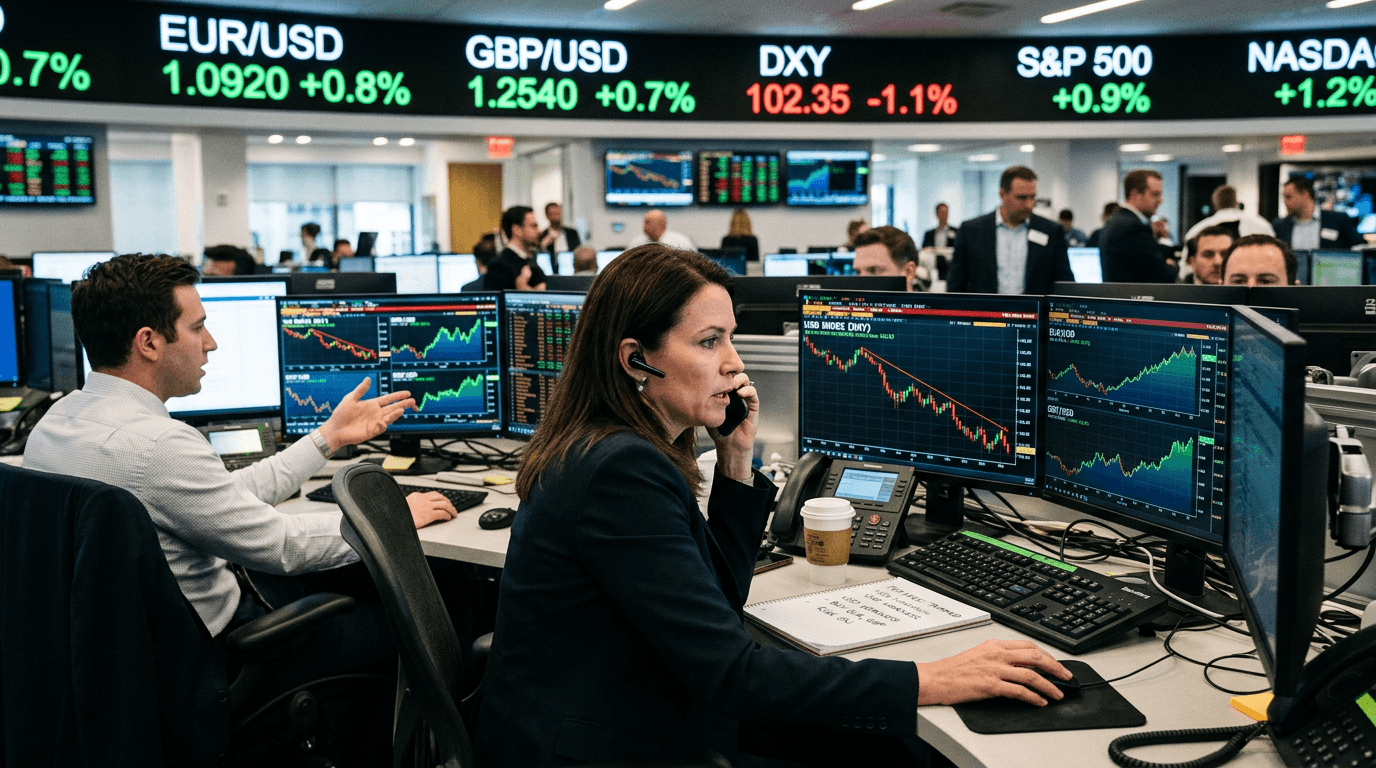
The US dollar’s latest slide is more than just a headline; it encapsulates how quickly macro narratives can flip when inflation cools and rate expectations shift. For traders, the move in the US dollar index is a live case study in how central bank repricing ripples through FX, futures, and risk assets, creating both opportunity and risk.
WHAT’S DRIVING THE DOLLAR’S DROP
The starting point for understanding the dollar’s weakness is the Federal Reserve’s policy backdrop. After cutting the federal funds rate by 0.25 percentage points in December 2025, the Fed has held rates in a 3.50%–3.75% range, reinforcing the sense that it is closer to the end than the beginning of the tightening cycle[14]. Softer recent US inflation data has added to this perception, encouraging markets to scale back expectations for further rate hikes and price in a longer pause.
As inflation surprises cool, traders focus less on “how high” rates will go and more on “how long” they will stay elevated. Fed funds futures and tools that track FOMC probabilities show a reduction in the implied odds of additional hikes, with some scenarios even pointing toward eventual cuts over the medium term[5][8]. When the market no longer expects the Fed to out-hawk its global peers, the dollar’s yield advantage narrows, undermining one of its key support pillars.
This repricing is visible in the US dollar index (DXY), which has dropped toward the lower end of its recent range after declining from levels above 101 in prior sessions[1][13]. Over the past year, the index has seen notable swings, including double-digit declines during earlier easing phases, reminding traders that the dollar can move sharply when policy expectations pivot[7][10][13]. The latest break below technical support reinforces the narrative that the “strong dollar” trend is under pressure, at least for now.
How Major Fx Pairs Are Responding
When the dollar weakens broadly, the most direct beneficiaries are the major currencies in its basket. EUR/USD and GBP/USD have both moved higher as dollar sellers rotate into European and higher-yielding currencies, pushing these pairs up through recent resistance zones. GBP/USD, for example, has been trading in the low-1.32s, reflecting a pound that has been grinding higher against the dollar as sentiment shifts[6][15].
The mechanics are straightforward: if the market expects fewer Fed hikes while still pricing in relatively firm policy stances from other central banks, the interest rate differential that once favored the dollar compresses. This can encourage carry flows into currencies with similar or higher yields and more attractive real-rate profiles. EUR and GBP, supported by their own evolving rate paths, are natural destinations in that environment[9].
For traders, the current move is a textbook example of trend extension following a macro catalyst. Breaks of key levels in DXY often align with fresh signals on EUR/USD and GBP/USD, with momentum traders looking for follow-through and mean-reversion traders watching closely for signs of exhaustion. Understanding how the index and individual pairs interact can help you avoid treating each chart in isolation.
Impact On Risk Assets And Cross-markets
Dollar weakness rarely stays confined to FX. A softer greenback tends to support US and global equities, especially sectors that benefit from easier financial conditions and improved risk appetite. A weaker dollar can also be a tailwind for commodities priced in USD, such as gold and energy, and for crypto assets, which often trade as high-beta expressions of liquidity and sentiment.
For global investors, a declining dollar can improve foreign currency returns on US assets and encourage rotation into international markets. At the same time, export-oriented US companies may benefit from improved competitiveness abroad as their goods become cheaper in local currency terms. These cross-asset dynamics matter for traders who use FX as part of a broader macro or multi-asset strategy.
In practical terms, this environment tends to favor strategies that lean into pro-risk themes: long equity indices, long cyclicals over defensives, and tactical long positions in higher-yielding or reflation-linked currencies. However, it also increases the importance of monitoring correlations, as shocks that reverse the dollar’s trend — such as a surprise hawkish turn from the Fed — can quickly unwind these trades.
What This Means For Simulated Finance Traders
For traders using simulated finance platforms like E8 Markets, the current dollar move is an ideal scenario to practice linking macro stories to trading decisions. SimFi allows you to build and test strategies without capital at risk, helping you learn how shifts in Fed expectations propagate across FX, futures, and indices.
One practical application is to design and backtest a “Fed repricing” playbook. For example, you might simulate a regime where DXY breaks below key support while EUR/USD and GBP/USD extend higher, then test different approaches: breakout entries, pullback entries, or options-based hedging on FX futures. By using historical ranges and volatility data for the dollar index and major pairs[1][13], you can evaluate which tactics perform best in similar environments.
You can also stress-test your strategies by modeling alternative paths for rates based on current Fed projections, which show a split committee with some officials favoring additional hikes and others seeing scope for cuts[8][11][14]. This kind of scenario analysis forces you to think in probabilities rather than certainties, an essential skill when trading macro-driven markets.
Key Takeaways For Your Trading Plan
1) Anchor your view in the policy path. Track not just the current Fed funds rate, but how futures markets are pricing the next 6–12 months, using tools that visualize FOMC probabilities and implied rate curves[5][8][14].
2) Link the dollar index to individual pairs. Watch DXY alongside EUR/USD and GBP/USD to see whether price action is confirming the macro story or diverging. Divergences can signal either opportunity or caution, depending on your setup[1][6][13][15].
3) Respect technical levels and volatility. Multi-month lows in the index often coincide with elevated intraday volatility. Plan entries, exits, and position sizing with wider ranges in mind, and consider using simulated environments to refine your risk management.
4) Think cross-asset. If you trade FX on a SimFi platform, experiment with strategies that also reference equity indices, commodities, or crypto, reflecting how broader risk appetite responds to dollar moves.
5) Practice “what if the narrative flips?” Build counter-scenarios where inflation re-accelerates or Fed communication turns more hawkish, leading to a swift dollar rebound. Test how your strategies hold up when the consensus view is challenged.
Conclusion
The US dollar index’s slide to a multi-month low is a clear reminder that macro narratives are dynamic, not static. As markets cut Fed rate-hike expectations on the back of softer inflation data, the dollar’s yield premium and safe-haven appeal look less dominant, opening the door for gains in EUR, GBP, and risk assets more broadly[1][6][8][14]. For traders, especially those honing their skills in simulated environments, this is an opportunity to study how policy, sentiment, and price action interact — and to turn that understanding into a more robust, adaptable trading playbook.