
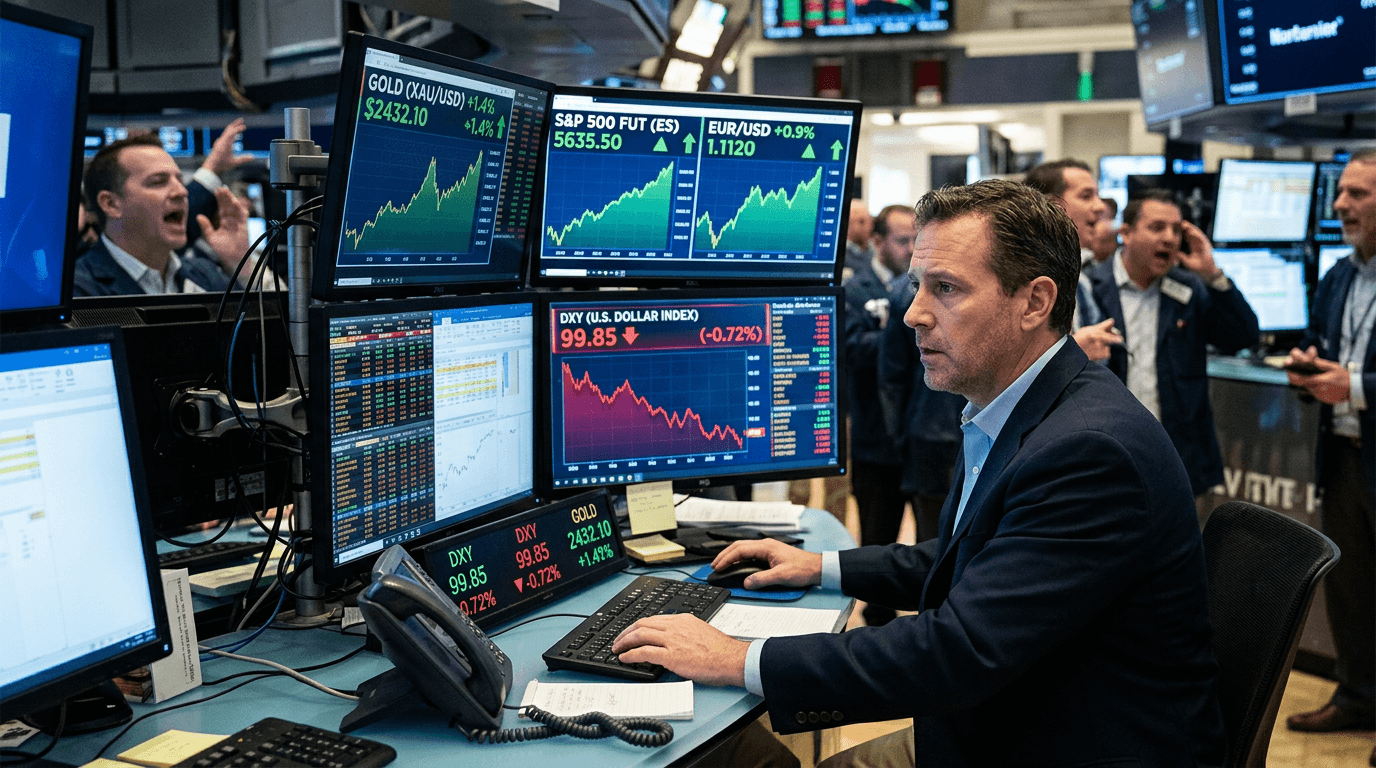
A sudden break below the 100 level in the U.S. Dollar Index has jolted global markets, unleashing sharp moves across major FX pairs, metals, and equity index futures. For traders, this is more than a headline moment—it’s a regime shift in dollar dynamics that can reshape risk, correlations, and opportunity sets for weeks or even months to come.
Understanding The Dollar Index Break
The U.S. Dollar Index (often referred to as DXY or USDX) measures the value of the dollar against a basket of six major currencies, dominated by the euro, with contributions from the yen, pound, Canadian dollar, Swedish krona, and Swiss franc.[2][4][7] Since its creation in 1973, the index has used 100 as a base level, meaning readings above 100 reflect a stronger dollar than in 1973, while readings below 100 signal a weaker dollar.[4][7]
When the index slides under 100 for the first time in several years, it is not just a technical event—it is a clear signal that the dollar’s relative strength trend has reversed, at least in the short to medium term. A break of such a widely watched level often acts as a trigger for systematic flows: trend-following strategies, macro funds, and algorithmic models that are tuned to regime thresholds tend to accelerate the move once the level gives way.
In this latest episode, the plunge happened during the Asian session, when liquidity can be thinner in some dollar pairs, amplifying price impact. As futures drove the index below 100, traders rapidly adjusted positions, causing a cascade of stop orders and fresh momentum buying in rival currencies.
WHAT DROVE THE SELLOFF?
The immediate catalyst for a sharp dollar selloff is usually a change in interest rate expectations. Because currencies are heavily influenced by rate differentials, any shift in how markets price future Federal Reserve policy tends to ripple quickly through the dollar complex. A dovish repricing—where traders reduce the odds of further hikes or bring forward expectations for cuts—can weaken the dollar as yield support fades.
In this context, a break below 100 suggests markets are reassessing the Fed’s path relative to other central banks. If participants begin to believe that U.S. rates have peaked while other economies may hold or even raise rates, carry advantage shifts away from the dollar. Large global asset managers, reserve managers, and macro funds then rebalance out of USD, reinforcing the move.
Beyond rates, sentiment and positioning matter. After extended periods of dollar strength, speculative positioning in futures and options can become crowded. Any catalyst—a weaker data print, a softer Fed communication, or geopolitical de-escalation that reduces safe-haven demand—can push traders to unwind long-dollar exposure. When these flows hit key levels like 100, selling often becomes self-reinforcing.
How Major Fx Pairs Are Repricing
The euro and the British pound typically react aggressively to dollar moves, given their weight in the DXY basket.[2][4][7] As the index slipped below 100, EUR/USD and GBP/USD surged higher, reflecting both dollar weakness and opportunistic buying in European currencies. Price action in these pairs tends to exhibit a mix of short-covering (traders closing out prior short positions) and fresh bullish momentum as technical levels break.
For EUR/USD, a decisive move through prior resistance can shift the narrative from “range-bound” to “emerging uptrend.” That invites trend-following strategies and systematic funds to add long exposure, while options markets may reprice implied volatility higher to reflect the new regime. GBP/USD behaves similarly, though the pound’s sensitivity to domestic factors—growth, inflation, and Bank of England guidance—can create different relative performance versus the euro.
Other G10 currencies respond as well. The Japanese yen and Swiss franc often attract both risk-off and anti-dollar flows, making USD/JPY and USD/CHF key barometers of broader sentiment. Commodity-linked currencies such as AUD, NZD, and CAD can benefit if a weaker dollar coincides with firmer commodity prices, creating a double tailwind for those FX pairs.
Implications For Gold And Equity Index Futures
A weaker dollar tends to be supportive for gold and other dollar-denominated commodities because it effectively lowers the currency “price” at which global investors access these assets. When the dollar falls, gold often sees renewed safe-haven and diversification demand, especially if the dollar weakness is tied to concerns about U.S. real yields or fiscal dynamics.
Equity index futures can respond in more nuanced ways. On one hand, dollar softness can be positive for U.S. multinationals, as foreign earnings translate more favorably back into dollars. On the other, a dollar downtrend that stems from worries about U.S. growth or policy uncertainty may weigh on risk sentiment. Outside the U.S., weaker dollar periods are often supportive for emerging market equities and credit, as financing conditions effectively ease and local currencies gain breathing room.
For traders, the key is to recognize that correlations are not static. In some regimes, a falling dollar coincides with rising equities and commodities; in others, it accompanies broader risk aversion. Understanding which narrative is driving the move—policy repricing, growth concerns, or positioning washout—helps determine whether to lean into risk or focus on defensive plays.
Practical Takeaways For Traders And Simulated Strategists
A major break in the U.S. Dollar Index offers several practical lessons for traders, whether they are active in live markets or honing strategies on a simulated finance (SimFi) platform:
1. Treat major levels like 100 as regime markers, not just chart lines. When such levels break, expect volatility spikes, correlation shifts, and larger-than-usual intraday ranges.
2. Anchor your FX views in rate differentials and central bank paths. Spot moves are often the visible tip of an iceberg driven by changes in yields, forward curves, and policy expectations.
3. Use simulated environments to stress-test strategies for different dollar regimes. For example, test how your EUR/USD or gold approach performs in scenarios where DXY trends lower versus periods of dollar strength.
4. Focus on risk management first. Wide swings in major pairs can quickly magnify leverage; predefined stop-losses, position sizing rules, and scenario planning help prevent emotional decision-making.
5. Watch cross-asset signals. Moves in gold, equity futures, and volatility indices can confirm—or challenge—the story FX markets are telling about growth, policy, and risk appetite.
By viewing the dollar’s plunge below 100 as a macro inflection point rather than a one-off shock, traders can better frame opportunities and risks. Whether you are trading live markets or exploring setups in a SimFi framework, the goal is the same: develop robust, adaptable strategies that can navigate changing dollar regimes without being caught off guard when the world’s reserve currency resets its trend.