
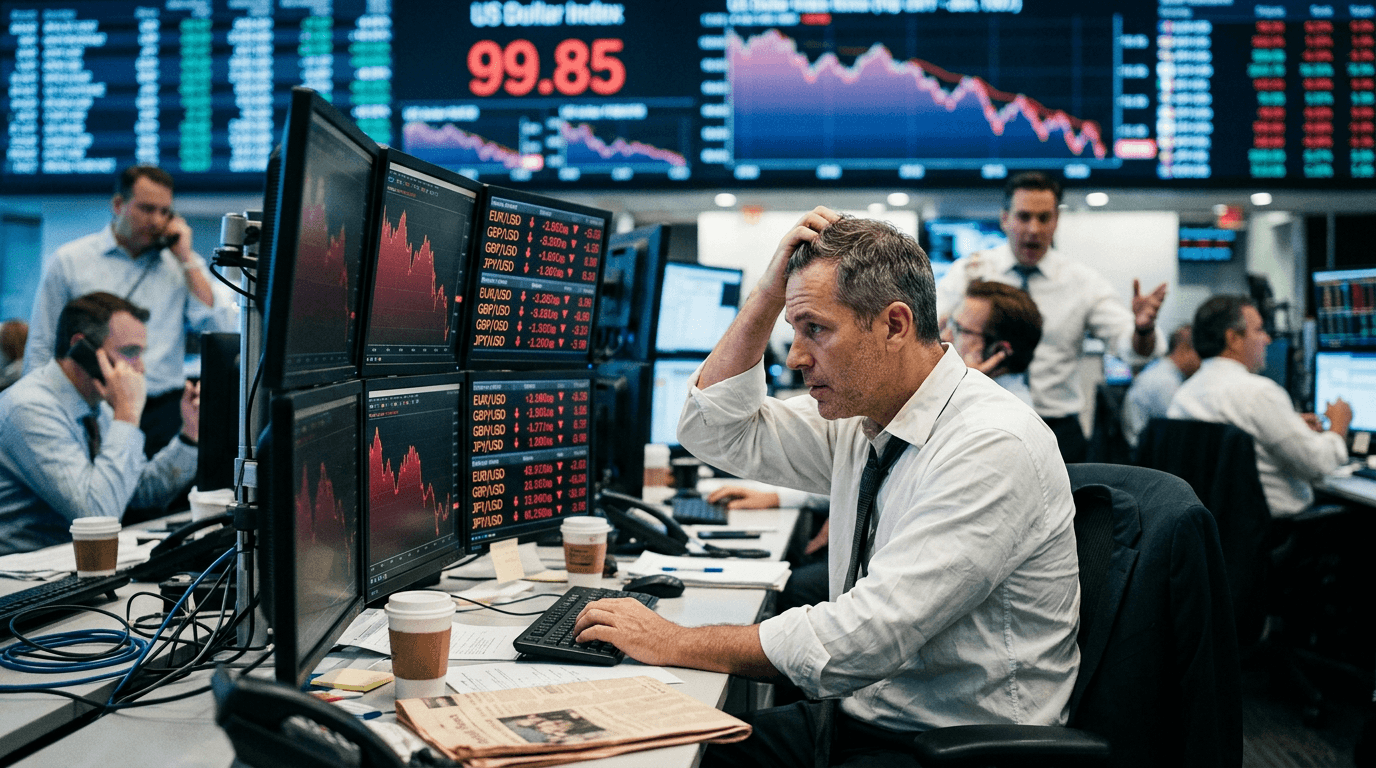
When the US dollar index gapped lower in Asian trade and broke below the 100 mark, it signaled more than a routine pullback in the world’s reserve currency. For the first time since mid‑2023, the dollar’s multi‑year strength story is being meaningfully challenged, unleashing sharp moves across major FX pairs, emerging‑market currencies, and interest‑rate expectations.[1] For traders, this is a regime change moment: volatility is back, and the playbook that worked in a strong‑dollar environment needs to be updated.
What Just Happened To The Dollar Index
The US Dollar Index (DXY) measures the value of the dollar against a fixed basket of major currencies, with the euro, Japanese yen, British pound, Canadian dollar, Swedish krona, and Swiss franc making up the basket.[6] A reading of 100 means the dollar is at its value relative to the basket’s base year; levels above or below 100 show how far the dollar has appreciated or depreciated over time.[6]
In recent sessions, dollar index futures gapped lower at the open in Asian trading and slid below 100, marking the first break of this threshold since July 2023.[1] The drop caps a broader reversal from near 110 down through the high‑90s, effectively erasing roughly 10% of prior dollar strength.[1] That move has been reinforced by position‑unwinding ahead of key central bank meetings and data releases, as crowded long‑dollar trades are aggressively reduced.[2]
Technically, the market is now trading around former support zones and pivot ranges that were previously the foundation of the dollar’s uptrend.[1][2] Below 100, traders are watching levels in the 99.70–98.50 zone, and even deeper supports near the mid‑90s, as potential accelerants for any further downside momentum.[1][2]
Why The 100 Level Is A Big Deal
Round numbers—like DXY 100—carry psychological weight even if they are not “official” policy thresholds. For the dollar index, 100 has historically acted as a dividing line between periods of broad dollar strength and more balanced or weaker dollar conditions.[1][6]
Dropping below 100 matters for three key reasons:
First, it challenges the narrative of “higher for longer” US interest rates. Dollar strength is closely tied to expectations that the Federal Reserve will keep rates elevated relative to other developed markets.[1] A break lower suggests traders are increasingly pricing in eventual rate cuts or at least a narrower rate differential versus other major central banks.
Second, it changes global capital flow incentives. A strong dollar tends to pull capital into US assets; a weaker dollar can support flows into non‑US equities, bonds, and commodities, as foreign returns become more attractive when translated back into dollars.[1][6]
Third, it can signal a broader shift in the nominal broad US dollar index tracked by the Federal Reserve, which captures a wider set of trading partners, including emerging‑market economies.[9] If both the DXY and the broad index weaken together, the impact on global FX and trade can be more pronounced than a move confined to major developed‑market currencies.
Fx And Rate Market Ripple Effects
The immediate consequence of the dollar’s break below 100 has been broad FX volatility. Major pairs such as EUR/USD, GBP/USD, and AUD/USD have seen rapid repricing as traders rotate out of the dollar and into higher‑beta currencies.[2] The euro and pound, which already have significant weight in the DXY basket, naturally respond strongly when the index moves.[6]
At the same time, emerging‑market currencies—often sensitive to dollar funding costs and risk sentiment—have experienced outsized intraday swings. When the dollar weakens, some EM currencies benefit through easier external financing conditions, but the transition phase can be turbulent as positions are adjusted and hedges are recalibrated.[9]
Rate markets are also reacting. Falling dollar expectations frequently coincide with shifts in US yield curves, as traders reassess how fast and how far the Federal Reserve might cut rates in future cycles.[1] A weaker dollar can be consistent with lower real yields or with foreign central banks catching up to the Fed by tightening policy further, compressing rate differentials. This repricing feeds into FX forwards, cross‑currency basis, and volatility surfaces, creating a more complex backdrop for macro and carry traders.
Practical Ways To Trade This Volatility
For traders, the key is not just recognizing that volatility has increased, but understanding how to engage with it intelligently.
One approach is to anchor decisions around well‑defined technical levels on the DXY itself. Support zones around 99.70 and 98.50, and deeper levels closer to the mid‑90s, can act as reference points for scenario planning: does price stabilize and reverse, or does it slice through support and trigger a trend‑extension move?[1][2] Similarly, resistance levels near 100.20–100.50 and up toward 101–103 highlight areas where short‑covering rallies may stall.[1][2]
Another approach is cross‑checking FX majors against the dollar index. For example, if the DXY is testing support while EUR/USD is pressing into strong resistance, traders can assess whether the correlation is intact or breaking down, and whether the relative setup offers a cleaner risk‑reward profile than trading the index directly.[2] Incorporating emerging‑market pairs with clear macro stories—such as commodity exporters that benefit from both weaker dollar and firmer commodity prices—can add diversification, but position sizing should reflect higher volatility.[9]
Risk management becomes critical in this environment. Wider spreads, faster moves, and occasional gaps mean that traditional stop distances may need adjustment. Using volatility‑based sizing, scaled entries, and clearly defined maximum loss thresholds helps avoid emotional decision‑making when markets move quickly.
Key Takeaways For Simulated Finance Traders
For SimFi traders using platforms like E8 Markets, this type of macro event is an ideal live‑fire training environment—without the capital risk of a live account. Simulated trading allows you to stress‑test your strategy against real‑world volatility while maintaining discipline and process.
Several practical exercises can add value
Test your strategy across multiple regimes by replaying historical periods when DXY moved sharply below and above 100, and compare your performance across those environments.[1][6]
Build a simple macro dashboard that tracks the DXY, a broad US dollar index, key FX pairs, and front‑end rate expectations, then use it to frame your daily bias before placing trades.[6][9]
Practice scenario planning: outline what you will do if DXY holds above key support and consolidates versus what you will do if it breaks much lower. Commit those rules to a written plan and follow them through in your simulated account.[1][2]
Ultimately, the dollar’s break below 100 is less about a single level and more about the possibility of a trend transition. Whether this move evolves into a sustained period of dollar weakness or proves to be a sharp but temporary shake‑out, traders who understand the mechanics of the dollar index, respect the technical levels, and continuously refine their risk framework will be better positioned to navigate the resulting volatility—both in their simulated strategies and, eventually, in live markets.