
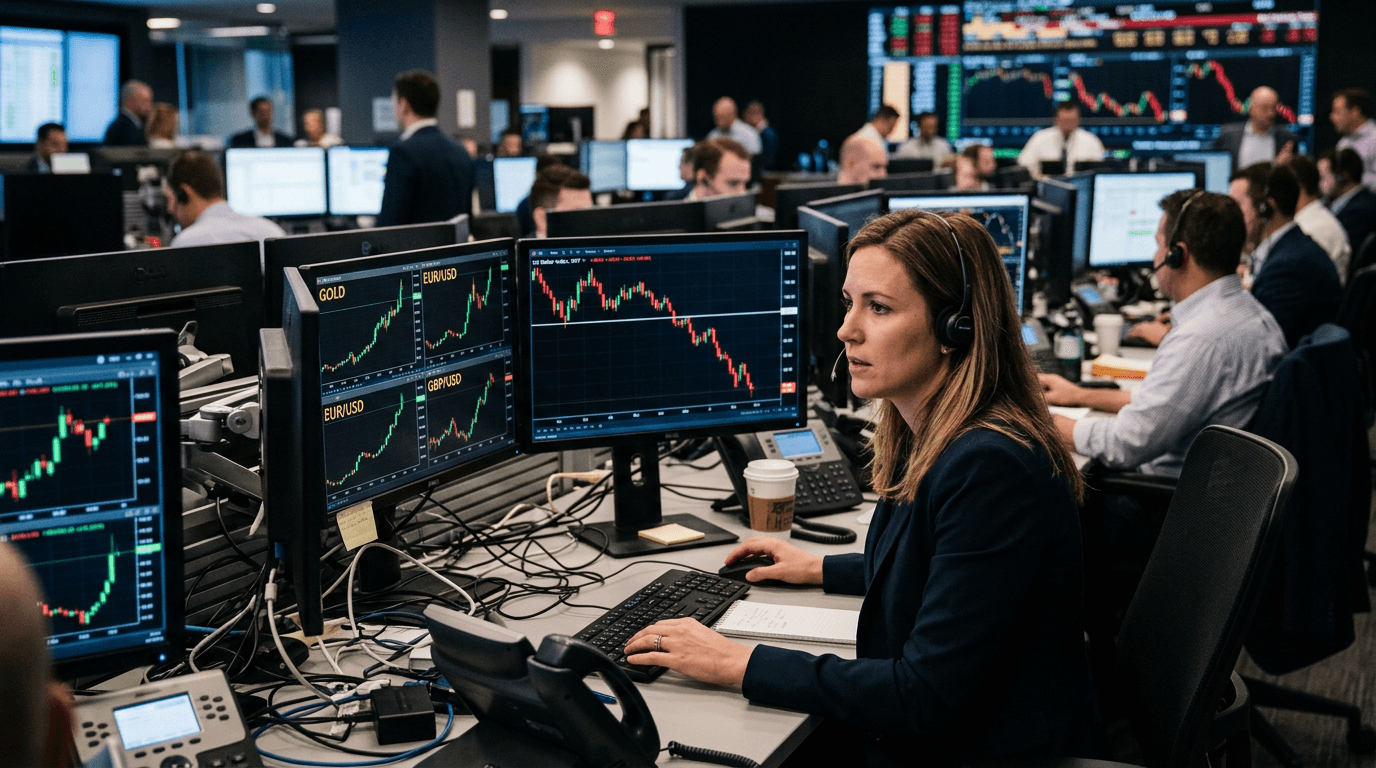
The US Dollar Index’s drop below the 100 handle is more than a technical headline – it is a clear signal that markets are rapidly repricing the Federal Reserve’s path, shifting from “higher for longer” to “cut faster and deeper.” As traders bet on more aggressive easing after soft US producer inflation and collapsing consumer confidence, the dollar’s multi‑day slide is radiating across FX, commodities, and risk assets, with volatility elevated into the weekend.[1]
WHAT IS THE US DOLLAR INDEX, AND WHY DOES 100 MATTER?
The US Dollar Index (DXY) tracks the performance of the dollar against a basket of six major currencies, dominated by the euro, yen, and pound.[3][5] When the index falls, it reflects broad dollar weakness rather than a move against a single counterpart.
Since its launch in the 1970s, the 100 level has repeatedly acted as a psychological pivot – a zone where trends often pause, reverse, or accelerate.[1] Round numbers attract attention from macro funds, systematic traders, and corporates managing currency risk. When price slices through such a level after a sustained move, it can trigger:
1) Forced position adjustments from leveraged traders. 2) Hedging activity from multinationals exposed to FX risk. 3) Algorithmic flows keyed to technical breakpoints.
In this case, the break below 100 comes after a steep retreat from recent highs, marking roughly a 10% reversal from levels near 110 and amplifying the sense that the post‑pandemic dollar bull cycle may be giving way to a more sustained correction.[1]
Fed Cuts In Focus: How Data Flipped The Narrative
The catalyst for the latest leg lower has been a combination of weaker inflation data and a sharp drop in consumer sentiment. A softer US Producer Price Index reading reinforced the message from earlier inflation prints that pipeline price pressures are easing, while sentiment surveys pointed to growing recession fears among households.
Markets have reacted by bringing forward and increasing the expected size of Fed rate cuts priced into futures. Instead of a gradual, cautious easing cycle, traders are now leaning toward a more front‑loaded path in which policymakers cut more aggressively to support growth. That shift has several important implications:
- Lower expected US yields reduce the dollar’s interest rate advantage over other currencies.
- Global investors have less incentive to hold USD assets purely for carry, encouraging diversification into other regions.
- Speculative long USD positions built on the “higher for longer” narrative are being unwound, accelerating the move.
This repricing has been reinforced by the Fed’s recent communication tone. Even without formal forward guidance for deep cuts, officials’ acknowledgment of downside growth risks and comfort with disinflation has been enough for markets to extrapolate a dovish trajectory.
Market Reaction: Fx, Gold, And Risk Sentiment
A clean break below 100 in DXY has unleashed broad‑based dollar selling across major FX pairs.[1] The euro, pound, and high‑beta currencies (such as AUD and NZD) have gained as traders rotate into higher‑yielding or growth‑sensitive assets. The yen’s behavior has been more nuanced due to its own monetary policy dynamics, but the underlying story is the same: the dollar is no longer the only game in town.
Gold has been a major beneficiary. Because it is priced in dollars globally, a weaker USD mechanically lowers the metal’s price in other currencies and often supports demand from international buyers.[1][5] When you overlay higher expectations for Fed cuts, lower real yields, and heightened macro uncertainty, the case for gold as a hedge strengthens further.
Equities, particularly in emerging markets and commodity‑linked economies, also tend to like a weaker dollar. Lower US yields can ease global financial conditions, while a softer USD reduces pressure on countries with dollar‑denominated debt. However, this is not a one‑way bet: if the dollar’s weakness is driven by mounting recession risks in the US, the risk‑on impulse can quickly flip back to risk‑off.
For now, volatility is elevated across FX and rates markets as traders digest the new Fed narrative into the weekend, making position sizing and risk management more critical than directional calls.
Key Levels And Technical Landmarks To Watch
From a technical standpoint, the break of 100 opens up a set of downside targets that many traders already have marked on their charts. Recent E8 Markets analysis highlights:
- Initial support around 99.70, where short‑term buyers may attempt to defend.[1]
- Deeper support near 98.50, which has not been meaningfully tested since early 2023 and is likely to be a high‑interest battleground.[1]
If 98.50 gives way on strong volume, it would signal that the selling is not just a positioning flush but potentially the start of a longer‑term trend shift away from a structurally strong dollar. Below that, historical zones around 97.50 and the 200‑day moving average on higher timeframes become increasingly relevant.[1]
On the topside, the old 100.20–100.50 band now flips from support to resistance, with further resistance around 101.60 and higher clusters toward 103.[1] Any sharp short‑covering rally will likely be judged against these levels: failure there would reinforce the bearish narrative, while a sustained break back above 101–102 would suggest the dollar’s downside may have been overdone.
Practical Takeaways For Active And Simulated Traders
For traders operating both in live and simulated (SimFi) environments, the DXY break below 100 offers a real‑time stress test of strategies:
1) Reassess directional USD exposure If your portfolio or strategy is explicitly or implicitly long USD, this is the moment to re‑evaluate. Consider how a further 3–5% decline in DXY would affect your positions in EUR/USD, GBP/USD, USD/JPY, and commodity FX. Scenario testing in a simulated environment can help quantify these risks without capital at stake.
2) Look for relative value, not just outright dollar shorts While a weaker dollar theme is compelling, not all currencies benefit equally. For example, currencies backed by improving growth and relatively hawkish central banks may outperform. Others with their own domestic vulnerabilities may lag. Relative value trades (pairing stronger vs. weaker beneficiaries) can reduce dependence on a single macro narrative.
3) Integrate macro data into your trading plan With markets hyper‑sensitive to the Fed’s path, high‑impact US data (inflation, jobs, growth, and sentiment) can drive outsized moves. Build an economic calendar into your process, define pre‑event risk limits, and decide whether you want to trade the event or stay flat. Simulated trading is a powerful way to back‑test how your approach performs around major releases.
4) Prioritize risk management over conviction Sharp moves through psychological levels often look obvious in hindsight but are messy in real time. Use predefined stop losses, avoid over‑leveraging into volatility spikes, and be realistic about slippage in fast markets. For intraday traders, spreads can widen around key breaks, so execution discipline matters as much as trade ideas.
What To Watch Next
The next phase of the dollar story will hinge on whether incoming data confirm the need for deeper Fed cuts or force markets to reassess their newfound dovishness. Several factors will be critical:
- The pace of disinflation in core and services sectors.
- Labor market resilience, particularly jobless claims and payrolls.
- The tone of Fed communication – do policymakers validate or push back against market pricing?
If data continue to soften and the Fed leans dovish, the path of least resistance for DXY may be lower, with 98.50 and then 97.50 in focus.[1] A surprise re‑acceleration in inflation or stronger‑than‑expected growth, however, could spark a sharp short squeeze, driving the index back above 100 and reminding traders that sentiment can turn quickly.
For now, the break below 100 is a clear wake‑up call: the dollar regime that dominated many trading strategies in recent years is changing. Whether you are trading live capital or refining your edge in a simulated environment, this is a time to adapt, not to assume that old patterns will automatically return.