
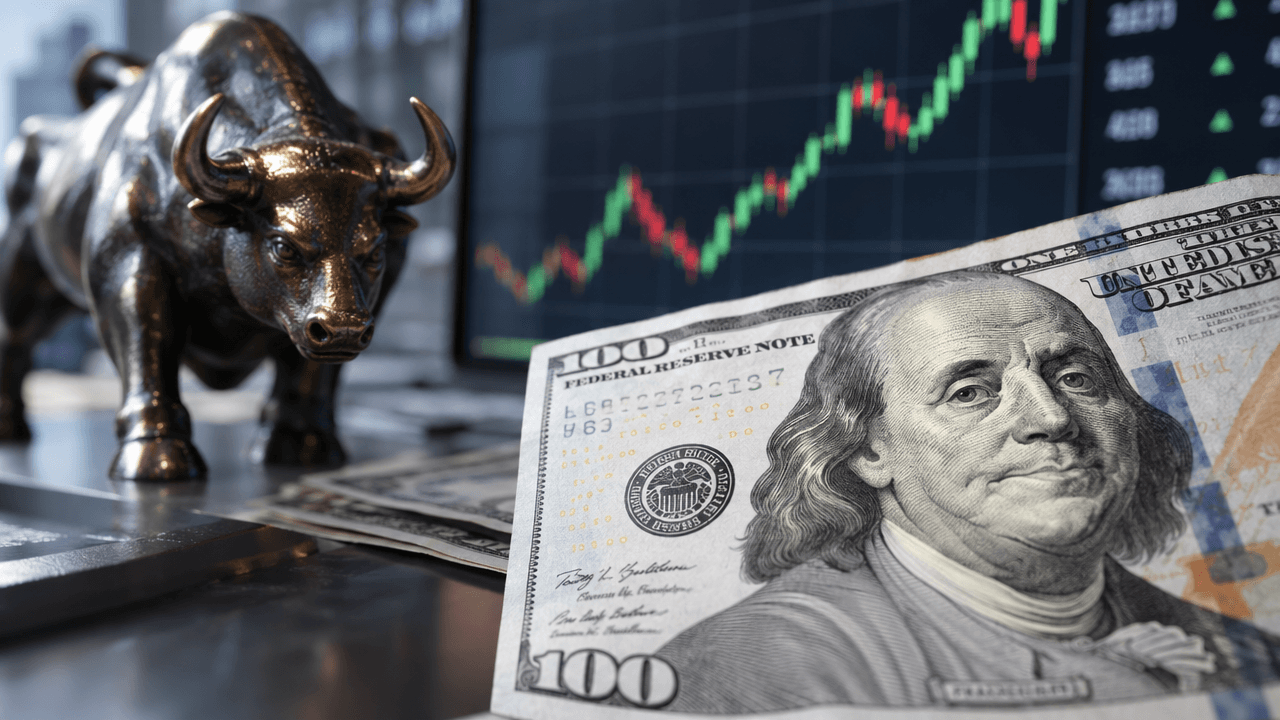
The US dollar is flexing its muscles again, holding firm near seven-week highs as traders steadily price in a higher chance of another Federal Reserve rate hike in October.[1][8][12][13] With the dollar index trading around 100.4 and risk assets recalibrating, the current environment rewards traders who understand how shifting rate expectations ripple through FX and broader markets.[1][8][13]
Dollar Holds Near Seven-week Highs
The US dollar index is trading close to 100.4, its highest area in roughly seven weeks, and is on track for a weekly gain of more than 1%.[1][8][13] This move reflects a broad repricing of interest rate expectations rather than a single headline shock. A stronger dollar typically tightens global financial conditions, especially for markets and companies reliant on dollar funding or with significant dollar-denominated debt.
The latest climb in the dollar index follows the Fed’s recent 25-basis-point rate increase, which lifted the target range to around 3.75%-4.00%—the first hike in about three years and a clear signal that policymakers remain focused on inflation risks.[3][5] As yields at the short end move higher, the dollar tends to benefit from improved carry and a perception that US assets offer more attractive risk-adjusted returns.
For traders, a dollar hovering at multi-week highs often translates into increased volatility and sharper intraday swings across FX pairs, commodities, and equity indices. Even if the headline index appears stable, beneath the surface individual currencies and sectors can experience meaningful rotation.
Why Markets Are Pricing Higher Fed-hike Odds
Prediction and derivatives markets are now assigning roughly mid-50% odds to another 25-basis-point hike at the Fed’s October meeting, up from the low-40% range just a week earlier.[2][5][10] That shift in probabilities may seem incremental, but it represents a notable change in how traders perceive the Fed’s reaction function.
Several factors typically drive such repricing: persistent core inflation, resilient labour markets, and data suggesting demand remains stronger than policymakers would like. While individual indicators can surprise in either direction, the aggregate picture has kept the door open for continued tightening.
This higher perceived probability of an October move also interacts with expectations for December, where some markets see an even greater chance of another hike.[5][10] When the market moves from “probably done” to “maybe one or two more hikes,” yield curves, credit spreads, and FX carry strategies all need adjustment.
For traders in a simulated finance environment, tracking these implied probabilities is crucial. It is not just the actual decision that matters; the journey of expectations—how odds move from 40% to 56%—can drive price action, revalue options, and reshape risk-reward profiles ahead of the meeting.
PRESSURE ON EUR/USD AND OTHER MAJORS
One of the clearest manifestations of dollar strength is in EUR/USD, which is hovering near 1.15 and is down about 0.2% on the day, extending a roughly 1% decline over the past week.[4][6][7][14] The pair has struggled to gain traction as higher US rate expectations outpace any perceived hawkishness from the European Central Bank.
When the market prices in relatively more tightening from the Fed than from other major central banks, interest rate differentials tend to move in favour of the dollar. That shift can draw capital toward US assets and away from European markets, weighing on the euro.
Other major pairs show similar dynamics. For example, dollar strength versus the yen often intensifies as US yields rise, while pro-cyclical currencies like the British pound can face headwinds when global risk appetite cools and dollar funding becomes more expensive.[4][6][7] Traders should monitor not only spot moves but also implied volatility and options skews, which can signal whether markets expect the current dollar strength to persist or fade.
For FX traders, this environment favours strategies aligned with a firm dollar: selling rallies in EUR/USD, favouring USD versus lower-yielders, and being more cautious with leveraged long positions in currencies vulnerable to higher US rates.
How Traders Can Navigate A Firmer Dollar
In both live and simulated markets, a firm dollar and rising Fed-hike odds call for a more structured approach to risk management. This begins with understanding which assets sit on the “dollar-sensitive” spectrum: FX majors, emerging market currencies, commodities priced in dollars, and sectors heavily exposed to US borrowing costs.
Shorter-term traders might focus on intraday patterns around data releases that can shift rate expectations—such as inflation prints or labour market reports—using tight risk controls and clear entry/exit criteria. Swing traders could look to position around support and resistance levels on DXY and major pairs, incorporating the evolving probabilities of future hikes into their bias.
In a SimFi environment like E8 Markets, this is an ideal backdrop to test playbooks without real capital at risk. Traders can:
1) Build scenarios where the Fed hikes again versus pauses, and simulate FX and index reactions. 2) Stress-test strategies against higher volatility and wider spreads that often accompany policy uncertainty. 3) Experiment with hedging approaches, such as offsetting FX exposure with index or rate proxies.
By doing so, traders gain experience in navigating a policy-driven market regime, improving their readiness for similar environments in live trading.
Key Takeaways For Your Simfi Playbook
First, the dollar’s move to seven-week highs near 100.4 reflects a broad reassessment of US rate expectations, not just a technical bounce.[1][8][13] That makes it more durable than a one-day spike and more impactful for cross-asset positioning.
Second, markets now price roughly mid-50% odds of another 25-basis-point hike in October, up from the low-40% range a week earlier.[2][5][10] Small changes in probabilities can drive significant price action, especially as traders adjust hedges and unwind crowded positions.
Third, EUR/USD near 1.15 and down about 0.2% on the day illustrates how rate differentials and a firm dollar pressure major FX pairs.[4][6][7][14] Similar dynamics play out in other currencies, particularly those with lower yields or greater external financing needs.
For traders, the practical response is clear: monitor rate expectations, focus on dollar-sensitive assets, and use simulation to refine strategies before committing real capital. Treat the current environment as a live case study in how central bank expectations shape markets.
Conclusion
The dollar’s firmness near seven-week highs and the market’s increasing conviction in another Fed hike together define the current macro trading landscape.[1][2][5][8][10][12][13] For traders, this is not simply a story about one currency moving higher; it is about how evolving expectations around policy tighten financial conditions, redistribute risk, and create opportunities.
By understanding the interplay between DXY levels, Fed-hike odds, and key pairs like EUR/USD, traders can better position themselves—whether in a simulated environment or live markets—to navigate the next phase of the cycle.[1][2][4][5][6][7][8][10][12][13][14] In a world where expectations move faster than official decisions, those who learn to read and trade the probability landscape gain a meaningful edge.