
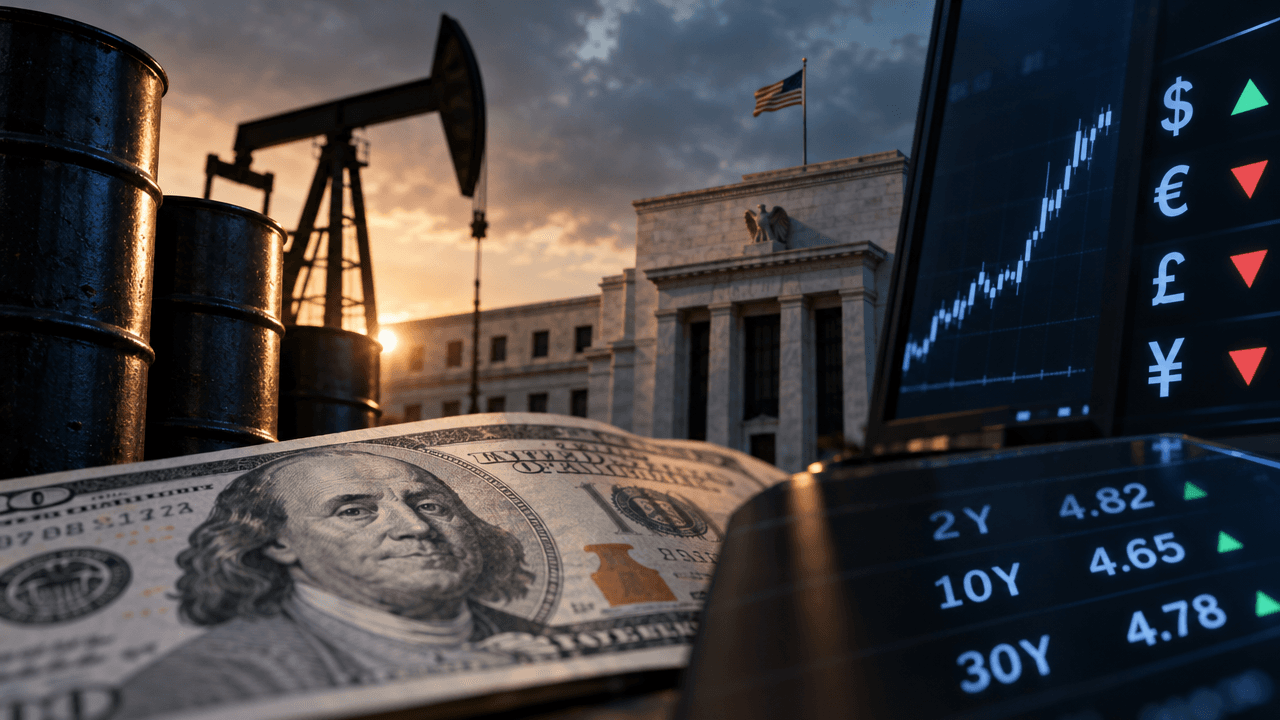
Traders woke up to a familiar but uncomfortable combination: a surging U.S. dollar, oil back above $100 per barrel, and Treasury yields pushing toward recent highs.[11][10][15] This mix is reigniting inflation worries, forcing markets to reassess the “higher for longer” narrative on U.S. interest rates and reviving expectations that the Federal Reserve may still have work to do on tightening.[10][13][14] For FX, rates, and risk assets, the result is a broad repricing of risk and a reminder that energy shocks still matter.[11][15]
Macro Backdrop: Oil, Inflation And Yields
Oil’s break above the $100 threshold has been driven in part by renewed geopolitical tensions, including intensified U.S.–Iran hostilities and Gulf-region risks that have disrupted expectations of a durable ceasefire.[7][11][13][15] As crude prices extended their rally, U.S. Treasury yields climbed to multiyear and cycle highs, with the 10‑year moving above 4.7%—its highest level since early 2025.[11][10] Shorter-dated yields, which more closely track Fed policy expectations, have risen too, reflecting markets’ growing conviction that further tightening is possible.[11][10]
Higher oil prices feed into headline inflation and inflation expectations, particularly through energy and transportation costs, which sharpen the Fed’s sensitivity to upside price risks.[14][11] Recent producer price data already showed the biggest monthly increase in three months, driven by energy, adding another layer to the inflation story.[14] When inflation surprises on the upside against a backdrop of already-tight labor markets, it becomes harder for policymakers to justify rate cuts and easier for markets to price another hike—or at least a prolonged pause.[10][13][14]
DOLLAR’S RALLY AND FX MARKET IMPACT
Against this backdrop, the U.S. dollar index has pushed to or near a two‑week high, trading in the upper 98–99 range and testing levels last seen in late August and early September.[2][3][6][12] The greenback’s strength reflects both higher U.S. yields and renewed demand for safe-haven assets as geopolitical tensions and risk-off sentiment accelerate.[5][8][15] FX markets are now recalibrating, with majors such as EUR/USD and GBP/USD under pressure as rate differentials move back in the dollar’s favor.[5][9][15]
The probability of a Fed rate hike, once seen as a tail risk, has risen sharply in futures markets as oil broke through $100.[7][13] Market-implied odds reportedly jumped from around 12–13% to the mid‑30% range within days, and traders have started to price in at least one quarter-point increase over the next several months.[7][13] As those expectations build, rate-sensitive currencies—especially those from economies where central banks are closer to easing—face renewed headwinds against the dollar.[3][12]
For yen traders, the dynamic is particularly delicate: higher U.S. yields and a stronger dollar keep USD/JPY elevated near levels that previously prompted intervention chatter from Japanese authorities.[4][9][11] Emerging market currencies, meanwhile, have seen broad pressure as higher dollar funding costs and rising U.S. yields erode carry trades and make dollar-denominated debt more expensive to service.[5][12][15]
Implications For Global Risk Assets
The dollar’s advance and the surge in yields have weighed on global equities, commodities ex‑energy, and cryptocurrencies, as investors rotate toward cash and short-term U.S. paper.[5][10] A stronger dollar typically tightens global financial conditions by making funding more expensive and reducing the attractiveness of risk assets relative to safe U.S. instruments.[5][10][15] When this coincides with higher energy costs, margin pressure grows for corporates, particularly in energy-intensive sectors such as transportation, manufacturing, and logistics.[11][14]
High and rising yields can unsettle equity valuations by increasing discount rates on future cash flows, particularly for long-duration growth stocks.[10][11] At the same time, credit markets must digest wider spreads as investors demand more compensation for inflation and policy uncertainty.[10][11] In such an environment, volatility can pick up quickly across asset classes as portfolios are rebalanced, risk models are updated, and leveraged positions are unwound.[5][10][15]
For commodity markets, the divergence between strong energy and softer industrial metals or agricultural contracts can signal stagflation fears—higher costs without commensurate growth.[10][11][14] That narrative is not fully priced in, but the combination of surging oil, sticky inflation data, and cautious central bank communication is enough to keep risk sentiment fragile.[10][11][14]
What This Means For Traders And Simulated Finance
For active traders, the current environment is a textbook case of how macro shocks propagate through correlated markets: energy drives inflation expectations, inflation drives yields, yields drive FX, and FX feeds back into risk assets.[10][11][14] Understanding this chain is critical for building robust strategies, whether in live markets or simulated settings where participants test and refine their edge without real capital at risk.
In FX, traders might focus on rate‑differential trades: going long USD against currencies where central banks are closer to cutting or firmly on hold, while managing exposure to pairs sensitive to geopolitical headlines.[3][9][12][15] In rates, strategies could include positioning for curve moves as front‑end yields respond more quickly to shifting Fed expectations than the long end.[10][11][13] Equities traders may look at sector rotation—favoring energy and certain financials over rate‑sensitive growth names—while monitoring volatility in high-beta segments.[10][11][14]
Simulated finance platforms provide an ideal environment to practice these cross‑asset plays under realistic conditions, stress-testing assumptions about how quickly correlations can change and how drawdowns might evolve in a regime shift. Scenario building—such as modeling outcomes under a further oil spike, an upside inflation surprise, or a surprising Fed hike—helps traders prepare for tail events and sharpen risk management. Integrating macro data, news flow, and market pricing into a cohesive trading framework is a skill that can be honed effectively in a simulation before being deployed with real capital.
Conclusion: Navigating A Higher-for-longer World
The dollar’s charge to a near two‑week high, powered by surging oil and rising U.S. yields, is more than just a headline; it is a signal that markets are still wrestling with the endgame of this tightening cycle.[3][5][10][15] As Fed hike bets creep higher and inflation data remain sensitive to energy, the “higher for longer” theme retains credibility and continues to shape FX, rates, and risk‑asset pricing.[10][13][14]
For traders and investors, the key takeaway is that macro shocks rarely stay confined to one asset class. A move in oil can ripple through yields, currencies, and equities in ways that reward those who think in cross‑asset terms and penalize those who operate in silos.[10][11][15] Using both real and simulated environments to build and test strategies around these dynamics can help turn complex macro episodes into opportunities—provided risk is managed with discipline and an eye on the bigger picture.