
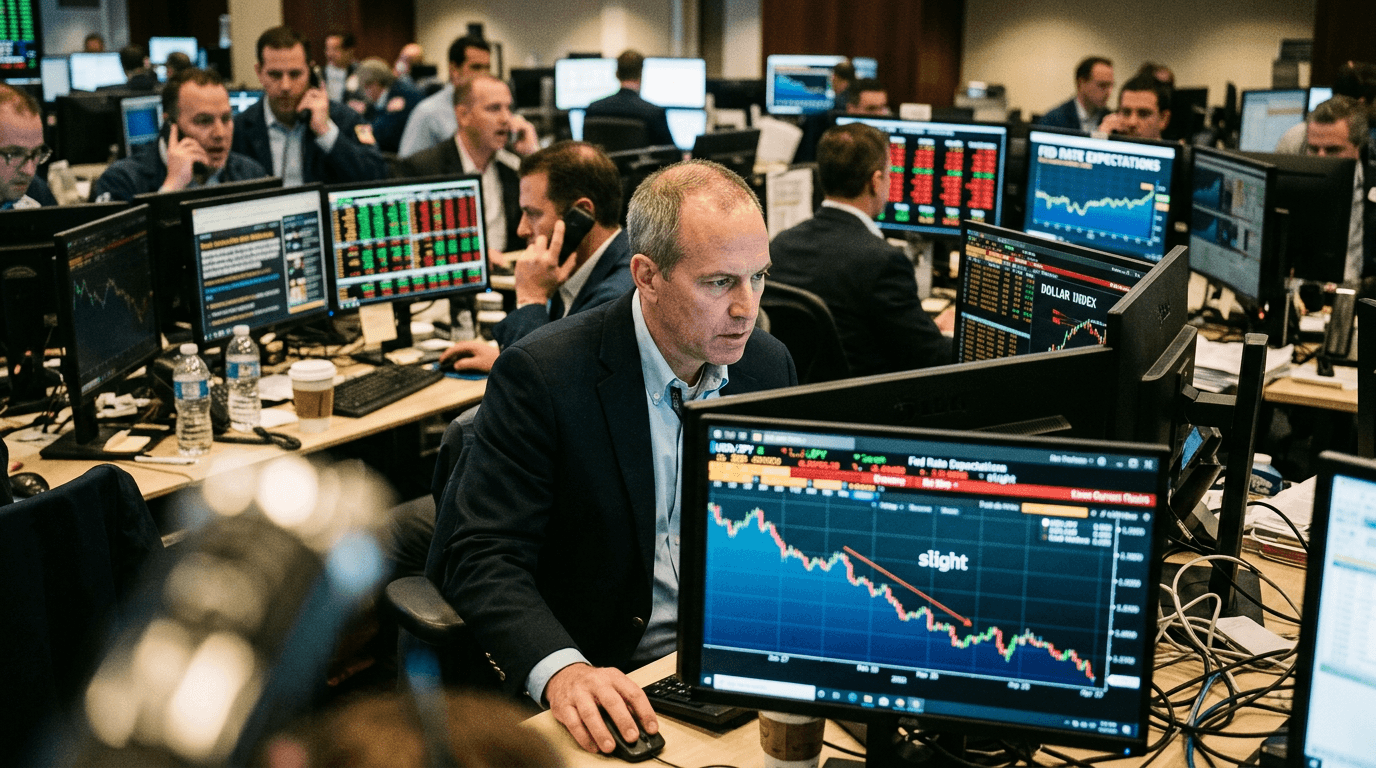
The U.S. dollar is hovering near a two‑week low as markets sharply scale back expectations for additional Federal Reserve rate hikes this year, and that shift in rate psychology is rippling across foreign exchange, bond yields, and equity futures. Softer U.S. data and easing inflation pressures have nudged traders away from the “higher for longer” narrative, giving room for the euro, the pound, and other majors to firm while leaving the already embattled yen under renewed pressure.
DRIVERS OF THE DOLLAR’S TWO-WEEK LOW
The dollar’s slide has been driven primarily by weaker‑than‑expected U.S. economic data, most notably the recent payrolls report showing a marked slowdown in job growth compared with prior months[1][2]. When labor data cools, it raises doubts about the need for further monetary tightening, prompting markets to mark down the probability of future Fed hikes[1][2]. At the same time, lower oil prices have helped ease inflation expectations, further reducing the urgency for aggressive policy moves[1][2].
As a result, the U.S. Dollar Index (DXY), which tracks the greenback against a basket of six major currencies, has slipped toward the lower end of its recent trading range and remains below the key 101 level following its largest weekly decline since April[2][9][10]. This is a classic example of how macro data and commodity prices can feed directly into rate expectations and, in turn, into currency valuations.
UNDERSTANDING THE U.S. DOLLAR INDEX
To understand why this move matters, it helps to look at what the U.S. Dollar Index actually measures. DXY was created in the 1970s to provide a trade‑weighted gauge of the dollar’s strength against major currencies[4][7]. It is heavily dominated by the euro, with additional weights from the Japanese yen, British pound, Canadian dollar, Swedish krona, and Swiss franc[4][7]. When DXY falls, it typically means the dollar is weakening versus this broad basket, not just a single pair.
For traders, this basket structure is important. A move driven by U.S. data tends to affect most dollar pairs, but not equally. Currencies backed by central banks perceived as closer to tightening—or at least less dovish than the Fed—often outperform. That is what we are seeing in the current episode: investors are reassessing relative rate paths, not just the absolute level of U.S. yields.
Fx Winners And Losers In A Softer Dollar Environment
With markets scaling back Fed rate‑hike expectations, the euro and the pound have found renewed support. Both the European Central Bank and the Bank of England have been wrestling with their own inflation challenges, and the perception that the Fed may be closer to the end of its tightening cycle narrows the interest‑rate gap in favor of EUR and GBP. Even without aggressive hikes abroad, a less‑hawkish Fed makes dollar‑denominated assets relatively less attractive, encouraging capital to flow into other regions.
The yen, however, remains an outlier. Despite the weaker dollar, the Japanese currency is still under pressure near multi‑decade lows, reflecting the Bank of Japan’s ultra‑loose policy stance and its reluctance to meaningfully lift rates. That keeps yield differentials strongly tilted against the yen, sustaining carry trades where investors borrow in low‑yielding yen to buy higher‑yielding currencies and assets. In other words, a softer dollar is providing relief to many majors, but the yen’s structural disadvantage continues to weigh heavily on its performance.
Ripple Effects Across Rates And Equity Futures
Currency moves of this scale rarely occur in isolation. As traders cut back on expected Fed hikes, U.S. Treasury yields tend to ease at the margin, especially at the front end of the curve where rate expectations are most concentrated. Lower yields can support risk assets by reducing discount rates on future cash flows and by improving the relative appeal of equities versus bonds. That is why equity futures often react alongside FX and rates—to the market, this is one integrated macro story.
Still, the picture is nuanced. A weaker dollar can be positive for U.S. multinationals, which benefit from more competitive export pricing and from foreign earnings translating into more dollars. Commodity‑linked sectors may also feel the impact through changes in global demand dynamics, as a softer dollar often eases financial conditions for emerging markets and commodity importers. For index traders, this environment tends to favor strategies that pay close attention to sector rotation and international exposure, not just headline index levels.
What This Fed Repricing Means For Active Traders
For discretionary and systematic traders alike, the key takeaway is that expectations—not just actual decisions—drive markets. The Fed has not necessarily announced a major policy pivot, but the market’s perception of its path has shifted, and that repricing is enough to move FX, rates, and equity futures meaningfully. Understanding how data releases feed into the implied policy path is essential for anyone trading macro‑sensitive instruments.
In practical terms, this environment often brings:
More two‑way volatility in dollar pairs as traders test new ranges.
Opportunities in relative‑value trades, such as long EUR/USD or GBP/USD, where the rate story has turned more supportive for the non‑USD leg.
Renewed interest in carry trades, especially against currencies whose central banks remain firmly dovish, like the yen.
However, these opportunities come with risk. If future data surprises to the upside or if the Fed reasserts a more hawkish tone, positioning built on the “softer Fed” narrative can unwind quickly. Scenario planning and disciplined risk management become critical.
Using Simulated Finance To Navigate Macro Shifts
For traders using SimFi platforms such as E8 Markets, this kind of macro repricing is exactly the environment where simulated strategies can add real educational value. Rather than risking capital in the heat of a narrative shift, traders can:
Test how their FX and index strategies perform under different assumptions for the Fed’s path, yields, and volatility.
Explore the interaction between dollar strength, global equity performance, and sector rotation.
Experiment with position sizing and risk limits around major data releases, such as jobs reports and inflation prints, to see how their systems hold up during surprise moves.
By treating simulated environments as a lab for macro scenarios, traders gain a deeper understanding of how quickly sentiment can change—and how that cascades through correlated markets. The current dollar story is a practical case study in why cross‑asset awareness is essential.
Conclusion: Watch The Story, Not Just The Price
The dollar hovering near two‑week lows is more than a short‑term chart pattern; it reflects a shifting narrative about U.S. growth, inflation, and the Fed’s reaction function. That narrative is supporting EUR and GBP, keeping the yen on the defensive, and reshaping risk‑reward across rates and equity futures. For traders, the edge comes from connecting these dots—tracking how data alters expectations, how expectations move prices, and how those price moves interact across markets.
Whether you trade live or via simulated environments, use this episode as a blueprint: follow the policy story, respect the role of expectations, and design strategies that can adapt when the market decides the Fed’s path has changed—even before the central bank says so explicitly.