
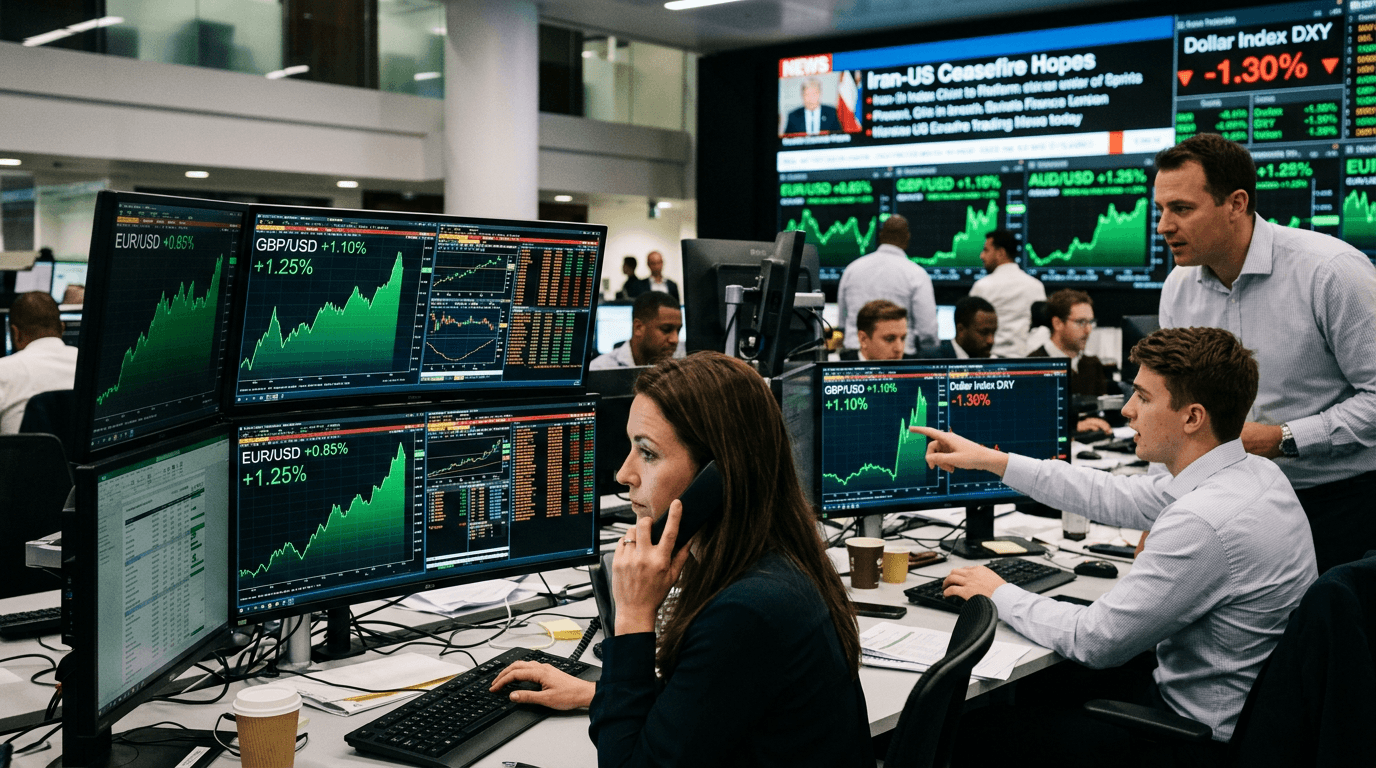
The US dollar’s latest retreat is a textbook example of how quickly FX markets can pivot when geopolitical risks shift from escalation to de‑escalation. As headlines point to progress toward an Iran–US ceasefire and potential sanctions relief, investors have moved out of the safety of the greenback and back into risk assets, sending EUR/USD, GBP/USD and AUD/USD higher and lifting global equities alongside high‑beta currencies.
Market Reaction: Dollar Down, Risk Fx Up
In the hours following the de‑escalation headlines, the US Dollar Index slipped as safe‑haven demand eased and investors rotated into currencies and assets that typically benefit from a “risk‑on” environment.
EUR/USD, GBP/USD and AUD/USD all rebounded as dollar buyers stepped back and traders priced in a less hostile geopolitical backdrop. That move was reinforced by renewed appetite for equities and credit, with investors more willing to hold growth‑sensitive and higher‑yielding assets rather than cluster in the dollar and Treasuries.
This pattern is familiar: when markets fear conflict or sanctions that might disrupt trade and energy flows, the dollar often strengthens as global investors seek liquidity, safety and access to deep US capital markets.[2][4] When the expected worst‑case scenario is dialed down, the reverse often occurs, and capital rotates back into higher‑beta currencies and risk assets.
WHY GEOPOLITICAL DE‑ESCALATION WEIGHS ON THE DOLLAR
To understand this move, it helps to revisit why the dollar tends to behave like a barometer of global risk sentiment.
The US dollar is still the world’s dominant reserve and transaction currency, accounting for the majority of global FX reserves and a large share of cross‑border trade and financial flows.[2][4] In periods of heightened uncertainty, large institutions, corporates and investors often flock to US dollar assets, especially Treasuries, because of their perceived safety and liquidity. That “flight to quality” supports the dollar.
When news flow shifts toward de‑escalation – in this case, hopes for an Iran–US ceasefire and hints of sanctions relief – several mechanisms kick in:
1. Reduced tail risk Markets begin to price out extreme scenarios such as a wider regional conflict, disruptions to energy supply, or additional rounds of sanctions. With less need for a protective hedge, demand for the dollar as a safe haven naturally softens.
2. Improved global growth sentiment Lower geopolitical risk usually supports global trade and investment. That helps pro‑cyclical currencies like the euro, pound and Australian dollar, which are closely tied to global demand, manufacturing and commodities.
3. Potential impact on energy and inflation If sanctions relief leads to more Iranian oil on the market over time, that can ease upward pressure on energy prices. Lower perceived inflation risk reduces the need for very restrictive monetary policy globally, which again is supportive of risk assets and risk‑sensitive FX.
The result is a “risk‑on” adjustment: the dollar gives back some safe‑haven premium, and higher‑beta currencies and equities gain ground.
Why Eur, Gbp And Aud Are Benefiting
While the dollar tends to weaken when risk appetite improves, not all currencies benefit equally. The current rebound in EUR/USD, GBP/USD and AUD/USD highlights a few key dynamics.
EUR/USD The euro is often seen as the main counterpart to the dollar in global FX. When broad dollar selling begins, EUR/USD is usually one of the first pairs to move, simply because it is the most liquid and heavily traded. An improved geopolitical backdrop, on top of stable to modestly improving euro area data, can encourage investors to add euro exposure at the expense of the dollar.
GBP/USD Sterling is a classic “risk sentiment” currency: it tends to strengthen when global markets are optimistic and weaken when fear rises. As investors rotate out of safe havens, GBP/USD often participates in the move, especially if UK data or Bank of England communication do not contradict the broader risk‑on tone. For short‑term traders, that makes GBP/USD a popular vehicle to express a view on global sentiment.
AUD/USD The Australian dollar is one of the highest‑beta major currencies. Its performance is tightly linked to commodity prices, Chinese and Asian growth, and overall risk appetite. When traders feel more comfortable with global growth and less worried about geopolitical shocks, AUD often outperforms other majors. In a de‑escalation story that supports commodities and global trade, AUD/USD has a strong fundamental rationale to rally against a softer dollar.
This pattern also extends, to varying degrees, to other risk‑sensitive currencies such as NZD and certain emerging‑market FX, though liquidity and idiosyncratic risks can make those trades more volatile.
Key Levels And What To Watch Next
For traders, the story does not end with the initial headline‑driven move. The next phase is about confirmation, follow‑through and the interaction with macro data and central bank expectations.
A few practical focal points
1. Confirmation of de‑escalation Markets will be sensitive to any concrete details: formal ceasefire announcements, timelines for sanctions relief, and responses from regional actors. Genuine progress would likely reinforce the current risk‑on move, while setbacks could quickly restore safe‑haven demand for the dollar.
2. Fed expectations vs risk sentiment Even as geopolitical risk fades, US monetary policy remains a key driver of the dollar. If upcoming data or Fed communication signal that rates will stay higher for longer, that could offset some of the downward pressure on the dollar. Conversely, any sign of earlier‑than‑expected easing would add fuel to dollar declines and support EUR, GBP and AUD.
3. Technical levels and positioning Intraday and swing traders should pay attention to key support and resistance levels in EUR/USD, GBP/USD and AUD/USD, as well as positioning data and sentiment indicators. If markets were heavily long dollars going into the headlines, the unwinding of those positions can amplify the initial move.
4. Volatility and liquidity conditions Headline‑driven markets can experience sharp moves and air pockets in liquidity. Spreads may widen around news flashes, and slippage can increase. Managing order types and execution timing becomes critical, especially for leveraged strategies.
Practical Takeaways For Simulated And Live Traders
For both simulated and live traders, this episode offers several actionable lessons about trading macro and geopolitical news.
First, understand the hierarchy of drivers. In FX, big shifts in risk sentiment often override slower‑moving macro factors in the short term. Knowing that de‑escalation typically means “risk‑on” helps you quickly map likely winners (EUR, GBP, AUD, equities, credit) and likely losers (USD, JPY, sometimes CHF) when headlines break.
Second, plan scenarios in advance. Before a major geopolitical event, outline how you would respond to escalation, status quo, and de‑escalation scenarios. That includes preferred instruments, entry zones, invalidation levels and position sizing. Doing this in a simulated environment can sharpen your decision‑making when real capital is at risk.
Third, avoid chasing extended moves. By the time a headline is widely known, the initial adjustment may already be priced in. Instead of reacting emotionally, look for pullbacks to technical levels that align with the underlying narrative, or wait for confirmation from follow‑up headlines and price action.
Finally, risk management comes first. Geopolitical news can reverse quickly. Use clearly defined stop‑loss levels, size positions conservatively relative to account equity, and be prepared for gaps around major announcements. One of the advantages of simulated trading is the ability to stress‑test your strategy through multiple news cycles without the psychological pressure of real losses.
As the Iran–US story evolves, expect the dollar and major FX pairs to remain sensitive to every new headline. For disciplined traders, this environment offers both opportunity and risk: the chance to capture meaningful trends in EUR/USD, GBP/USD and AUD/USD, but only if those trades are grounded in a clear understanding of how geopolitics, risk sentiment and macro policy intersect in the FX market.