
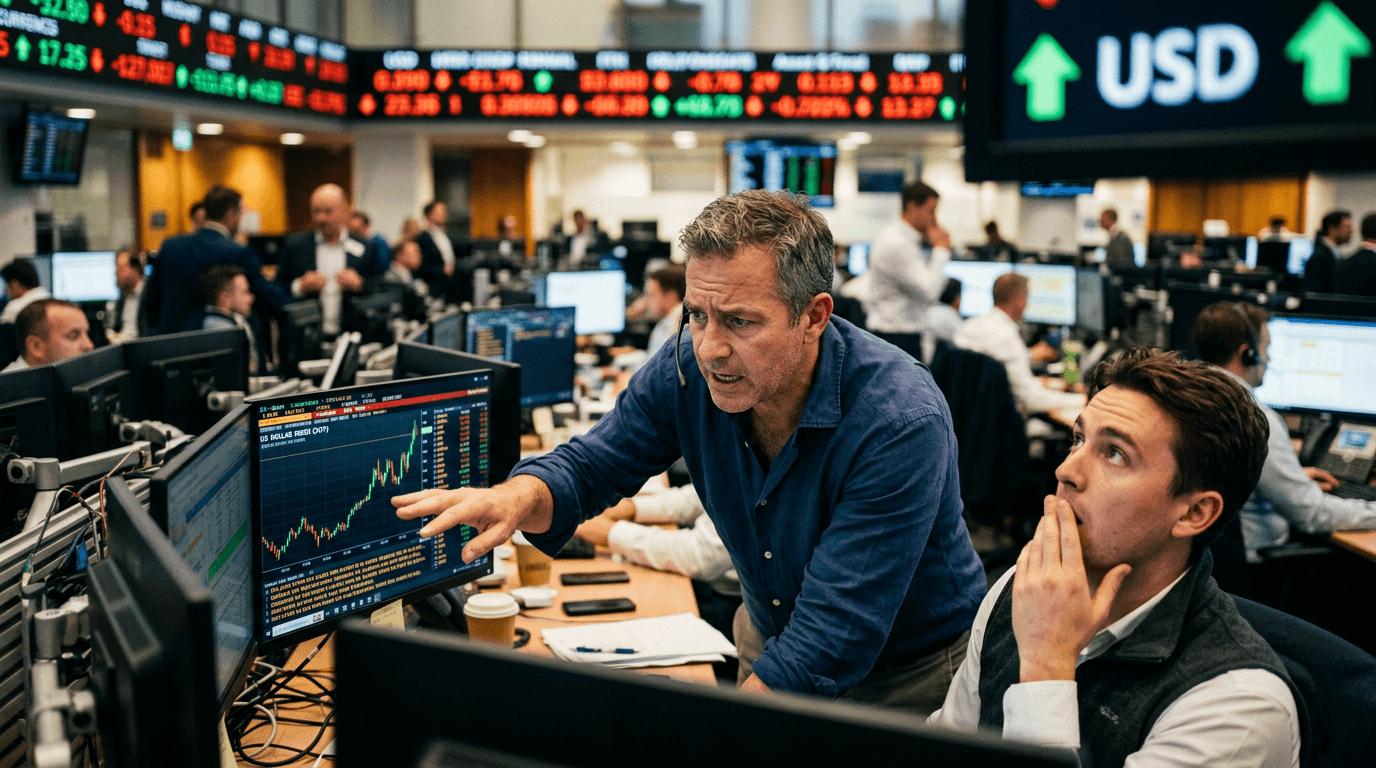
The US dollar experienced a significant rally in early March 2026 as markets sharply repriced their expectations for Federal Reserve rate cuts. What had been consensus forecasts for three 25-basis-point cuts throughout the year shifted to expectations of only two cuts, sending the US Dollar Index higher and signaling a meaningful turning point in currency markets. This repricing reflects the impact of hotter-than-expected inflation data, particularly recent Producer Price Index readings that have challenged the market's previous assumption of a predictable easing cycle. The result has been a flight toward the safety and stability of dollar-denominated assets, supported by heightened geopolitical tensions that have amplified demand for traditional safe-haven currencies.
The Rate Cut Expectations Reset
For the first two months of 2026, financial markets had largely embraced a dovish Federal Reserve narrative. Major investment banks including Morgan Stanley, Goldman Sachs, and Citigroup were forecasting cumulative rate cuts of 50 to 100 basis points throughout the year, with many anticipating consistent quarterly reductions as economic data softened. The Fed's own forward guidance in January had signaled openness to continued easing, with Fed officials emphasizing their shift from "fighting inflation" to "preventing recession." This dovish positioning had put considerable downward pressure on the dollar, with the US Dollar Index falling below the critical 97.0 level and touching near four-year lows around 95.5 by late January.
However, the March inflation data fundamentally altered this calculus. Hotter-than-expected PPI readings suggested that disinflation was not proceeding as smoothly as markets had assumed. Core inflation metrics remained sticky at elevated levels, creating uncertainty about how aggressively the Fed could pursue rate cuts without risking a reacceleration of price pressures. This data-dependent pivot is precisely the kind of market repricing that creates both opportunities and risks for traders. Markets now factor in only two 25-basis-point cuts for all of 2026 instead of three, a meaningful reduction that has substantial implications for currency valuations and global capital flows.
The Inflation Surprise Factor
The importance of this inflation surprise cannot be overstated. Throughout late 2025 and early 2026, the investment community had become increasingly confident that the worst of inflation was behind us. The Federal Reserve's policy focus appeared to have genuinely shifted toward supporting employment and economic growth, with rate cuts seen as the natural policy path. Core PCE inflation, while still elevated at 2.8% on a year-over-year basis in January, was showing a clear downward trend that supported this narrative. The PPI data disrupted this orderly decline, injecting uncertainty into the inflation outlook and forcing portfolio managers to reassess their positioning.
For the dollar, inflation surprises to the upside are consistently bullish. A higher inflation environment makes the Federal Reserve less likely to pursue aggressive rate cuts, which supports the real value of dollar-denominated assets and raises their expected return. Additionally, inflation concerns drive safe-haven demand as investors seek to preserve capital in currencies backed by stable, deep, liquid markets. The combination of stickier inflation data and a more hawkish Fed outlook has proven to be a powerful support for the dollar, reversing the early-year weakness that had characterized the first phase of 2026.
Safe-haven Flows And Geopolitical Support
Beyond the domestic inflation and interest rate dynamics, broader geopolitical developments have intensified the dollar's safe-haven appeal. Elevated geopolitical tensions globally have historically driven capital toward the US dollar, and this pattern has reasserted itself in early March. Risk-averse investors are actively rotating out of emerging market assets and higher-yield currencies into the stability offered by US Treasuries and dollar deposits. Capital that had been flowing out of dollar assets in January and February, when investors were chasing higher yields in the Eurozone and emerging markets, has reversed direction. This geopolitical premium on the dollar, combined with the repricing of rate cut expectations, creates a powerful tailwind for the currency.
The dollar's strength is also supported by the broader stability of US financial markets and the deep liquidity of dollar markets globally. When global uncertainty rises, the dollar benefits from its role as the world's primary reserve currency. This structural support, combined with the improved rate cut dynamics, has created a convergence of factors all pointing toward dollar strength in the near term.
What This Means For Traders And Investors
For active traders and portfolio managers, this shift in market expectations creates both tactical and strategic considerations. The repricing of rate cuts suggests that the extended period of dollar weakness witnessed in 2025 and early 2026 may be entering a new phase. While the early-year consensus had focused on continued dollar depreciation throughout 2026, the March repricing introduces meaningful uncertainty and likely volatility around future Fed communications and economic data releases.
The key technical levels to watch are now determined by this repricing event. Markets are likely to remain sensitive to upcoming economic data, particularly inflation indicators and employment reports that will shape the Fed's decision-making process. Any further inflation surprises could trigger additional repricing and currency volatility, while softer data could restore market confidence in the original easing cycle. Traders should also monitor Fed communications closely for any signals about the central bank's reaction to the recent inflation data.
For longer-term investors, this development suggests that the dollar may provide more support for portfolio returns than had been expected in early 2026. Currency diversification remains important, but the case for defensive positioning in US dollar assets has strengthened meaningfully given both the inflation dynamics and geopolitical environment.
The US dollar's recent strength represents a market repricing around fundamental economic realities rather than a fundamental shift in long-term trends. However, in financial markets, repricing events often create the most significant trading opportunities and volatility. Investors and traders who can adapt their positioning to these shifting expectations will be best positioned to navigate the currency markets through the remainder of 2026.