
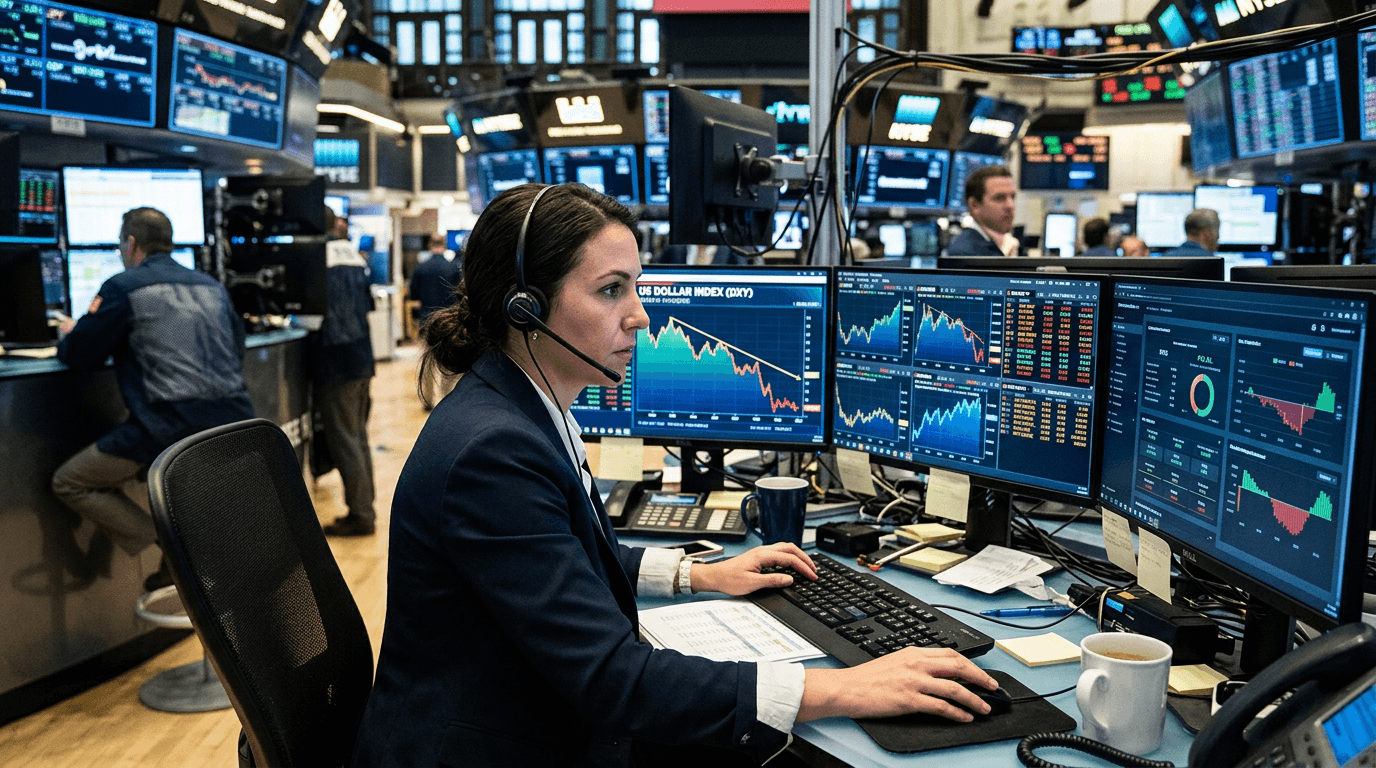
The U.S. dollar’s latest pullback is a reminder that FX trends can shift quickly when interest-rate expectations move, even if economic fundamentals haven’t dramatically changed overnight.[5][8][14] For traders, the retreat in the dollar index is less about a sudden loss of confidence in the U.S. economy and more about a nuanced repricing of how far and how fast the Federal Reserve is likely to tighten policy.[3][7][14]
Markets Reassess The Fed Path
After a period of renewed strength, the U.S. dollar index (DXY) has eased back, slipping toward the 99 area and giving back more than half a percent on the day in recent trade.[5] This move comes as a stream of softer U.S. economic data, including milder inflation readings and weaker labor indicators, has prompted markets to scale back expectations for imminent rate hikes from the Federal Reserve.[1][9][10][15]
Futures markets and tools such as CME FedWatch now show the probability of a near-term hike falling to roughly one-third, down sharply from around three-quarters just a few weeks ago.[2][7][8][14] In parallel, the odds that the Fed simply holds rates steady in upcoming meetings have risen into the mid‑60% range, reflecting a market that increasingly sees the tightening cycle as closer to its peak.[3][14][15]
This shift matters because FX pricing is highly sensitive to expected interest-rate differentials, not just current rates. When traders believe the Fed is less likely to raise rates further, the future yield advantage of holding dollars diminishes relative to other currencies, making the greenback less attractive at the margin.[3][8][14]
How Fx Traders Read A Softer Dollar
The retreat in the dollar has given major counterparts like the euro and yen room to edge higher, reversing part of the recent dollar‑driven pressure on these currencies.[8][9][15] At the same time, the move has supported broader risk sentiment, with dollar‑linked and USD‑settled futures seeing a modest improvement in tone as funding conditions look less likely to tighten aggressively.[5][8][14]
For FX traders, the pattern is familiar: when rate‑hike bets are scaled back, carry trades funded in dollars can look more appealing, and high‑beta currencies and indices often find support.[7][10][14] However, the current backdrop is not a simple “risk‑on” story; concerns about geopolitical risks and uneven global growth are still capping enthusiasm, keeping the dollar’s losses relatively contained.[10]
In practice, professional traders watch three layers of information in this kind of environment: spot FX moves, short‑term interest-rate futures, and options pricing. One‑month options have started to tilt away from the dollar for the first time in months, signaling that positioning and hedging flows are beginning to anticipate more two‑way risk rather than a one‑directional dollar grind higher.[2]
IMPLICATIONS FOR RISK ASSETS AND USD‑SETTLED FUTURES
A softer dollar often acts as a mild tailwind for commodities, equities, and emerging‑market assets priced in U.S. dollars because it lowers the effective hurdle rate for foreign buyers and reduces funding stress.[5][7][14] In the current episode, the easing of Fed‑hike expectations has partly underpinned risk sentiment in USD‑settled futures, even as investors remain cautious about macro and geopolitical headlines.[5][10]
For index futures, a less aggressive Fed path can translate into lower discount rates applied to future earnings, supporting valuations and encouraging tactical long positions, particularly in rate‑sensitive sectors.[3][11][14] In rates futures, the shift in probabilities shows up as rallies in short‑dated contracts, reflecting the market’s belief that peak policy rates may be lower or arrive sooner than previously thought.[3][11][15]
FX and macro traders also pay close attention to cross‑asset correlations here. When the dollar weakens alongside a rally in equities and a stabilization in credit spreads, it suggests the move is driven by a “growth‑but‑less‑tightening” narrative rather than a pure risk‑off flight away from the U.S.[5][7][10] That narrative is exactly what current pricing implies: a softer, but not collapsing, U.S. economy that allows the Fed to be more patient.[10][15]
What Traders Will Watch In The Jobs Report
All eyes now turn to the upcoming U.S. nonfarm payrolls release, which markets see as a key driver for the next leg in rates, equities, and FX volatility.[5][14][15] Recent data have already pointed to unexpected job losses in some reports and more subdued wage pressures, reinforcing the impression that labor‑market tightness may be easing.[10][15]
If the jobs number comes in significantly weaker than consensus, it would likely further reduce the perceived need for additional Fed hikes, potentially extending the dollar’s retreat and supporting higher‑beta currencies and risk assets.[3][8][14][15] Conversely, a strong upside surprise in payrolls and wages could quickly re‑ignite rate‑hike bets, pushing short‑term yields and the dollar higher as traders re‑price a more hawkish Fed stance.[3][9][11][15]
Volatility around NFP is often elevated because the release compresses a large amount of information about growth, inflation pressure, and policy prospects into a single data print. Options markets typically price this with higher implied volatility in the days leading up to the release, creating both risk and opportunity for hedging and tactical trading.[2][8]
Practical Takeaways For Simulated Traders
For traders using a simulated finance environment like E8 Markets, this episode is an ideal case study in how macro expectations translate into FX and futures pricing.
First, practice mapping the chain from data to policy to price. Start with recent inflation and jobs numbers, then note how implied probabilities for Fed meetings have shifted, and finally observe how DXY and major currency pairs have responded.[1][3][5][8][9][10][15] This helps build intuition about which macro inputs truly move markets and which are noise.
Second, set up scenario‑based trades around the jobs release. In simulation, design three paths: a weak NFP scenario with a softer dollar and steeper yield curve; a strong NFP scenario with renewed dollar strength and higher front‑end yields; and an in‑line scenario where positioning rather than data drives the move.[3][8][14][15] Back‑test how your strategies perform across these paths before committing capital in live markets.
Third, use the current environment to refine risk management. With the dollar retreating but headline risk still elevated, focus on sizing positions appropriately, using stop‑loss levels that reflect typical NFP‑day volatility, and diversifying across FX pairs and USD‑settled futures rather than concentrating risk in a single instrument.[2][5][10][14]
Finally, pay close attention to how quickly the narrative can change. The market moved from pricing a roughly three‑in‑four chance of a near‑term Fed hike to closer to one‑in‑three within weeks as data softened.[2][7][8][14] In a simulated setting, track these shifts day by day and adjust hypothetical positioning, reinforcing the discipline of staying aligned with evolving macro probabilities rather than fixed views.
Conclusion
The U.S. dollar’s retreat as traders pare back Fed rate‑hike expectations highlights how powerful the “expectations channel” is for FX and cross‑asset pricing.[3][5][8][14] The move is less about a single data point and more about a cumulative reassessment of inflation, jobs, and the Fed’s tolerance for further tightening.[1][9][10][15]
For active traders and those learning in SimFi environments, the current market offers a valuable, real‑time lesson in connecting macro data to rate expectations and, ultimately, to currency and futures trends. By studying this episode, building scenarios around the upcoming jobs report, and practicing disciplined risk management, traders can sharpen their ability to navigate future shifts in central‑bank expectations—whether the next surprise pushes the dollar down or sends it right back up again.[3][5][8][14][15]