
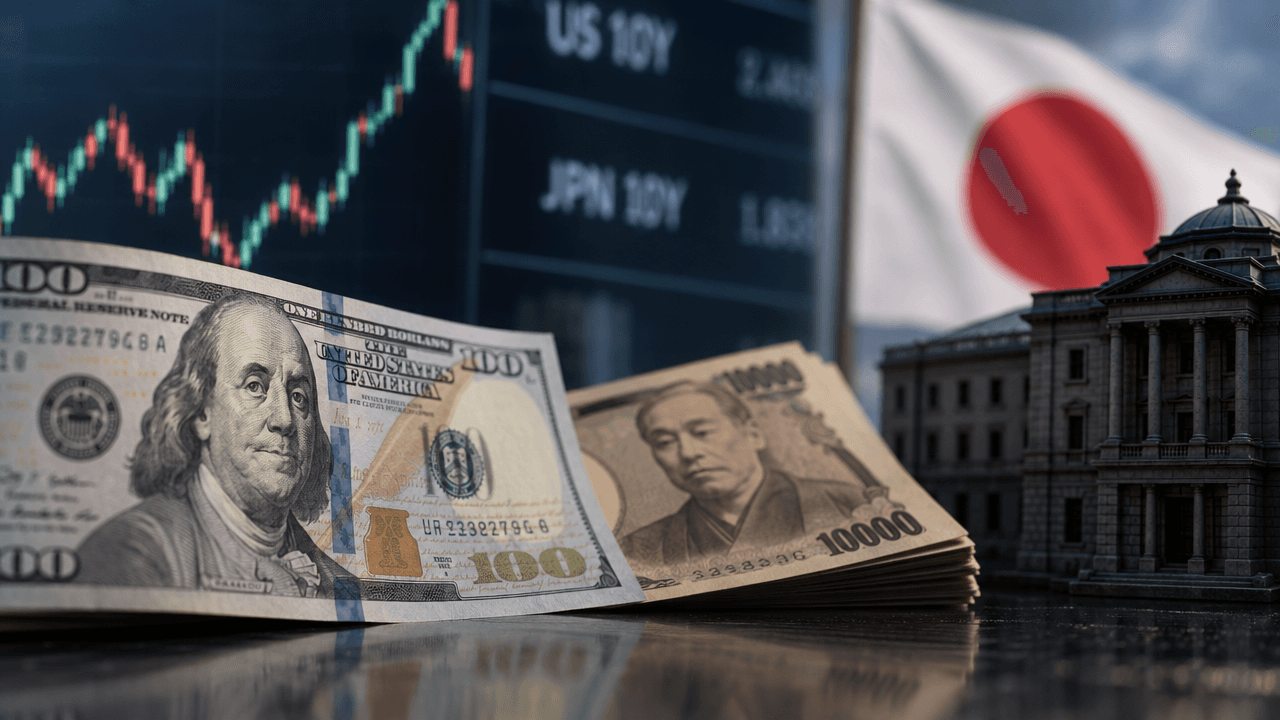
The US dollar is easing modestly, but USD/JPY remains close to 158 as traders balance a softer greenback against persistent pressure on the Japanese yen. Recent trading placed the pair around 158.08 to 158.34, while the euro held near $1.1233. The relatively narrow range is important: it signals that markets are hesitant to push the yen significantly weaker while Japanese authorities continue to warn that intervention remains possible.
For currency traders, this is less a story of a decisive trend reversal than a market trapped between competing forces. The interest-rate gap still favors the dollar, but the risk of official action is limiting the willingness to chase USD/JPY higher.
Dollar Weakens, But The Yen Remains Vulnerable
The dollar’s modest decline reflects softer US yields and reduced demand for the greenback. When Treasury yields fall, the return advantage of holding dollar-denominated assets can narrow, reducing one of the key supports for USD/JPY. The dollar has also been under broader pressure against several major currencies, with the euro recently trading near $1.1233. [2]
However, a softer dollar does not automatically mean a stronger yen. USD/JPY remains elevated because the yield differential between the United States and Japan continues to encourage carry trades. In a carry trade, investors borrow in a lower-yielding currency, such as the yen, and invest in assets denominated in a higher-yielding currency, such as the dollar.
As long as that yield advantage remains substantial, the yen can stay under pressure even when the dollar loses ground elsewhere. This helps explain why USD/JPY has remained near 158 instead of falling sharply with the broader dollar move.
Why 158 Has Become A Critical Level
The 158 area has become both a technical reference point and a psychological barrier. A sustained move above it could encourage traders to test the 159 level, especially if US yields rebound or Japanese economic data disappoints. Conversely, a decisive break below nearby support could trigger profit-taking from long-dollar positions and accelerate yen buying.
Yet recent price action has been unusually contained. USD/JPY has largely remained within an October range near 156.95 to 158.95, suggesting that buyers and sellers are unwilling to commit aggressively in either direction. [1] Narrow ranges often precede a larger move, but they do not reliably predict its direction.
Traders should therefore avoid treating 158 as a guaranteed reversal point. Instead, it is better viewed as a zone where fundamental, technical, and political factors are colliding.
Intervention Risk Changes The Trading Equation
The most significant factor limiting yen weakness is the possibility of Japanese intervention. Finance Minister Satsuki Katayama has warned that authorities are prepared to act again if necessary, and the market remains sensitive to any language suggesting that currency movements have become excessive. [3]
Japan and the United States previously carried out a coordinated yen-support operation after USD/JPY approached levels near 164. The intervention helped push the pair lower, but the yen subsequently gave back part of those gains and returned toward the 157–159 region. [1]
This history creates a difficult environment for traders. A slow rise in USD/JPY may be tolerated, while a rapid and disorderly surge could increase the probability of official action. That distinction matters because intervention can produce sudden, sharp moves that overwhelm normal stop-loss planning.
The narrow range near 158 may therefore reflect caution rather than conviction. Traders may still believe the yen is fundamentally weak, but they may be reluctant to build large short-yen positions while Japanese officials are watching the market closely.
Boj Policy And The Next Market Catalysts
Monetary policy is the other major influence on USD/JPY. The Bank of Japan’s future rate decisions, guidance, and inflation assessment will help determine whether the yen’s weakness is temporary or part of a longer trend. A more hawkish BOJ could support the yen by narrowing the interest-rate gap and encouraging investors to reduce carry trades.
The timing of policy communication is especially important because the next BOJ meeting is approaching. Reports indicate that traders are weighing the possibility of a cautious near-term stance alongside expectations for further tightening later. [11] This uncertainty is likely contributing to the pair’s lack of direction.
US data and Federal Reserve expectations will be equally important. Strong US growth, sticky inflation, or higher Treasury yields could revive dollar demand and push USD/JPY toward the upper end of its range. Weaker economic figures or falling yields could produce the opposite result.
Practical Takeaways For Traders
First, monitor price speed as well as price level. A gradual move toward 159 is different from a sudden surge, which could provoke a stronger official response.
Second, watch US Treasury yields and Japanese policy headlines together. USD/JPY is being driven by the relative outlook for both economies, not by dollar sentiment alone.
Third, treat the 157–159 area as a risk-management zone rather than a simple buy-or-sell signal. Range-bound conditions can generate false breakouts, particularly when intervention fears are elevated.
Finally, size positions conservatively. The market may appear calm, but a policy statement, intervention warning, or unexpected central-bank signal can rapidly change liquidity and volatility.
Conclusion
The dollar’s modest decline has not removed the yen’s structural challenges. USD/JPY remains near 158 because the US-Japan yield gap continues to support the dollar, while intervention risk and potential BOJ tightening limit the pair’s upside.
For now, the market is balancing carry-trade demand against official resistance to excessive yen weakness. Until a clear catalyst emerges, patience and disciplined risk management may be more valuable than aggressive directional positioning. The next sustained move will likely depend on whether US yields rise again, the BOJ adopts a firmer tone, or Japanese authorities signal that the current exchange-rate level has become unacceptable.