
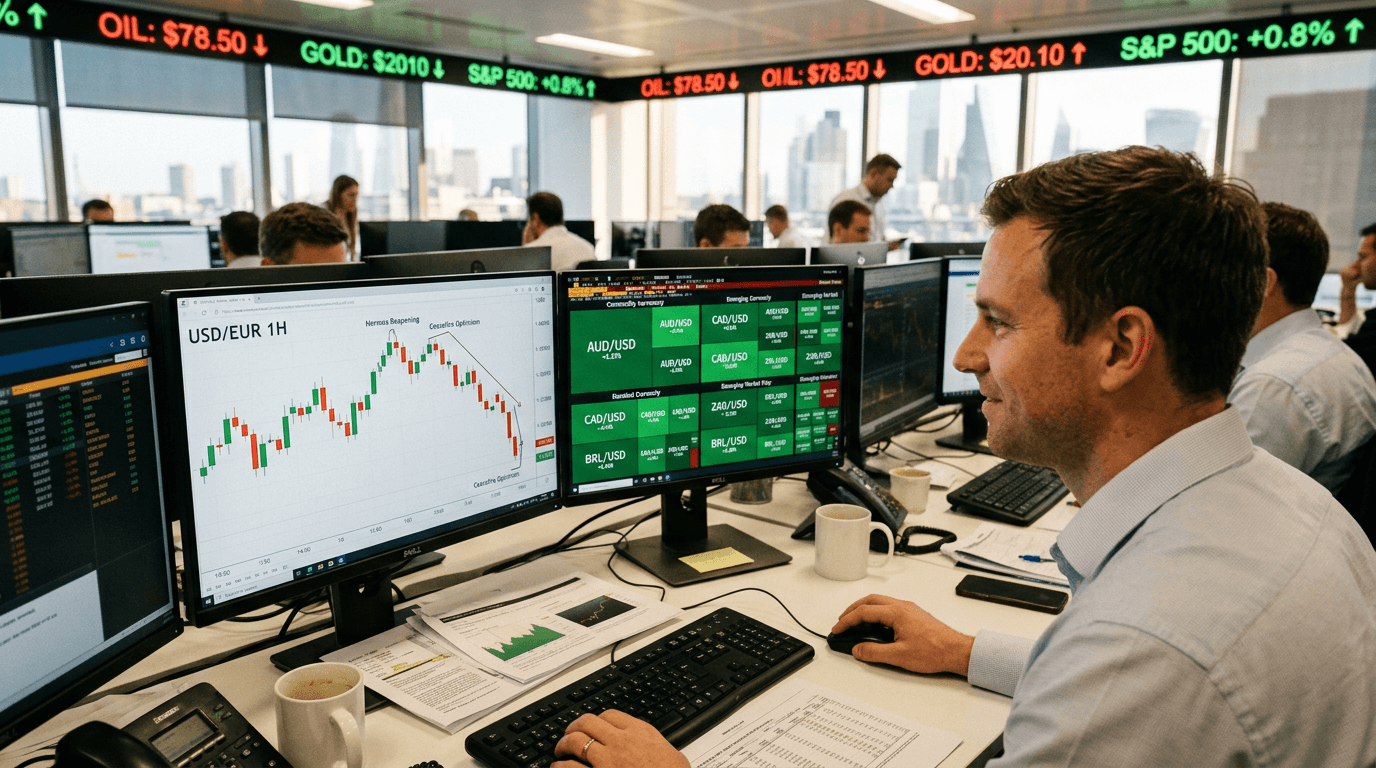
Financial markets are signaling a collective exhale as traders bet that tensions in the Middle East are set to cool and the Strait of Hormuz will soon reopen. The result: the U.S. dollar, which had been buoyed by safe-haven flows and oil-driven inflation fears, is easing against major currencies as risk appetite returns.[5][9] For traders, this is a classic example of how geopolitics can quickly reprice FX, commodities and global rates.
Markets Price A Middle East De-escalation
In recent sessions, the U.S. dollar index has slipped from a two-month high near 100.21 to around 99.77 as optimism about a peace deal to reopen the Strait of Hormuz gained traction.[5] This modest but meaningful pullback follows weeks in which the dollar strengthened on fears of prolonged conflict and disrupted energy supply.
As investors grow more confident that a ceasefire and shipping resumption are possible, they are rotating out of defensive dollar positions and into risk-sensitive currencies. The euro has firmed off recent lows, while the Australian dollar and other high-beta FX have edged higher, reflecting improved risk sentiment.[5][9] In short, the market is beginning to trade a “de-escalation” scenario rather than a worst-case conflict path.
Key takeaway: When the narrative shifts from escalation to de-escalation, defensive dollar strength can give way to a broader risk-on move that lifts EUR, commodity currencies and select EM FX.
How Geopolitics Flow Through The Fx Market
The recent price action is a textbook illustration of how geopolitical risk channels into currency markets via three main drivers: safe-haven demand, commodity prices and growth expectations.
During periods of heightened tension in the Middle East, the dollar tends to rally as investors seek liquidity and perceived safety, especially when oil supply is at risk.[4][12] The earlier closure and disruption in the Strait of Hormuz pushed oil prices higher and stoked inflation worries, encouraging markets to price in a more hawkish Federal Reserve path.[1][8] That combination boosted both real and perceived value in holding dollars.
As signals of a ceasefire and reopening surfaced, that logic began to reverse. With lower perceived tail risk, demand for safe-haven dollars diminished, while cyclical currencies and equities benefited from the prospect of more stable energy supply and reduced geopolitical uncertainty.[5][9] Traders are unwinding extreme “safety trades” and rebalancing positioning more evenly across asset classes.
Key takeaway: Geopolitics rarely move FX in isolation; they matter because they alter the risk premium on the dollar, expected energy costs and, ultimately, central bank reaction functions.
Impact On Oil, Inflation And Global Rates
The Strait of Hormuz is one of the world’s most critical chokepoints for crude and refined product flows. Its closure amplified oil price volatility and elevated inflation expectations, particularly in the U.S., where prior episodes of tension saw analysts discuss upside risks to Fed rate hikes.[1][8] As markets now price a reopening, that “energy shock” narrative is moderating.
A credible path toward normalized shipping would
- Reduce the risk premium embedded in oil futures and energy equities.
- Ease forward-looking inflation expectations as supply constraints recede.
- Lower the perceived need for aggressive or prolonged rate hikes by major central banks.
Recent analysis has already highlighted how easing Middle East tensions have shifted the dollar from being driven primarily by safe-haven demand back toward a more data-and-rates story.[9] That transition is critical: the more inflation fears subside, the more the market will refocus on core macro data such as employment, growth and underlying price trends.
Key takeaway: For FX and rates traders, de-escalation is not only a geopolitical story; it is an inflation and yield-curve story that can reshape expectations for the Fed, ECB and other central banks.
Trading Implications For Simulated And Real Markets
For traders operating on simulated finance platforms as well as in live markets, this environment offers a practical case study in event-driven positioning and risk management.
Several tactical themes stand out
- Dollar safety unwinds: Defensive long-dollar positions built during the height of tensions are being reduced as the probability of worst-case outcomes declines.[3][9] Simulated strategies can test how fast and how far such unwinds typically run.
- Rotation into risk FX: The euro, Australian dollar and other high-beta currencies often benefit when risk appetite improves and commodity-related fears fade.[5][9] This provides a backdrop for exploring relative value trades (e.g., short DXY vs. a basket of pro-cyclical FX).
- Volatility around data: As geopolitics fade slightly into the background, the dollar’s short-term swings become more sensitive to economic releases, especially jobs and inflation data.[9] Simulated environments are ideal for modeling how shocks to data interact with changing geopolitical risk.
From a risk management perspective, the episode underscores the importance of scenario analysis. Traders who had mapped both escalation and de-escalation outcomes—incorporating oil prices, spreads and central bank paths—were better positioned to adjust quickly as the narrative shifted.
Key takeaway: Use periods like this to stress-test strategies, build playbooks for geopolitical swings and understand how safe-haven flows can both amplify and reverse FX trends.
What To Watch Next
Although markets are currently pricing higher odds of de-escalation and a Strait of Hormuz reopening, the situation remains fluid. Traders should monitor several key signposts:
- Diplomatic headlines: Concrete progress on ceasefire negotiations and shipping agreements can accelerate the current risk-on move; setbacks can quickly revive safe-haven dollar demand.[3][8][9]
- Oil price behavior: Sustained declines in crude on reopening news would reinforce the narrative of easing inflation pressure and potentially softer long-term rate expectations.[1][8]
- Central bank communication: If policymakers signal that reduced energy risk lowers the need for hawkish policy, the dollar could face additional headwinds, particularly against currencies where rate expectations remain firm.
- Technical levels in DXY: Recent commentary has highlighted resistance zones near the high-90s to low-100s and support in the high-90s area.[8][9] How price behaves around these levels can offer clues about the durability of the shift away from safe-haven trades.
For traders and investors, the broader lesson is clear: geopolitical risk is not a static backdrop but a dynamic driver of cross-asset pricing. Understanding how narratives evolve—from escalation to negotiation to normalization—can be as important as reading the economic data itself.