
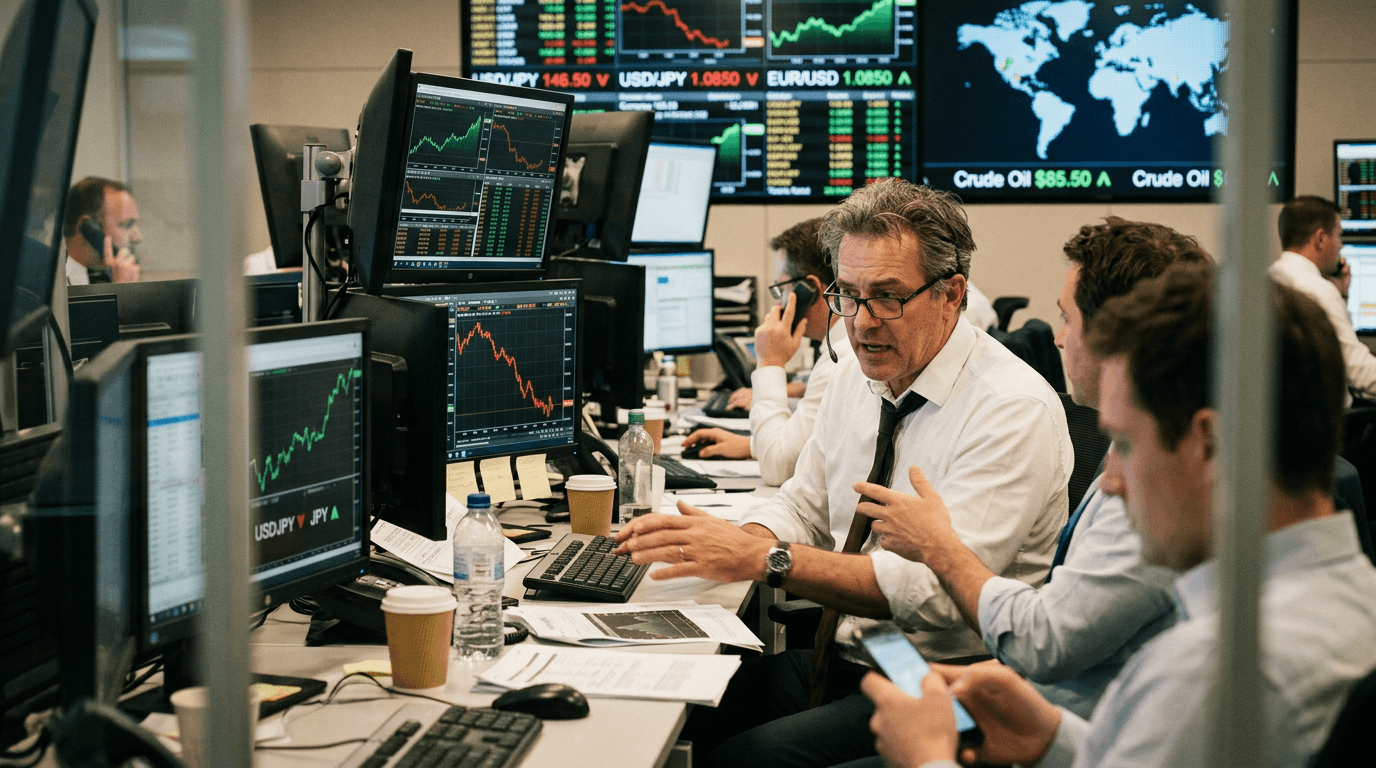
The latest move lower in the US dollar underlines how quickly FX narratives can flip when interest-rate expectations and geopolitical risks collide. As traders scale back bets on additional Federal Reserve hikes, yield support for the greenback is fading, even as rising war risk around Iran injects a fresh safe-haven bid into the Japanese yen and other defensive currencies.[4][9][10][15] The result is a market where policy repricing and risk sentiment pull in opposite directions, creating both opportunity and complexity for traders.
Market Backdrop: Fed Expectations Cool
For much of this year, the dollar’s strength has been anchored in the prospect of at least one more Fed rate hike, with futures markets at times pricing a roughly 30–40% probability of an additional 25-basis-point move.[1][12][14] That narrative is now being challenged as incoming US data show a mix of moderating inflation and uneven growth, softening the case for tighter policy. Recent releases have helped ease inflation concerns, and a flurry of economic numbers has prompted traders to trim the odds of near-term hikes compared with earlier sessions.[4][14][15]
Fed funds futures have reflected this shift, with the implied probability of a rate increase at coming meetings slipping from prior peaks as markets reassess how much more tightening is realistic this late in the cycle.[4][12][14] When rate expectations roll over, the carry advantage that supported the dollar against lower-yielding currencies narrows, encouraging investors to lock in profits on long dollar positions and reallocate into other assets. US Treasury yields have responded in kind, with shorter-dated yields particularly sensitive to perceived changes in the policy path, which directly feed into FX pricing.[4][10][15]
The key takeaway is that the dollar’s recent softness is less about a sudden deterioration in the US outlook and more about an incremental repricing of policy risk. In a world where the Fed had already shifted from projected cuts to a possible additional hike, even a small pullback in hawkish expectations can feel significant because positioning and sentiment were skewed toward a stronger dollar.[5][12][14] For traders, that underscores how quickly FX trends can reverse when the marginal buyer of dollars steps back.
Iran War Risk And The Safe-haven Bid
Overlaying this policy repricing is a renewed escalation in tensions involving the US and Iran, which keeps geopolitical risk elevated and injects a war premium into energy markets and broader volatility measures.[9][10][15] Reports of renewed US strikes on Iranian-linked targets and concerns over regional infrastructure have kept traders focused on the possibility of supply disruptions, even if an outright shock to oil flows has yet to materialize.[10][15] Historically, such shocks tend to drive higher oil prices, wider credit spreads, and a pickup in volatility indices such as the VIX, all of which feed into risk-off behavior in global markets.[9][10][15]
In many past episodes of Middle East stress, the dollar has actually strengthened as a safe-haven asset, supported by its role as the world’s primary reserve currency and by higher oil prices that tighten global financial conditions.[10][15] At the same time, elevated geopolitical risk often dampens risk appetite, pressuring equities and high-yielding currencies while favoring more defensive assets. Energy price swings, in particular, have become a key driver of FX volatility, with traders watching oil as a proxy for how far and fast geopolitical tensions might spill over into broader markets.[9][13][15]
What makes the current environment unusual is that elevated geopolitical risk is coinciding with a modest easing in US rate expectations. That leaves the dollar caught between its traditional safe-haven role and a less compelling yield profile, allowing other havens—most notably the yen—to absorb more of the risk-off flow. For traders, this means the usual “buy USD in a crisis” playbook may not be as straightforward when the policy backdrop is shifting at the same time.
How The Yen Fits Into A New Risk Landscape
The yen has long been viewed as a classic safe-haven currency, benefiting from Japan’s large net foreign asset position and its historical use in carry trades that are unwound in times of stress.[7][15] However, recent episodes linked to the Iran conflict have highlighted that the yen’s haven status is not automatic. During some earlier spikes in tensions, the yen actually weakened toward levels that prompted Japanese authorities to consider or undertake intervention, as markets focused more on Japan’s energy import bill and ultra-accommodative monetary policy than on its defensive credentials.[8][11]
Analysts have noted that the yen’s behavior during commodity shocks is particularly context-dependent, and some have gone as far as arguing that its safe-haven aura has faded when energy prices surge and the Bank of Japan remains behind its peers in normalizing policy.[7][8] Uncertainty around domestic fiscal policy, questions about the timing of BoJ rate hikes, and the impact of higher imported energy costs have all contributed to episodes where the yen failed to rally despite rising geopolitical risk.[8][11]
In the current setting, the combination of softer US rate expectations and heightened war risk opens space for the yen to act more like a traditional safe haven again. As US yields edge lower and the dollar’s rate premium narrows, investors seeking a defensive currency can rotate into the yen without giving up as much carry as before. At the same time, Japanese authorities remain sensitive to sharp yen moves, particularly around psychological levels that have previously triggered intervention, which adds an additional layer of policy risk that traders must respect.[8][11]
Implications For Dollar, Energy And Volatility
For FX traders, the interaction between Fed repricing and Iran war risk matters most through three channels: currency levels, energy prices, and volatility. On the currency side, a softer dollar and a firmer yen can compress USD/JPY, especially if markets perceive that US policy risk is skewed toward a pause while Japanese policy is slowly, if cautiously, normalizing.[4][6][11] Other safe-haven or low-beta currencies, such as the Swiss franc, can also benefit when global risk sentiment wobbles and US yields retreat.
Energy markets sit at the heart of the Iran narrative. Even when outright supply disruptions are avoided, fear of potential outages can sustain a risk premium in oil, which in turn influences inflation expectations, bond yields, and central-bank reaction functions.[9][10][15] That feedback loop can either reinforce or offset FX trends: higher oil can support petrocurrencies and tighten financial conditions, while also complicating the Fed’s job if inflation pressures re-emerge.[9][10][13]
Finally, volatility itself becomes an asset class in this environment. Elevated geopolitical risk often coexists with surprisingly subdued FX volatility, as seen in recent analyses that highlight how markets can remain complacent until a shock forces a repricing.[10][15] For traders, that means option strategies, volatility selling or buying, and hedging costs can all shift rapidly as newsflow around Iran and Fed policy evolves. Understanding how energy, rates, and FX volatility link together is critical to building robust strategies rather than reacting to headlines in isolation.
Practical Takeaways For Traders
This backdrop creates a rich learning environment for both live and simulated traders. One practical step is to map out separate scenarios for policy and geopolitics: for example, a steady Fed with escalating Iran tensions, a more dovish Fed with stabilizing tensions, and combinations in between. Each scenario can be translated into directional views on USD/JPY, oil, and equity indices, and then tested using historical analogs and simulated performance.
Risk management is equally crucial. When both geopolitics and policy expectations are in flux, correlation structures can change quickly, and positions that looked diversified can suddenly move together. Using position sizing, stop-loss disciplines, and scenario-based stress tests can help traders avoid over-leveraging on a single narrative. Paying attention to key event dates—such as Fed meetings, BoJ decisions, and scheduled diplomatic milestones—can also improve timing and reduce exposure to gap risk.
Finally, traders should resist the temptation to treat the yen or the dollar as static “safe havens” and instead evaluate them dynamically based on yields, policy trajectories, and the specific nature of the shock. In some Iran-related episodes, the dollar has carried the safe-haven mantle; in others, rate repricing has dulled its edge, allowing the yen and other currencies to take the lead.[7][10][11][15] The edge goes to traders who can adapt quickly as those roles shift.
In the coming weeks, the balance between a softer Fed outlook and elevated Iran war risk will likely continue to drive cross-currents in FX. A disciplined focus on policy expectations, energy markets, and safe-haven flows can help traders navigate this complex landscape with greater confidence, whether they are experimenting in a simulated environment or managing real capital exposure.