
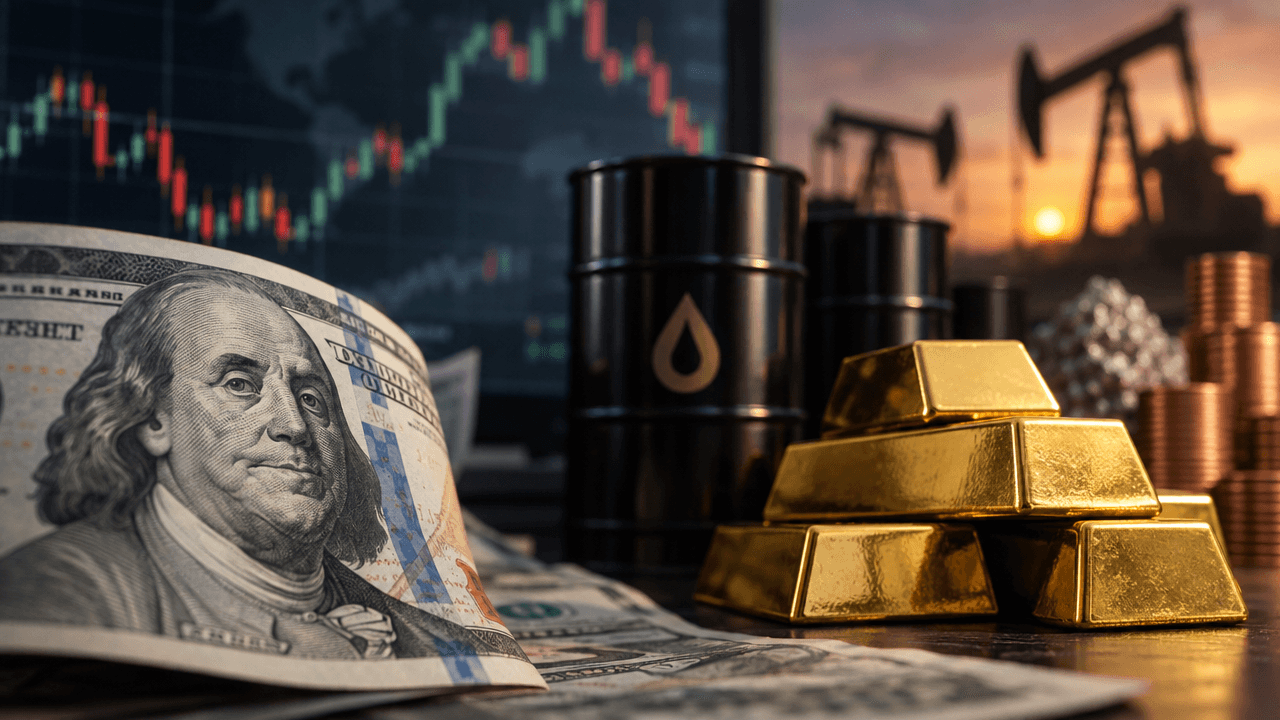
The dollar’s latest show of strength is colliding with another bout of commodity market volatility, leaving traders to navigate conflicting signals from currencies, metals, and energy. A firm greenback, choppy gold, and range‑bound oil are not random moves; they reflect a market recalibrating around US labor data, interest‑rate expectations, and evolving energy‑supply risks. Understanding how these forces interact is essential for anyone trading commodities, FX, or multi‑asset portfolios.
Market Snapshot: Firm Dollar, Choppy Commodities
When the dollar index grinds higher rather than surging in a single spike, commodities rarely react in a uniform way. Some contracts sell off quickly, others drift, and a few even hold firm despite currency headwinds. That is exactly what markets are signaling now: gold has shown downside probes followed by fast recoveries, while oil prices are stabilizing after an earlier drop as traders weigh supply narratives against a stronger dollar backdrop.
This pattern is consistent with recent behavior across the complex: energy prices are oscillating as geopolitical risk premia fade or re‑price, precious metals are feeling the drag from higher real yields, and industrial metals are responding more to supply constraints and demand trends than to FX alone[2][11]. The result is a patchwork of moves rather than a single, unified commodity story—precisely the type of environment that can trip up traders who rely on simple “dollar up, commodities down” heuristics.
How A Strong Dollar Shakes Commodity Prices
Most global commodities are priced in US dollars, so moves in the dollar feed directly into the prices that international buyers pay[8][13]. When the dollar strengthens, the same barrel of oil or ounce of gold becomes more expensive in euros, yen, or emerging‑market currencies. That tends to cool physical demand at the margin and can encourage speculative longs to take profit or reduce exposure[3][5][8].
Empirical studies by institutions such as the IMF and BIS show that commodity prices and the US dollar often move in opposite directions, particularly over shorter horizons[1][7][12]. Stronger US monetary conditions and a firmer dollar are associated with weaker dollar‑denominated commodity prices, while looser policy and a softer dollar often support commodity rallies[12][14]. Because the invoicing currency is the dollar, importers in other economies experience amplified volatility in local‑currency terms when both the dollar and commodity prices swing[4][7].
Energy commodities tend to exhibit the largest price swings over time, with typical upcycles and downcycles involving prices nearly tripling and then falling back by similar magnitudes[15]. The current backdrop—firm dollar, shifting rate expectations, and fluid geopolitics—fits squarely into that historical pattern of pronounced energy volatility. For traders, the key takeaway is that dollar trends set the macro stage, but supply‑demand specifics determine how each contract actually performs.
Macro Drivers: Labor Data, Rates, And Energy Headlines
Recent market action underlines how sensitive both the dollar and commodities are to US labor data. Stronger‑than‑expected employment or wage figures tend to reinforce “higher for longer” rate narratives, pushing Treasury yields and the dollar higher while weighing on non‑yielding assets such as gold[2][9][12]. Softer labor prints, by contrast, can trigger rapid repricing toward future policy easing, weakening the dollar and offering relief to rate‑sensitive commodities.
Central bank research suggests that even small surprises in US policy expectations can move commodities meaningfully. A 10‑basis‑point shock to the federal funds rate is associated with around a 2% decline in oil prices and a 1% drop in food prices, highlighting how closely commodity valuations are tied to policy and FX dynamics[12]. In a world of high‑frequency data and algorithmic trading, these relationships can play out in minutes, not weeks.
Energy supply headlines add another layer of volatility. Episodes of conflict, sanctions, shipping disruptions, or OPEC decisions can override the dollar narrative in the short term, propelling crude higher even when the greenback is firm[3][11]. Conversely, easing geopolitical tensions or evidence of ample inventories can cap rallies and drag prices lower, especially when higher yields and a strong dollar are tightening financial conditions globally[2][10]. Traders must therefore track both macro data and micro supply signals rather than relying on a single driver.
Practical Takeaways For Active Traders
In this type of environment, a structured approach can help turn volatility into opportunity rather than noise:
1) Map exposures to the dollar If your portfolio includes gold, oil, base metals, or agricultural futures, you effectively have embedded FX exposure because contracts are priced in dollars[8][13]. A stronger dollar can hurt commodity positions even if local fundamentals look supportive, while a weaker dollar can amplify rallies.
2) Separate macro from micro drivers Start each trading day with two checklists: one for macro factors (US labor data, inflation releases, Fed communication, yield moves) and one for commodity‑specific catalysts (inventory reports, production outages, weather, and geopolitical events)[2][11]. This helps explain whether a move is primarily currency‑driven or driven by supply‑demand shifts.
3) Avoid one‑size‑fits‑all assumptions Energy, metals, and agricultural contracts do not respond identically to the same macro shock. Historical analysis shows energy has the most pronounced price swings, while base metals often find floors when supply constraints tighten despite macro headwinds[11][15]. Tailor strategies by sector rather than treating “commodities” as a single bucket.
4) Use volatility to refine risk management Commodity markets are inherently volatile, particularly when monetary policy, FX trends, and supply risks collide[13][15]. Instead of trying to predict each move, traders can focus on position sizing, defined risk (via options or stop levels), and scenario planning around known data releases.
Simulated Finance: A Safer Sandbox For Volatility
Simulated Finance platforms like E8 Markets give traders a controlled environment to test how a firm dollar and volatile commodities interact, without putting real capital at risk. By running strategies in a realistic simulation, traders can observe how their positions behave when the dollar grinds higher, gold whipsaws around key levels, or oil reacts to unexpected supply headlines.
This sandbox is particularly valuable for stress‑testing multi‑asset portfolios. Traders can explore questions such as: How does a surprise upside in US payrolls affect a gold‑oil spread? What happens to a diversified commodity basket when the dollar rallies 3% over a month[3][8][12]? Which risk‑management rules remain robust across different interest‑rate scenarios? Simulated environments help answer these questions through practice rather than theory.
Ultimately, the goal is to build playbooks before market stress arrives. By rehearsing responses to labor data surprises, rate repricing, and energy shocks in a SimFi setting, traders can reduce emotional decision‑making when similar conditions appear in live markets. The current mix of a firm dollar and volatile commodities is an ideal backdrop for that kind of structured learning.
Conclusion
The coexistence of a resilient dollar and volatile commodity markets is not a contradiction; it is a reflection of the complex way currencies, interest rates, and physical supply interact. A stronger dollar and tighter monetary conditions raise the hurdle for commodity rallies, especially in gold and other non‑yielding assets, yet specific supply stories can still drive sharp moves in energy and select metals[2][5][11][12]. For traders, the edge lies in understanding these linkages, mapping dollar exposure, and preparing for data and headlines that can shift the landscape quickly. Using simulated environments to test and refine strategies turns today’s volatility from a source of anxiety into a training ground for better decision‑making when it matters most.