
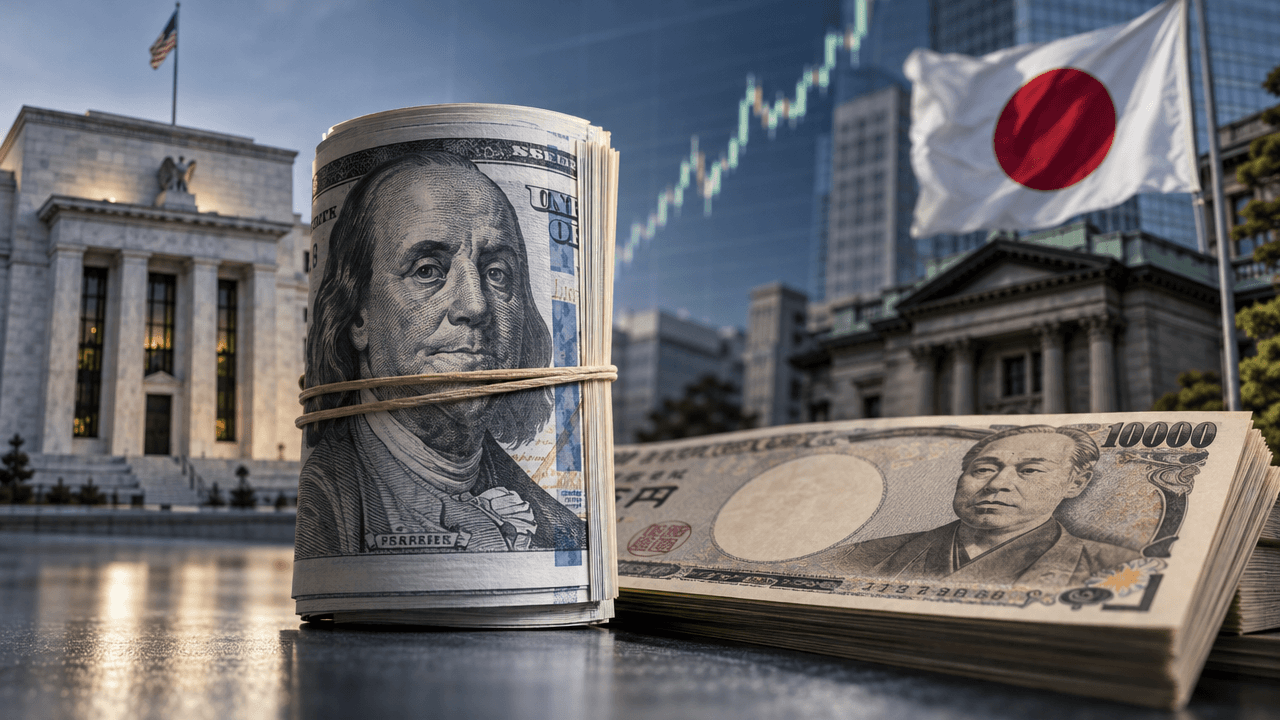
The dollar is pressing higher against major currencies, while USD/JPY is approaching the politically sensitive 160 level. The Dollar Index recently climbed approximately 0.6% to 102.9, its highest point since April 2025, as stronger inflation signals and increasingly hawkish Federal Reserve commentary encouraged traders to price in additional US interest-rate increases. [3]
At the same time, USD/JPY rose to roughly 159.90, bringing the currency pair close to a level associated with previous Japanese intervention. The move reflects a widening policy contrast: US rates may remain higher for longer, while uncertainty over the Bank of Japan’s next hike continues to weigh on the yen. For traders, the central question is no longer simply whether USD/JPY can reach 160, but whether it can remain above that threshold without provoking an official response.
Why The Dollar Is Strengthening
The latest dollar advance has been driven primarily by changing expectations for Federal Reserve policy. Recent inflation data reinforced concerns that price pressures may be proving more persistent than policymakers would prefer. As a result, markets increased the probability of a 25-basis-point Federal Reserve rate hike in December to approximately 87%, up from around 70% one month earlier. [3]
Comments from Fed officials added momentum to the repricing. Governor Christopher Waller indicated that he was leaning toward a 25-basis-point increase, while suggesting that a larger move could be considered if core inflation continued running at approximately 0.3% per month or higher. Dallas Fed President Lorie Logan also signaled that further tightening could be necessary if inflation remains elevated. [10][13]
Higher expected US interest rates tend to support the dollar because they increase the potential return on dollar-denominated assets. They can also widen the yield gap between US and Japanese government bonds, encouraging investors to borrow yen and purchase higher-yielding dollar assets. This type of carry-trade demand has been a major force behind the recent rise in USD/JPY.
WHY 160 MATTERS FOR USD/JPY
The 160 level is important for both technical and policy reasons. Technically, it is a large round number that can attract profit-taking, option activity, and defensive orders. Psychologically, it represents a visible milestone after a rapid rise in the pair.
More importantly, Japanese officials have previously acted when sharp yen depreciation threatened to become disorderly. Atsushi Mimura, Japan’s vice finance minister for international affairs, warned that recent currency movements were too rapid as USD/JPY moved back toward 160. Officials have not declared that 160 automatically triggers intervention, but their language signals that the pace and direction of the move are being monitored closely. [4][2]
Japan reportedly spent approximately ¥15.4 trillion during intervention operations on July 30–31 and August 3 to support the yen. That history means traders are reluctant to assume that a sustained break above 160 would be a straightforward bullish signal for the dollar. [11]
Intervention can take several forms. Authorities may begin with verbal warnings designed to discourage speculative selling of the yen. If those warnings fail, Japan’s Ministry of Finance can instruct the Bank of Japan to sell dollars and buy yen in the foreign-exchange market. Even the threat of such action can cause sharp, sudden reversals.
The Policy Divide Between The Fed And Boj
The pressure on the yen is not caused by US policy alone. Expectations surrounding the Bank of Japan remain a crucial part of the equation.
Although Japan has begun normalizing monetary policy, markets remain uncertain about the timing and scale of future rate increases. Dovish comments from some Bank of Japan policymakers have raised questions about whether another hike will arrive soon. At the same time, stronger Japanese wholesale inflation has provided arguments for continued policy tightening, creating a conflicting signal for yen traders. [5][14]
This uncertainty contrasts with the increasingly clear hawkish tone from the Federal Reserve. If US inflation remains firm while Japanese policymakers proceed cautiously, the interest-rate differential could continue favoring the dollar. Conversely, a more confident Bank of Japan or a softer US inflation report could narrow that gap and trigger a pullback in USD/JPY.
What Traders Should Watch Next
The most important indicators will be future US inflation data, employment figures, Treasury yields, and Federal Reserve communications. A continued rise in US yields could maintain upward pressure on the dollar, particularly if markets begin assigning greater probability to multiple rate hikes.
Traders should also monitor Japanese official statements for changes in language. References to excessive volatility, one-sided moves, or readiness to take appropriate action often attract immediate attention. The combination of a rapid price increase and increasingly direct warnings may be more significant than the exact USD/JPY level itself.
From a risk-management perspective, buying USD/JPY near 160 carries unusual event risk. A trader may be correct about the longer-term direction and still face a rapid loss if intervention headlines trigger a sharp yen rally. Wider stops, smaller position sizes, and clearly defined maximum losses are especially important around policy-sensitive levels. Traders should also account for overnight gaps and sudden liquidity changes, which can make planned exit levels difficult to execute.
The dollar’s advance remains supported by stronger US rate expectations, but USD/JPY is entering a zone where policy risk can overwhelm technical momentum. A clean break above 160 would not necessarily confirm a durable new trend; it could instead increase the likelihood of official action and a volatile reversal.
For SimFi traders, the practical lesson is to separate directional conviction from trade execution. The fundamental case for a stronger dollar may remain intact, yet the path can become unpredictable when central banks and finance ministries are watching the same price level. Monitoring yields, inflation expectations, central-bank communication, and position size together provides a more complete framework than relying on the 160 level alone.