
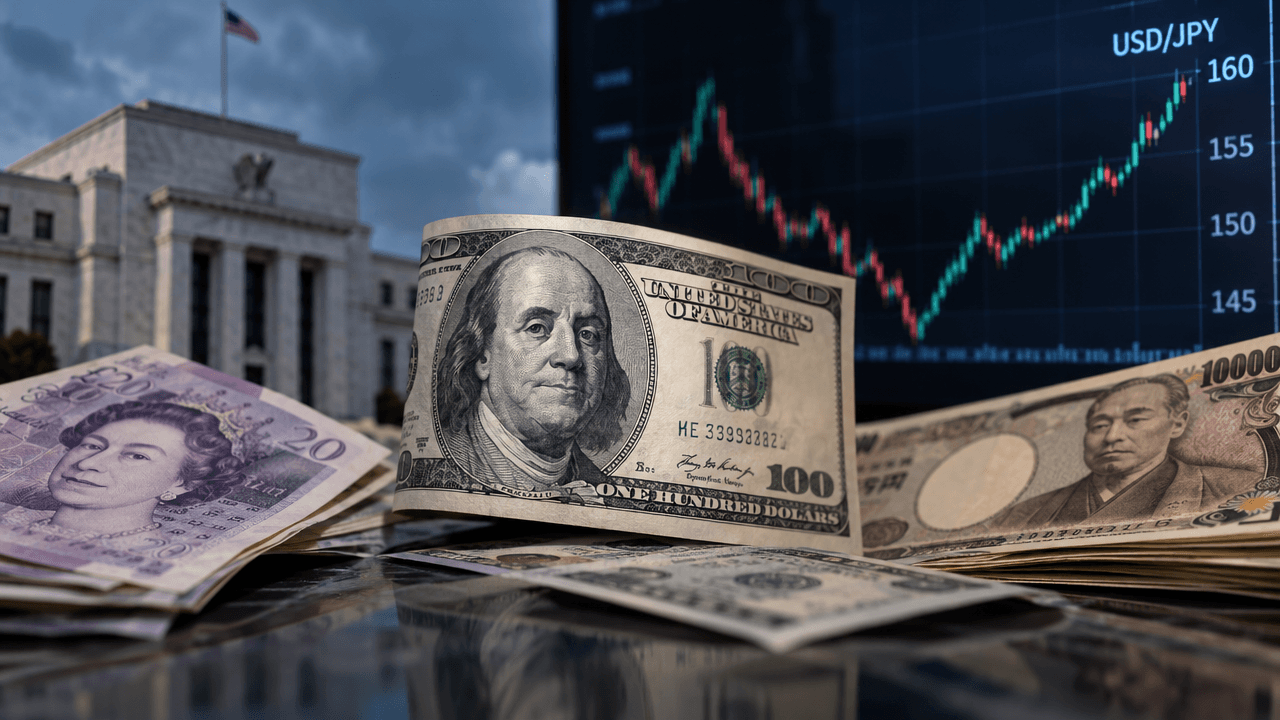
The dollar is holding close to a 19-month high, reflecting a sharp shift in expectations about U.S. monetary policy. At the same time, sterling has fallen to a new 2026 low, while the Japanese yen remains under pressure near the politically sensitive 160-per-dollar level. Together, these moves show how quickly interest-rate expectations, inflation concerns, and government intervention risks can reshape the foreign-exchange market. [2]
THE DOLLAR’S RATE ADVANTAGE
The dollar’s latest advance has been driven primarily by expectations that the Federal Reserve may need to tighten monetary policy more aggressively. Recent inflation data and hawkish comments from policymakers have encouraged traders to price in a higher probability of another rate increase, including expectations for a 25-basis-point hike in December. [12]
Higher U.S. interest rates generally support the dollar because they increase the potential return on dollar-denominated assets. When investors can earn more on U.S. Treasury securities and other dollar investments, demand for the currency tends to rise. The effect can be especially powerful when other major central banks appear more cautious or when economic uncertainty encourages investors to seek liquidity.
The dollar’s strength is therefore not simply a reflection of optimism about the U.S. economy. It also reflects a widening policy gap. If the Federal Reserve keeps rates higher for longer while other central banks move more slowly, international capital may continue flowing toward the United States.
For traders, this makes upcoming U.S. inflation, employment, and central-bank communications particularly important. A continuation of strong economic data could reinforce the dollar rally. Conversely, signs that inflation is cooling or growth is weakening could prompt markets to reduce rate-hike expectations and take some support away from the greenback.
Sterling Slides To A 2026 Low
Sterling’s decline to a new yearly low highlights the currency’s vulnerability when the dollar is broadly strengthening. GBP/USD has faced pressure as traders reassess the outlook for interest rates, economic growth, and the Bank of England’s policy path.
A weaker pound can reflect concerns that the Bank of England may be unable to match the Federal Reserve’s tightening stance. If U.S. yields rise faster than U.K. yields, the relative appeal of dollar assets improves. That interest-rate differential can encourage selling of sterling against the dollar.
The pound is also sensitive to domestic economic expectations. Slower growth, weak consumer demand, fiscal uncertainty, or disappointing data can reduce confidence in the currency. Even when the underlying issue is not unique to the United Kingdom, sterling may underperform if investors view the U.S. outlook as comparatively stronger.
A 2026 low does not automatically mean that sterling must continue falling. Markets can reverse quickly when positioning becomes crowded. However, traders should distinguish between a temporary oversold condition and a genuine change in trend. A sustained recovery would likely require more than a short-term bounce; it may require improving U.K. data, a more hawkish Bank of England, or a moderation in dollar strength.
USD/JPY AND THE 160 INTERVENTION RISK
The most politically sensitive move is taking place in USD/JPY. The pair is trading near 160, a level that has repeatedly attracted the attention of Japanese officials and foreign-exchange traders. Japan’s finance minister has warned that the government will respond appropriately to excessive currency volatility, while officials have reminded markets not to forget previous intervention episodes. [7][14]
The fundamental pressure behind USD/JPY remains clear. Higher expected U.S. interest rates support the dollar, while the yen continues to struggle with a large interest-rate disadvantage. Even if the Bank of Japan is considering additional policy normalization, traders may still favor the dollar when the short-term yield gap remains wide.
Yet USD/JPY is not a normal trend-following trade at these levels. Intervention risk can create sudden and violent reversals. Japanese authorities do not need to announce a precise trigger in advance. A rapid, one-sided move, particularly one that contributes to domestic inflation, could be enough to increase the probability of official action.
This creates an unusual trading environment. The pair may continue rising because of strong fundamentals, but every move toward or above 160 can also increase the risk of a sharp pullback. Traders who chase strength without controlling position size may find that a profitable trend can turn into a large loss within minutes.
What Traders Should Watch
The next phase of the currency market will depend on whether the data validates current policy expectations. Key indicators include U.S. inflation, payrolls, consumer spending, Treasury yields, and Federal Reserve guidance. The most important question is whether markets are pricing a genuine change in the Fed’s path or simply reacting to a temporary burst of hawkish sentiment.
For sterling, traders should monitor U.K. inflation, wages, economic activity, and comments from Bank of England officials. A dovish policy outlook combined with weak growth could keep the pound under pressure. But any evidence that inflation remains persistent may force markets to reconsider how long rates need to stay elevated.
For USD/JPY, technical levels matter, but official communication matters just as much. Traders should track statements from Japan’s Ministry of Finance, sudden changes in price momentum, and unusually rapid intraday moves. Stops should account for possible volatility spikes rather than being placed too close to obvious levels.
A practical approach is to reduce leverage, define the maximum acceptable loss before entering a position, and avoid assuming that a historically important level will behave predictably. Traders can also consider scenario planning: one plan for continued dollar strength, another for a hawkish U.S. surprise, and a third for intervention-driven yen buying.
The Broader Market Message
The dollar’s 19-month high, sterling’s 2026 low, and USD/JPY’s approach to 160 are connected by a single theme: interest-rate expectations remain the dominant force in major currency markets. The dollar benefits when investors anticipate tighter Federal Reserve policy, while currencies linked to slower growth or less aggressive central banks face greater pressure.
However, strong momentum does not eliminate risk. The closer markets move toward politically sensitive thresholds, the more important liquidity, positioning, and official reaction become. A disciplined trader should therefore focus not only on direction but also on the quality of the move and the risks surrounding it.
The current environment favors careful analysis over automatic trend chasing. If U.S. data stays firm and the Federal Reserve remains hawkish, the dollar may retain its advantage. But sterling could stabilize, and the yen could rebound sharply if policy expectations change or Tokyo intervenes. In a market shaped by both monetary policy and government action, flexibility may be as valuable as conviction.