
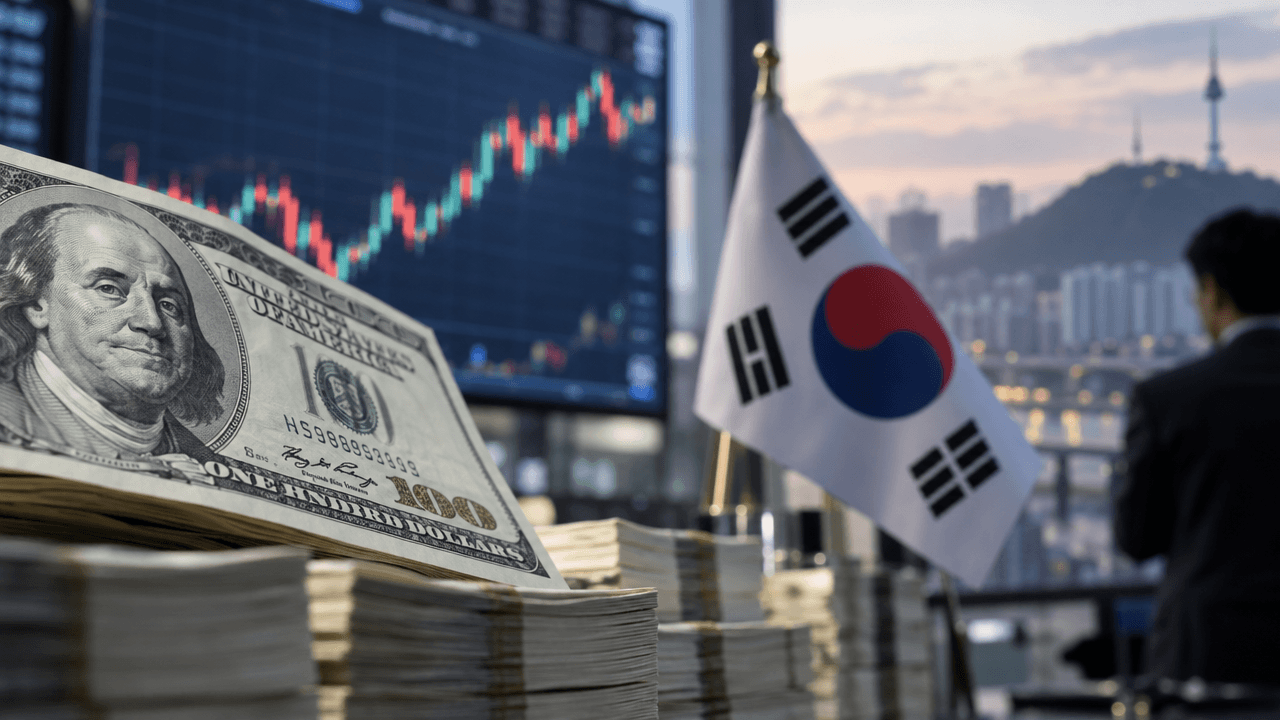
The U.S. dollar strengthened against the Korean won on November 17 as investors increased their exposure to dollar futures, pushing USD/KRW to 1,340 won. The exchange rate rose 4.30 won from the previous Seoul session close of 1,335.70 and reached an intraday high of 1,342.90. Foreign investors purchased more than 56,000 dollar-futures contracts, reinforcing demand for the greenback and adding pressure to one of Asia’s most actively traded currencies. [1]
What Drove The Move
The immediate catalyst was positioning in the futures market. When investors buy dollar futures against the won, they are expressing expectations that the dollar will appreciate or that the won will weaken. Those transactions can influence spot-market pricing as dealers adjust their hedges and manage exposure.
The move also reflected broader dollar strength. The U.S. Dollar Index climbed above 103, while concerns about persistent U.S. inflation increased speculation that the Federal Reserve could maintain a restrictive policy or consider additional rate increases. Higher expected U.S. interest rates generally support the dollar because they can attract capital toward dollar-denominated assets. [1]
This relationship is especially important for Asian currencies. If U.S. yields rise relative to local yields, investors may reduce exposure to emerging-market assets or hedge currency risk more aggressively. The result can be a stronger dollar even when there is no major deterioration in a country’s domestic economy.
WHY USD/KRW MATTERS
USD/KRW measures how many Korean won are required to purchase one U.S. dollar. When the pair rises, the dollar is strengthening and the won is weakening. A move to 1,340 therefore signals that Korean importers, businesses, and investors must pay more won for the same amount of dollar-based goods or assets.
The exchange rate matters because South Korea is deeply integrated into global trade. Energy, raw materials, machinery, and many technology inputs are priced in dollars. A weaker won raises the local-currency cost of those imports, particularly when commodities such as crude oil are also climbing.
At the same time, a weaker won can benefit exporters by making Korean products relatively cheaper for overseas buyers. Companies that receive revenue in dollars may also see their foreign-currency earnings translate into more won. However, the benefit is not uniform. Businesses dependent on imported components or energy may face higher costs that offset some of their export advantage.
Recent trading has shown how quickly the balance can change. The won strengthened to around 1,330 per dollar earlier in November as export growth remained firm and foreign selling pressure eased. [14] It later weakened as foreign equity sales, importer demand, and a stronger dollar returned to the market. [3]
The Role Of Risk Sentiment
Currency markets respond not only to interest rates but also to investor confidence. When global markets are calm and investors are willing to hold stocks and higher-risk assets, capital can flow into emerging markets. That demand may support currencies such as the won.
During periods of uncertainty, investors often seek liquidity and safety. The U.S. dollar is one of the world’s primary reserve currencies, so it can attract buying when geopolitical risks, inflation worries, or concerns about global growth rise.
Oil prices can intensify this dynamic for South Korea. Because the country imports much of its energy, higher oil prices can increase demand for dollars to pay overseas suppliers. Recent reports linked a stronger dollar and pressure on the won to rising oil prices and uncertainty surrounding U.S.-Iran talks. [13]
This does not mean every dollar rally will continue in a straight line. Exporters may sell dollars when exchange rates rise, while authorities and market participants may become more alert to excessive volatility. Previous market commentary placed the exchange rate in a broad 1,320-to-1,350 range, depending on supply, demand, and external developments. [3]
What Traders Should Watch
The first indicator is whether dollar-futures buying continues. A single session of heavy positioning can move the market, but sustained purchases would suggest that investors are building a stronger conviction about further dollar gains. Traders should compare futures activity with spot-market volume, foreign equity flows, and changes in U.S. Treasury yields.
The second factor is Federal Reserve expectations. Strong U.S. inflation data, resilient economic activity, or hawkish central-bank communication could lift Treasury yields and support the dollar. Conversely, softer data or signs that rate expectations are easing could reduce dollar demand.
The third factor is Korea’s external balance. Export growth, semiconductor demand, and the country’s current-account performance can provide fundamental support for the won. Exporter dollar selling may also limit upward pressure in USD/KRW, even when speculative demand is strong.
For SimFi traders, the key lesson is to avoid treating a currency move as an isolated signal. A rising USD/KRW pair may reflect several forces at once: futures positioning, interest-rate expectations, equity flows, commodity prices, and risk sentiment. Building a trade thesis requires identifying which of those factors is dominant and determining what evidence would invalidate the idea.
Practical Takeaways
Track the dollar index and U.S. Treasury yields alongside USD/KRW rather than analyzing the currency pair alone.
Watch foreign purchases or sales of Korean equities and dollar futures for clues about capital-flow pressure.
Consider how oil prices affect Korea’s import bill and dollar demand.
Use defined risk when trading leveraged currency products, because futures positioning can reverse quickly.
Treat the 1,340 area as a market reference point, not a guaranteed support or resistance level.
Conclusion
The rise in USD/KRW to 1,340 illustrates how derivatives positioning can amplify a broader macroeconomic trend. More than 56,000 dollar-futures contracts purchased by foreign investors helped reinforce demand for the dollar, while higher U.S. rate expectations and pressure on Asian currencies added momentum. [1]
For traders, the most important message is not simply that the dollar strengthened. It is that exchange rates reflect the interaction of futures positioning, monetary policy, trade flows, commodities, and investor confidence. Monitoring those connections can help market participants interpret the next move more effectively—whether the dollar extends its advance or the won finds support from exporters, improving risk sentiment, or changing expectations for U.S. interest rates.