
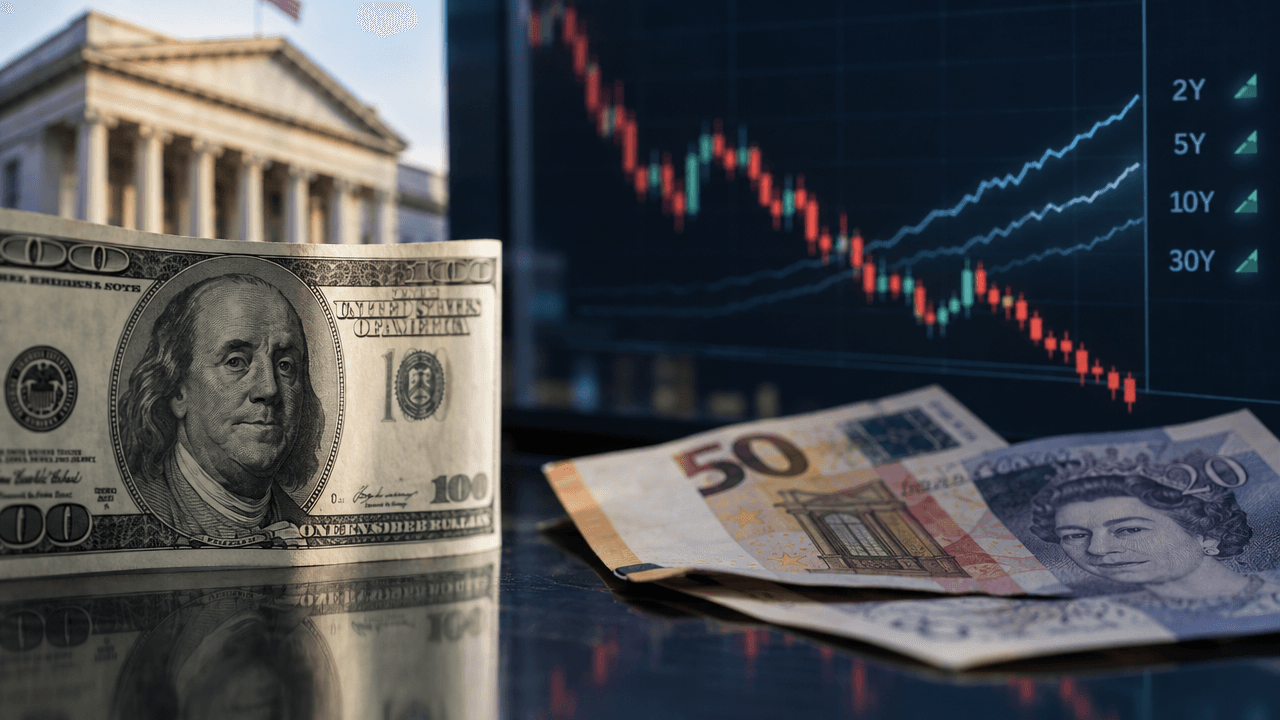
The latest upswing in the US dollar and Treasury yields is a timely reminder that macro drivers still dominate FX price action. As investors re-evaluate the Federal Reserve’s policy path, rate expectations and term premia are pushing yields higher across the curve and providing fresh support for the greenback. EUR/USD is sliding back toward its yearly lows and GBP/USD is under pressure as the dollar regains its interest-rate advantage, reshaping opportunities and risks for currency traders.
Global Market Snapshot
The US Dollar Index has moved above the 101 level, signaling a broad-based strengthening of the dollar against major peers.[1][9][11] This shift reflects renewed demand for dollar assets as US yields adjust higher, improving the return profile for investors holding dollar-denominated securities.[2][7] In FX markets, that combination of higher yields and a firmer dollar is playing out most visibly in the euro and the pound, where recent gains are being challenged.
US Treasury yields have risen across the maturity spectrum, with benchmark 10-year rates trading near the 4.7–5.0% area and long bonds above 5%.[2][7][10] The upward move has been driven less by sudden fiscal fears and more by resilient economic growth, persistent inflation uncertainty, and a higher premium for holding longer-dated debt.[2][8] Shorter tenors such as the 2-year note have also climbed, tightening financial conditions and reinforcing the sense that policy may stay restrictive for longer.
On the FX side, EUR/USD has slipped toward the 1.14 region, close to its lowest levels over the past year as the euro underperforms against the stronger dollar.[5] GBP/USD has retreated toward the mid‑1.33s, trading near multi‑month lows as investors reassess the pound’s rate advantage amid a more hawkish Fed backdrop.[3][12][15] Together, these moves highlight how quickly rate and yield repricing can ripple through major currency pairs.
Why Higher Treasury Yields Boost The Dollar
Understanding why rising Treasury yields tend to support the dollar is critical for traders who want to move beyond headline watching. At a basic level, higher yields increase the compensation investors receive for holding US government debt. When those yields rise relative to other developed bond markets, global capital is incentivized to flow into dollar assets, lifting the currency. This “rate differential” story is especially powerful when the move is anchored in expectations of policy staying higher for longer.
Recent analysis indicates that the latest yield move is being driven by resilient US growth, modest inflation repricing, and a higher term premium, not a disorderly fiscal scare.[2][8] That backdrop matters: when higher yields are seen as sustainable and economically justified, investors are more willing to hold longer-dated Treasuries and associated dollar positions. For FX markets, it reinforces a carry-friendly environment where funding in lower-yielding currencies and rotating into higher-yielding dollar assets becomes more attractive.
For leveraged traders, the interplay between yields and FX can create both opportunity and risk. A rapid repricing of rate expectations, especially around key Fed speeches or data releases, can trigger sharp intraday moves in EUR/USD and GBP/USD. Aligning trade horizons with the underlying macro theme—rather than just chasing price momentum—helps avoid being on the wrong side of a sentiment swing.
PRESSURE ON EUR/USD AND GBP/USD
The euro’s slide toward yearly lows against the dollar reflects more than a single news headline. It underscores the structural challenge for the euro area when US yields and growth outpace those in Europe.[5] If investors believe the Fed will maintain restrictive policy for longer while the European Central Bank leans more cautiously amid weaker growth, the rate differential naturally favors the dollar. That differential shows up directly in EUR/USD’s drift lower.
Sterling faces a similar dynamic. GBP/USD has fallen back toward three‑month lows as markets weigh softer UK data, evolving Bank of England expectations, and the renewed strength of the dollar.[3][12][15] When US short-end yields rise faster than equivalent UK maturities, the pound’s previous rate advantage erodes. For traders, this can shift GBP/USD from a trend-following long candidate into a pair where rallies are viewed as opportunities to re-establish dollar strength.
In practice, these moves often reprice in stages. The first reaction tends to be in front-end yields and short-term FX positioning. As data and central bank communication confirm or challenge the initial move, longer maturities and spot FX can follow. Active traders who monitor both yield curves and FX charts can better distinguish between a short-lived squeeze and a sustained macro trend.
What This Means For Active Traders
For discretionary and systematic traders alike, the current environment calls for a renewed focus on macro context. When the dollar is being driven by clear shifts in yields and Fed expectations, purely technical setups in EUR/USD and GBP/USD may underperform unless they are aligned with the broader narrative. That does not mean abandoning charts; it means integrating rate differentials, yield spreads, and event risk into the trading framework.
One practical takeaway is to build a calendar around key Fed speeches, inflation prints, labor data, and bond auctions. These events tend to shape expectations for future policy and can accelerate moves in both yields and FX. Ahead of such catalysts, position sizing and leverage should reflect the potential for volatility. For example, EUR/USD hovering near yearly lows can either break decisively lower on a hawkish surprise or mean-revert if the data softens expectations.
Another takeaway is to pay attention to cross-market signals. If US yields are rising in an orderly fashion, credit spreads are stable, and the dollar is firm but not disorderly, the environment favors trend and carry strategies. Conversely, if yield moves are accompanied by stress in credit or sharp equity drawdowns, the FX reaction may become more risk-off and less about rate differentials. Adapting strategy to these regimes is a core edge.
Applying These Themes In Simulated Finance
For traders using simulated finance platforms, this kind of macro period is ideal for stress-testing strategies without capital risk. A stronger dollar, rising yields, and pressure on major pairs like EUR/USD and GBP/USD create a natural laboratory to practice multi-asset thinking. Instead of viewing FX in isolation, simulated portfolios can include proxies for bond exposure and scenarios built around shifts in the yield curve.
One useful exercise is to design scenarios based on different Fed paths: higher-for-longer, gradual normalization, or a late-cycle pivot. Traders can then track how each scenario would likely impact the dollar index, EUR/USD, GBP/USD, and broader risk sentiment. By running trades in a simulated environment, it becomes easier to see where a strategy is too sensitive to single data points or overly reliant on one macro assumption.
Another practical application is testing risk management rules under volatility. SimFi setups let traders experiment with tighter stops, dynamic position sizing based on event risk, and diversification across currency pairs. Observing how a portfolio behaves when EUR/USD retests yearly lows or GBP/USD extends a drawdown provides valuable insight into drawdown tolerance and psychological responses—without the emotional stress of real capital losses.
Market Outlook And Key Takeaways
The combination of a firmer dollar, higher Treasury yields, and pressure on EUR/USD and GBP/USD signals that the macro cycle remains in flux.[1][2][5][7] As long as US growth holds up and inflation uncertainty persists, markets are likely to test how restrictive policy needs to be, keeping yield volatility elevated. For FX traders, that means more frequent recalibration of fair value levels and trend biases.
Three key takeaways stand out. First, rate differentials remain a primary driver of major currency pairs; understanding yield curves is no longer optional. Second, simulated environments offer a powerful way to rehearse strategy and risk management before committing capital. Third, in an environment where news flow and central bank communication can quickly shift expectations, having a structured macro framework helps traders filter signal from noise.
Ultimately, whether EUR/USD decisively breaks its yearly lows or stabilizes will depend on how the next wave of data and Fed commentary shapes the path of US yields. Traders who prepare now—by studying these relationships, practicing in SimFi, and refining their macro playbook—will be better positioned to navigate the next phase of dollar strength or reversal.