
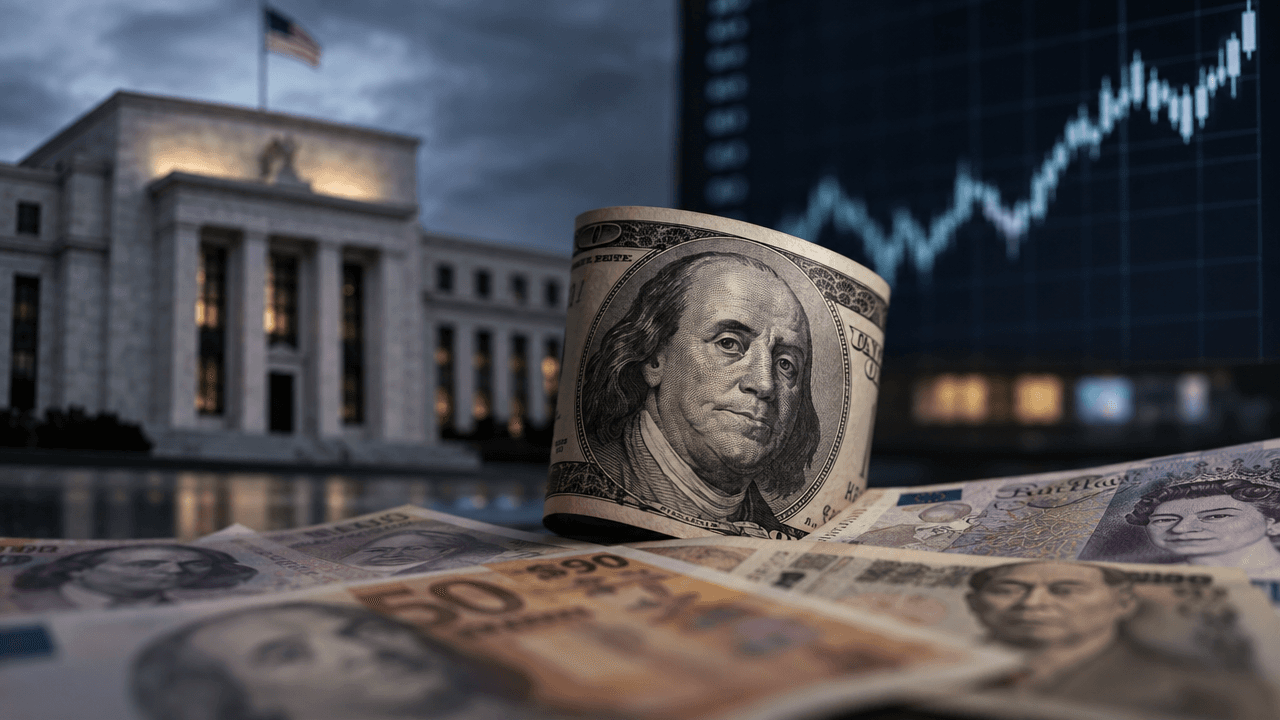
The dollar’s latest surge is a textbook example of how central bank communication can ripple through global markets, lifting U.S. yields and putting broad pressure on major currencies from the euro to the Australian dollar.[1][2][7][13] For traders, the message is clear: the Federal Reserve’s higher-for-longer stance is no longer just a narrative—it is directly shaping FX trends and volatility.[1][2][10][11]
FED’S MESSAGE: RESTRICTIVE FOR LONGER
The minutes from the Federal Reserve’s September meeting showed broad support among policymakers for keeping monetary policy restrictive and potentially raising rates again before year-end.[1][2][10] Most participants judged that another increase in the federal funds rate would likely be appropriate, reinforcing the idea that inflation risks remain elevated despite recent cooling in some data.[2][10][15]
Importantly, the minutes underscored that all FOMC participants backed the September rate hike, signaling a strong consensus around the current tightening trajectory.[1][10] This unified stance matters for markets because it reduces the odds of a sudden dovish pivot and anchors expectations around a prolonged period of higher real rates.[1][10][11] In parallel, hawkish remarks from officials such as Minneapolis Fed President Neel Kashkari—who still sees inflation around 3% and envisions two more hikes in the cycle—have reinforced the restrictive bias.[15]
Higher Yields, Stronger Dollar
As rate expectations have firmed, U.S. Treasury yields have climbed toward multi‑decade highs, particularly at the longer end of the curve.[6][10][11] Higher yields increase the relative attractiveness of dollar-denominated assets, encouraging capital inflows and boosting demand for the greenback.[1][5][11] That dynamic has pushed the dollar index (DXY) to levels around 102–102.5, near its highest readings since early 2025 and flirting with an 18‑month high.[5][10][11]
This yield-driven dollar strength reflects a classic macro relationship: when a major central bank signals sustained restrictive policy, its currency often benefits, especially if other regions face softer growth or more dovish outlooks.[1][5][14] For FX traders, the key is not just the current level of rates, but the expected path—markets are now pricing a meaningful probability of another Fed hike in coming months, even if the next meeting may be a pause.[3][11][14]
G10 Currencies Under Pressure
The euro has been one of the clearest casualties of the latest dollar upswing, slipping as the greenback rallies and as Europe grapples with political and fiscal risks in countries like Spain and France.[1][5][11] EUR/USD has come under renewed pressure, with analysts noting that rising oil prices and a more hawkish Fed have tilted the balance in favor of the dollar.[5][11][14] Sterling has similarly softened, with the dollar rising to recent highs against the pound as U.S. rate expectations outpace those in the UK.[1][13]
In the Asia-Pacific region, the Australian dollar has fallen toward the 0.6950 area against the U.S. dollar, as hawkish Fed minutes boost the greenback and highlight the policy divergence with the Reserve Bank of Australia.[7] The Japanese yen remains weak, trading around the mid‑150s per dollar, reflecting the stark contrast between the Fed’s tightening bias and the Bank of Japan’s still‑ultra‑loose stance.[3][5][11] The result is broad G10 currency pressure, with the dollar outperforming across the board as higher yields and policy divergence dominate FX pricing.[1][5][13]
Trading Implications And Strategies
For traders, the current environment emphasizes the importance of tracking central bank communication as closely as economic data releases. Fed minutes, speeches, and market-implied probabilities for future hikes (such as CME FedWatch readings) now directly inform directional biases in USD pairs.[3][8][11] A hawkish surprise in the language or in rate projections can trigger swift repricing in yields and an immediate reaction in the dollar index.[1][5][10]
In practical terms, several themes stand out. Dollar strength tends to favor trend-following strategies in pairs where the policy divergence is most pronounced, such as EUR/USD, GBP/USD, AUD/USD, and USD/JPY.[1][3][7][13] At the same time, elevated yields can increase volatility, so position sizing and risk management become critical; traders should be prepared for sharp intraday moves around Fed events and major U.S. data.[3][8][10] Finally, carry considerations are back on the table: owning the higher-yielding currency (the dollar) versus lower-yielding counterparts can offer an additional tailwind, provided volatility is contained.[5][6][11]
Using Simulated Finance To Navigate Usd Cycles
In a higher‑for‑longer world, simulated finance platforms like E8 Markets give traders an important sandbox to test how different Fed paths might affect FX performance without putting real capital at risk. Scenario-based practice—such as modeling an extra 25‑basis‑point hike versus an extended pause—helps traders understand how EUR/USD, GBP/USD, and AUD/USD could react under varying yield and volatility assumptions.[1][2][7][11]
By replaying past episodes of dollar strength, including recent moves toward 18‑month highs in the DXY, traders can refine strategies around momentum, mean reversion, and event-driven trading.[1][5][10] Simulated environments also allow experimentation with portfolio hedging, such as using dollar longs to offset risk in other asset classes during periods of tightening financial conditions.[5][6][11] This kind of structured practice is especially valuable in an environment where central bank communication can rapidly shift market narratives.
Outlook And Key Takeaways
Looking ahead, the durability of the dollar rally will hinge on whether incoming U.S. inflation and labor data justify the Fed’s hawkish bias or force a reassessment of the need for additional hikes.[2][8][11] If inflation proves sticky and growth holds up, the case for another rate increase this year stays intact, supporting yields and keeping the dollar well bid against most G10 peers.[2][10][15] Conversely, a sharp slowdown or softer price pressures could prompt markets to price a shorter tightening cycle, potentially easing upward pressure on the greenback.[3][8][11]
For traders, three key takeaways stand out. First, the Fed’s commitment to restrictive policy is the primary driver of current FX dynamics, and its minutes and speeches are essential trading inputs.[1][2][10] Second, yield differentials and policy divergence are pushing the dollar higher against the euro, sterling, the Australian dollar, and the yen, creating both trend opportunities and risk of sharp reversals.[1][5][7][13] Third, using simulated environments to test strategies under different rate scenarios can help traders build robust playbooks for future periods of dollar strength or weakness, improving discipline and decision-making when real markets move.[1][5][11]