
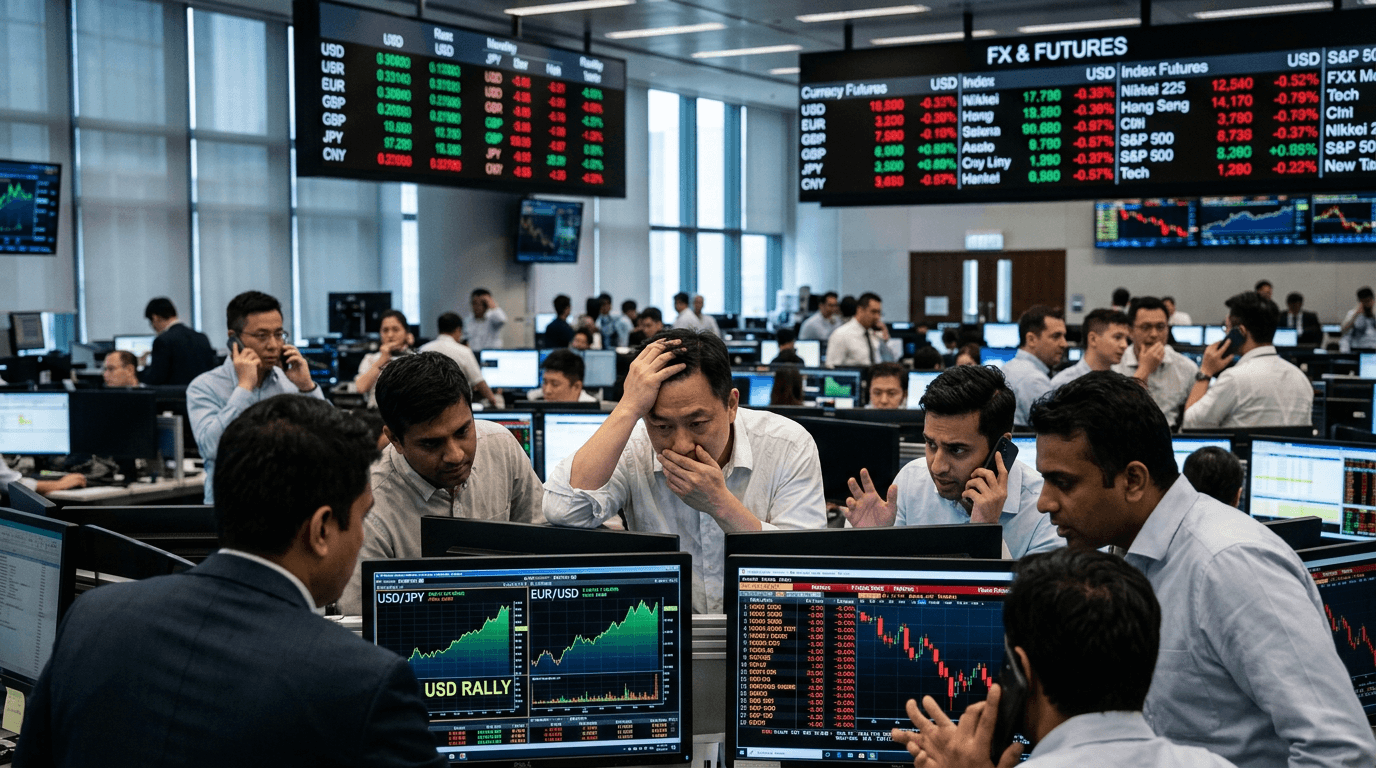
Risk sentiment flipped sharply as the U.S. dollar firmed and Asian equity markets, led by heavyweight tech names, sold off in what traders dubbed a “bloodbath.” A stronger dollar, surging Treasury yields, and a 5–6% slump in key Asian benchmarks in Japan and Taiwan have created a classic risk-off backdrop that is rippling through FX and futures markets.
GLOBAL RISK-OFF: DOLLAR IN THE DRIVER’S SEAT
The dollar is back at the center of global markets, with the U.S. Dollar Index (DXY) pushing to its highest levels in roughly a year as traders ramp up expectations for further Federal Reserve tightening.[6][11] Futures pricing now reflects a rising probability of at least one rate hike later in the year, reinforcing the appeal of the dollar as yields move higher.[6][11]
This move is not happening in isolation. A sharp selloff in global technology shares has reinforced demand for the greenback as a perceived safe haven, echoing prior episodes where stock routs and geopolitical risks pushed investors into the dollar.[6][8] When investors dump equities and reduce leverage, they typically cut exposure to higher-yielding or riskier currencies and rotate into defensive assets like the dollar and short-dated Treasuries.
In practical terms, a rising DXY and higher U.S. yields mean that dollar funding costs are increasing, carry trades become less attractive, and currency pairs tied to global growth and risk appetite—such as AUD/USD, NZD/USD, and many emerging-market FX crosses—are more vulnerable to sharp repricing.
Tech-led Bloodbath In Asia
The eye-catching part of this story is the tech-led slump in Asian markets. Major indices in Japan and Taiwan saw intraday losses of up to 6% as investors rushed to take profits in semiconductor names and other high-beta technology stocks. A correction in the global AI and chip narrative, already visible in recent pressure on AI-related stocks and cryptocurrencies, has spilled over into the broader region.[8]
Tech-heavy markets like Taiwan and segments of Japan’s equity complex are particularly sensitive to shifts in the global growth and rate outlook. When investors start to question lofty earnings expectations, high-duration growth stocks—those whose value depends heavily on future cash flows—are hit hardest. Higher discount rates from rising yields reduce the present value of those future earnings, amplifying downside moves.
Beyond equities, a sharp tech selloff is a signal that risk appetite is evaporating. That pushes traders to reduce margin exposure, trim leveraged positions, and raise cash—often in dollars. The result: equity volatility spikes, credit spreads widen, and funding currencies such as the yen and euro can see erratic price action as carry trades are unwound.
WHY STRONGER U.S. DATA MATTERS FOR CURRENCIES
At the core of the dollar’s resilience is a stream of U.S. data that, while mixed at times, has generally underscored economic resilience and kept inflation above levels consistent with rapid easing.[3][5][10] Better-than-expected figures in areas like services activity, housing, and parts of the labor market have supported the view that the Fed can afford to stay hawkish for longer.[3][5][10]
When data surprises on the upside, bond markets typically respond by pushing Treasury yields higher, as traders demand more compensation for inflation and reprice the future policy path.[5] Higher yields support the dollar via several channels:
- Foreign investors are more likely to buy U.S. bonds for the additional yield, which requires dollar purchases.
- Interest-rate differentials widen in favor of the dollar versus lower-yielding currencies.
- Expectations of further Fed hikes or fewer cuts increase, reducing the appeal of shorting the dollar.
We’ve seen this dynamic repeatedly: episodes where the dollar index rises to multi-month or one-year highs coinciding with renewed expectations of higher U.S. policy rates and stronger local data.[8][9][11] In this environment, any sign of stress in global equities—which we’re now seeing in Asian tech—adds another tailwind to the greenback.
Implications For Fx And Futures Traders
For FX and futures traders, a dollar firming in tandem with a tech-led equity slump is more than a headline—it’s a regime shift signal. Several practical implications stand out:
1. Volatility and correlation changes Risk-off regimes tend to increase cross-asset correlations. Equity indices across regions begin to move together, and risk-sensitive currencies weaken versus the dollar and yen. Volatility rises in index futures, FX pairs, and even commodity-linked contracts as traders scramble to rebalance portfolios.
2. Pressure on carry and growth currencies Currencies tied to global growth or popular carry trades—such as AUD, NZD, certain Asian FX, and EM baskets—often underperform. As rate differentials become less important than risk sentiment, previously steady carry strategies can flip from steady income to rapid mark-to-market losses.
3. Wider intraday ranges and gapping risk Sharp equity moves often translate into wider intraday ranges in FX and index futures, with more frequent gaps on open and around data releases. This has direct implications for intraday strategies, stop-loss placement, and position sizing.
4. Funding and margin dynamics A stronger dollar can tighten financial conditions for non-U.S. participants who borrow in dollars, while falling equity prices reduce collateral values. Futures traders need to be mindful of margin calls, liquidity conditions, and the potential for slippage during periods of stress.
Practical Takeaways For Simulated And Live Traders
Whether trading in a simulated environment or live markets, this kind of episode offers a valuable real-time case study in macro, risk management, and multi-asset behavior.
Key takeaways
- Link the narrative: Connect stronger U.S. data to higher yields, higher yields to a stronger dollar, and a stronger dollar to global risk-off behavior. Understanding this chain improves your ability to anticipate moves rather than simply react.
- Watch the dollar and yields as “anchor” variables: DXY, U.S. 10-year yields, and Fed funds futures often lead broader risk sentiment.[5][8][11] When they move sharply, expect knock-on effects in equities, FX, and commodities.
- Respect regime changes: A tech-led “bloodbath” in Asia alongside a firm dollar suggests a transition from a complacent, risk-on environment toward a defensive posture. Strategies that worked in low-volatility, trend-friendly markets may need to be scaled down, hedged, or temporarily shelved.
- Practice scenario analysis: Simulated trading platforms are ideal for testing how your strategies perform under stress. You can replay similar episodes—such as prior tech routs or dollar surges—and examine how different position sizes, stop placements, and diversification choices would have fared.
- Focus on risk, not just opportunity: Elevated volatility can be attractive, but unmanaged risk is where most traders come undone. In a dollar-driven risk-off phase, tightening risk limits, reducing leverage, and focusing on liquid instruments can help you stay in the game long enough to capitalize on the next phase.
In short, a firm dollar and an Asian tech slump are not isolated events—they are connected expressions of shifting global risk appetite and changing expectations around U.S. policy. For traders, the edge lies in recognizing that connection early, adjusting positioning quickly, and using both live and simulated markets to refine playbooks for the next bout of volatility.