
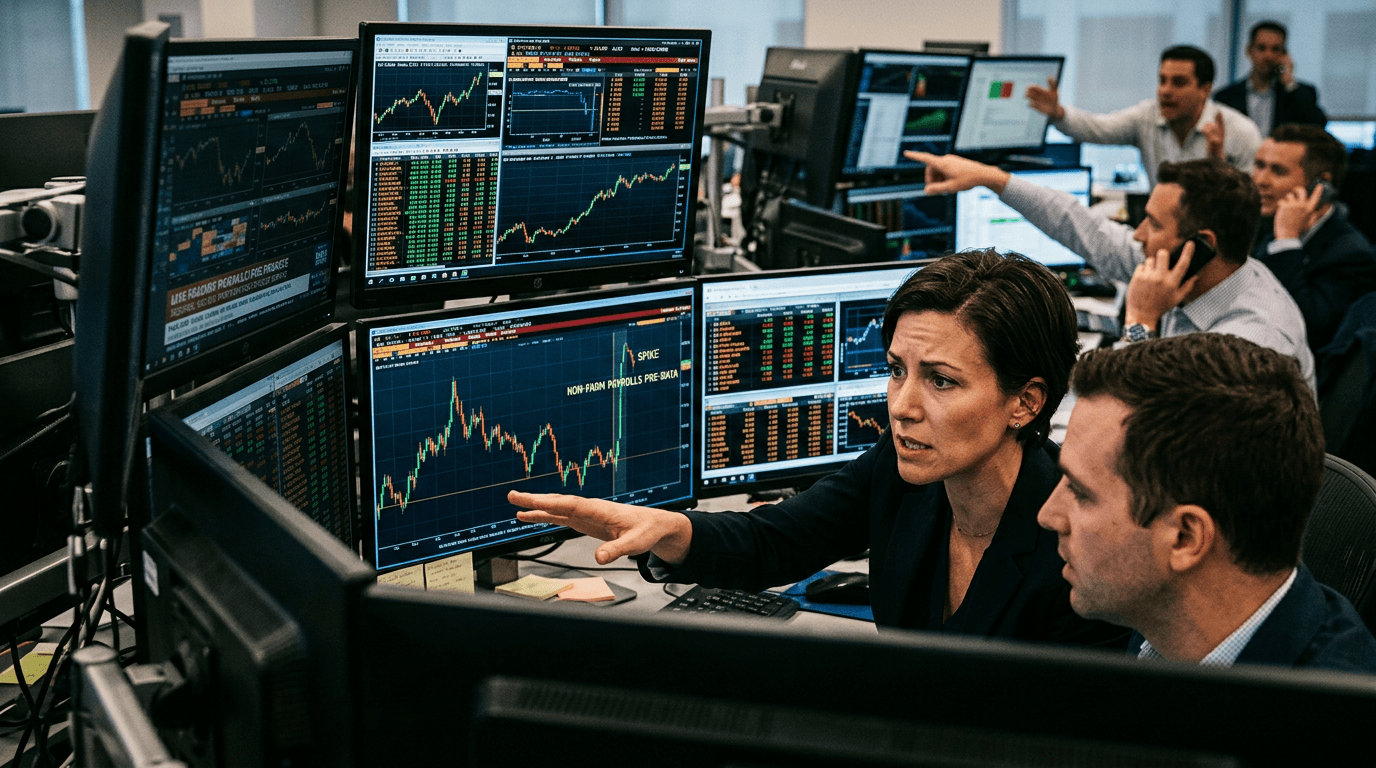
The US dollar’s latest rally has been a textbook example of how expectations, data, and positioning collide in modern FX markets. Heading into the latest U.S. payrolls release, the dollar index briefly broke to a one‑year high as traders doubled down on the idea that the Federal Reserve would need to stay hawkish for longer, only to retreat once softer economic data hit the tape and forced a rethink of that narrative[3][16][13]. For active FX and futures traders, the move highlighted both the opportunity and the risk that come with trading around major macro catalysts.
Market Snapshot: Dollar At A One-year High
The U.S. dollar index (DXY), which tracks the dollar against a basket of major currencies including the euro, yen, and pound, has been grinding higher for months on the back of relatively resilient U.S. growth and interest rate expectations[12][3]. In recent sessions it pushed above the 101 handle, marking its highest level in roughly a year and breaking out of a consolidation zone that had capped dollar bulls for weeks[3][16][13]. That breakout reflected a market leaning heavily toward the view that the Fed would deliver or at least signal additional rate hikes amid sticky inflation and firm labor data.
Data from major index providers show the dollar’s 52‑week high sitting just above 101, underscoring how this latest push took the index to the top of its one‑year range[13][9]. At the same time, the broader nominal U.S. dollar index tracked by the Federal Reserve has remained elevated relative to its 2006 baseline, signaling that the dollar’s strength is not just a DXY story but part of a wider pattern against a broad set of trading partners[10]. Put simply, going into payrolls, the dollar was strong, expectations were hawkish, and positioning was skewed toward further upside.
The Data Surprise: Payrolls And Softer Indicators
When a market is heavily positioned for one scenario, even modest surprises can trigger outsized price moves. That is exactly what unfolded when softer‑than‑expected data began to filter through after the dollar touched its one‑year high. Payrolls and related indicators did not collapse, but they were sufficiently weaker at the margin to challenge the consensus that the Fed had room—or the need—to stay aggressively hawkish.
For FX markets, the key message was not that the U.S. economy had suddenly rolled over, but that the “higher for longer” rate narrative might have been priced too aggressively. As traders digested the softer releases, rate‑hike probabilities were marked down, U.S. yields edged lower, and the dollar gave back some of its gains. This shift illustrates a crucial point for traders: what moves markets is the change in expectations, not just the level of the data. When expectations are one‑sided, even incremental softness can drive meaningful reversals.
Two-way Volatility In Major Fx Pairs
The result was pronounced two‑way volatility in major FX pairs. In the run‑up to the one‑year high, pairs like EUR/USD, GBP/USD, and USD/JPY had largely been trading in a “strong dollar” regime, where rallies in the dollar index tended to press these crosses lower, sometimes in tight, trend‑like fashion. After the data surprise, that dynamic flipped intraday, with short‑dollar covering and profit‑taking driving sharp rebounds in dollar‑bloc crosses.
USD/JPY is a good illustration of this dynamic. As the dollar marched higher, the yen slid toward multi‑year lows, prompting warnings from Japanese authorities about potential intervention and underscoring how divergent monetary policy expectations were between the Fed and the Bank of Japan[3]. Once softer U.S. data challenged the Fed‑hawkish narrative, the move in USD/JPY became less one‑way, with intraday swings reflecting both the unwinding of dollar longs and the possibility that policymakers in Tokyo might step in if depreciation became disorderly. The broader takeaway: FX volatility can shift from trending to choppy very quickly when the macro narrative is questioned.
What It Means For Cme Currency Futures And Simulated Traders
These swings were mirrored in CME currency futures tied to major dollar pairs, where traders expressed views not only on spot FX, but also on the future path of rates and volatility. In the days leading up to payrolls, open interest and volume tended to pick up as participants positioned for a strong print and further dollar strength. Once the softer data emerged, the market rotated into a more balanced stance, with both long liquidation and new short‑dollar positions contributing to two‑way flows.
For traders operating in simulated environments, this episode offers a rich case study. First, it shows how quickly narratives can flip from “breakout and continuation” to “failed breakout and mean reversion.” Second, it highlights the importance of understanding the calendar of economic releases and how they interact with existing positioning. SimFi platforms that mirror CME currency futures allow traders to test strategies around events like payrolls—whether that means trading pre‑data breakouts, fading post‑data overreactions, or using options to structure volatility plays—without capital at risk. The goal is to learn how markets behave when consensus is challenged.
Practical Takeaways For Active Traders
There are several actionable lessons traders can draw from the dollar’s surge to a one‑year high and subsequent retreat:
1. Respect positioning and narrative extremes. When a market narrative (in this case, persistent Fed hawkishness) is widely held and reflected in price, the bar for positive surprise gets higher, while the impact of negative surprise grows. Monitoring sentiment, positioning data, and technical levels such as one‑year highs can help you gauge when the risk‑reward of chasing a move is deteriorating.
2. Anchor trades around catalysts, not just charts. Payrolls and other tier‑one data releases are catalysts that can validate or invalidate existing trends. Trading purely off chart patterns near such events, without considering the macro backdrop, can leave you exposed to abrupt reversals. A more robust approach is to combine technical signals with an understanding of what the market is currently pricing in.
3. Plan for two‑way volatility. Around major data, it is often not enough to be “directionally right”; trade sizing, risk limits, and execution matter. Using simulated environments to stress‑test your strategy through surprise scenarios—softer payrolls after a hawkish build‑up, for example—can reveal where your risk management might need refinement.
4. Treat one‑year highs and lows as information, not destiny. The dollar’s break to a one‑year high signaled strong momentum and conviction, but it did not guarantee continuation. Long‑term levels are useful context, yet they must be interpreted in light of evolving fundamentals. A level is where the market has been; the next move depends on where expectations are going.
As the dust settles, the dollar remains historically strong, but the latest episode is a reminder that the path can be far from linear. For traders in both live and simulated markets, the challenge—and opportunity—is to stay nimble, align with the prevailing macro narrative, and be ready to adjust when the data tell a different story.