
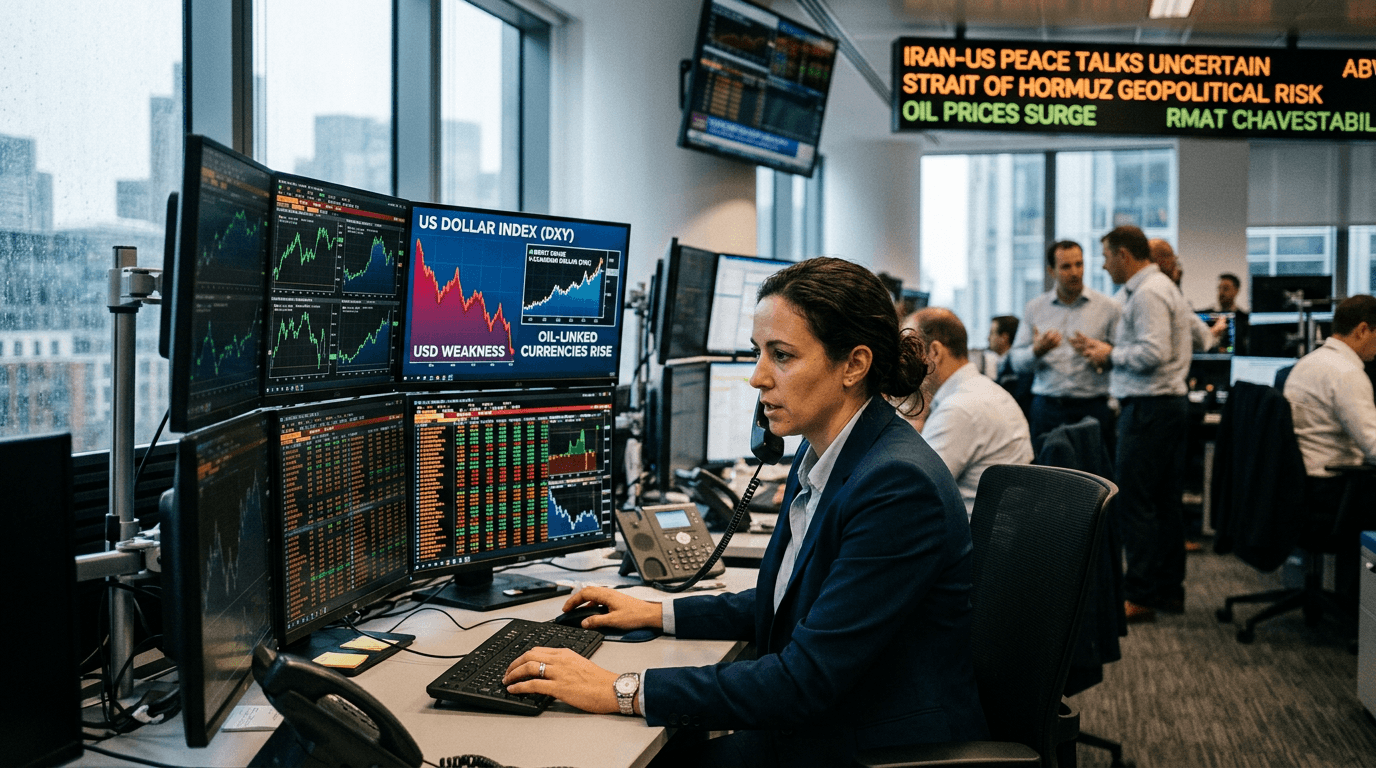
For many FX and commodity traders, the latest shift in the dollar is a textbook example of how geopolitics can quickly reprice risk across global markets. Hopes for de‑escalation between Iran and the United States, and a more stable regime around the Strait of Hormuz, have pushed investors out of the safety of the U.S. dollar and into risk currencies and oil‑linked FX, reshaping major pairs and related futures in the process.[3][8]
Shift In Geopolitical Risk Premia
At the heart of this market move is a changing perception of Middle East risk. After months of confrontation and fears of a broader conflict, Washington and Tehran have moved back toward diplomacy, with indirect talks facilitated by regional mediators in Oman, Switzerland, and Qatar.[1][6][8][11]
These negotiations have produced a preliminary framework: a 60‑day ceasefire, sanctions waivers, and steps toward reopening the Strait of Hormuz to commercial shipping.[3][7][8] As maritime traffic through the strait has increased and oil flows normalize, markets are pricing in a lower probability of worst‑case scenarios—such as prolonged supply disruption or direct military confrontation.[8]
In FX terms, that shift shows up as a compression of geopolitical risk premia. When traders no longer see the same tail‑risk in Middle East oil supply, the extra “insurance” they demand to hold risk assets falls, and safe‑haven currencies lose some of their appeal.
Key takeaway: As geopolitical risk premia compress, expect the dollar and other safe havens to underperform versus cyclicals and commodities‑linked currencies.
HOW DE‑ESCALATION SHAPES FX AND OIL MARKETS
Oil has been central to both the conflict and the market reaction. The Strait of Hormuz is one of the world’s most critical chokepoints for crude and refined products; uncertainty over its closure previously drove an energy shock that lifted gasoline prices and fueled demand for the dollar as a defensive hedge.[3][8]
With diplomacy back on the table and shipping activity in the strait recovering, Brent crude prices have eased back toward pre‑conflict levels.[8] At the same time, the U.S. has temporarily suspended some sanctions, allowing Iran to sell oil and receive payments during the ceasefire period.[7] These developments lower perceived supply risk, but they also increase expected future oil export volumes from Iran, which supports oil‑sensitive currencies.
The mechanics for FX are straightforward
- Less fear about oil supply disruption reduces safe‑haven demand for USD.
- More confidence in stable energy flows supports currencies of oil‑exporting nations.
- Lower volatility and clearer policy signals encourage carry trades and risk‑on positioning in high‑yielding and cyclical FX.
Key takeaway: When energy supply risks ease and sanctions soften, oil‑linked FX typically benefits at the expense of traditional safe havens.
WINNERS: OIL‑LINKED AND RISK CURRENCIES
The clearest beneficiaries of the current narrative are oil‑linked currencies and broader risk FX. While individual moves will vary by country‑specific factors, the general pattern tends to look like this:
- Oil exporters such as Canada and Norway often see their currencies strengthen as the market anticipates more stable demand for their crude and a firmer medium‑term price floor.
- Some emerging‑market producers (for example, in Latin America or the Middle East) can experience both currency support and improved sovereign risk pricing as energy revenues look less uncertain.
- Cyclical “risk” currencies like AUD and NZD, and high‑yielders used in carry trades, benefit from improved global risk appetite once a major geopolitical tail‑risk appears less acute.
On the other side, the U.S. dollar, Japanese yen, and Swiss franc—the classic safe‑haven trio—tend to lose momentum when the urgency to hedge geopolitical shocks fades. De‑escalation hopes reduce demand for dollar‑denominated defensive positions and Middle East risk hedges, which is exactly what we are seeing as traders unwind previous flight‑to‑quality flows.[3][8]
Key takeaway: In de‑escalation phases, look for relative strength in commodity and cyclical FX, and relative weakness in traditional safe‑haven currencies.
What Traders Should Watch Next
For traders, the current move in the dollar is not just about today’s headlines; it is about assessing how durable this de‑escalation path will be. The preliminary agreement between the U.S. and Iran is explicitly time‑bound and partial—many core issues, particularly around Iran’s nuclear program and regional activities, remain unresolved and are deliberately pushed into future rounds of negotiation.[3][6][8]
That means the risk premium has compressed, not disappeared. Shipping through the Strait of Hormuz has increased, but analysts still warn that any breakdown in talks could re‑ignite tensions and reintroduce downside risk for risk FX and upside risk for the dollar and crude.[8][11]
Practical monitoring points for FX and oil traders include:
- Progress on implementation of the ceasefire and sanctions waivers, including inspectors’ access and the release of frozen Iranian assets.[3][7][8]
- Signals from both sides on whether the framework will be extended beyond the initial 60 days.
- Any new incidents affecting shipping or energy infrastructure in the Gulf, which could quickly reverse risk sentiment.
- The reaction function of major central banks, particularly the Federal Reserve, to any inflation effects from lingering energy shocks.
Key takeaway: The current dollar weakness is contingent on diplomacy holding; a setback in talks could rapidly restore demand for safe‑haven FX.
Implications For Simulated Finance Traders
For traders using Simulated Finance (SimFi) platforms like E8 Markets, this episode offers a rich case study in how to translate geopolitical narratives into structured trading strategies. You can use simulated accounts to test:
- Relative value trades: Long oil‑linked FX (e.g., CAD, NOK) versus short USD, to express a view on sustained de‑escalation and stable crude flows.
- Risk‑on versus risk‑off baskets: Buy a basket of risk currencies (AUD, NZD, selected EM FX) against a basket of safe havens (USD, JPY, CHF) to capture broad sentiment swings.
- Event‑risk hedging: Structure scenarios for “deal holds” versus “talks break down,” and practice how you would adjust positions, stops, and position sizing as new information arrives.
Because SimFi environments mirror market mechanics without real capital at risk, they are well suited to learning how geopolitical risk premia feed through into FX prices, futures curves, and cross‑asset correlations. As this Iran–U.S. story evolves, simulated trading allows you to refine your playbook for future episodes of geopolitical stress—whether they involve energy chokepoints, sanctions cycles, or diplomatic breakthroughs.
Key takeaway: Use simulated trading to turn geopolitical headlines into disciplined, back‑tested strategies, rather than reactive decisions.
Ultimately, the dollar’s slip amid Iran–U.S. de‑escalation hopes is a reminder that geopolitics is not just background noise—it is a tradable factor that can reshape FX trends, commodity markets, and risk appetite in a matter of days.[3][8] Traders who understand how risk premia ebb and flow, and who practice their responses in simulated environments, will be better prepared the next time diplomacy—or conflict—drives the world’s reserve currency and its counterparts.