
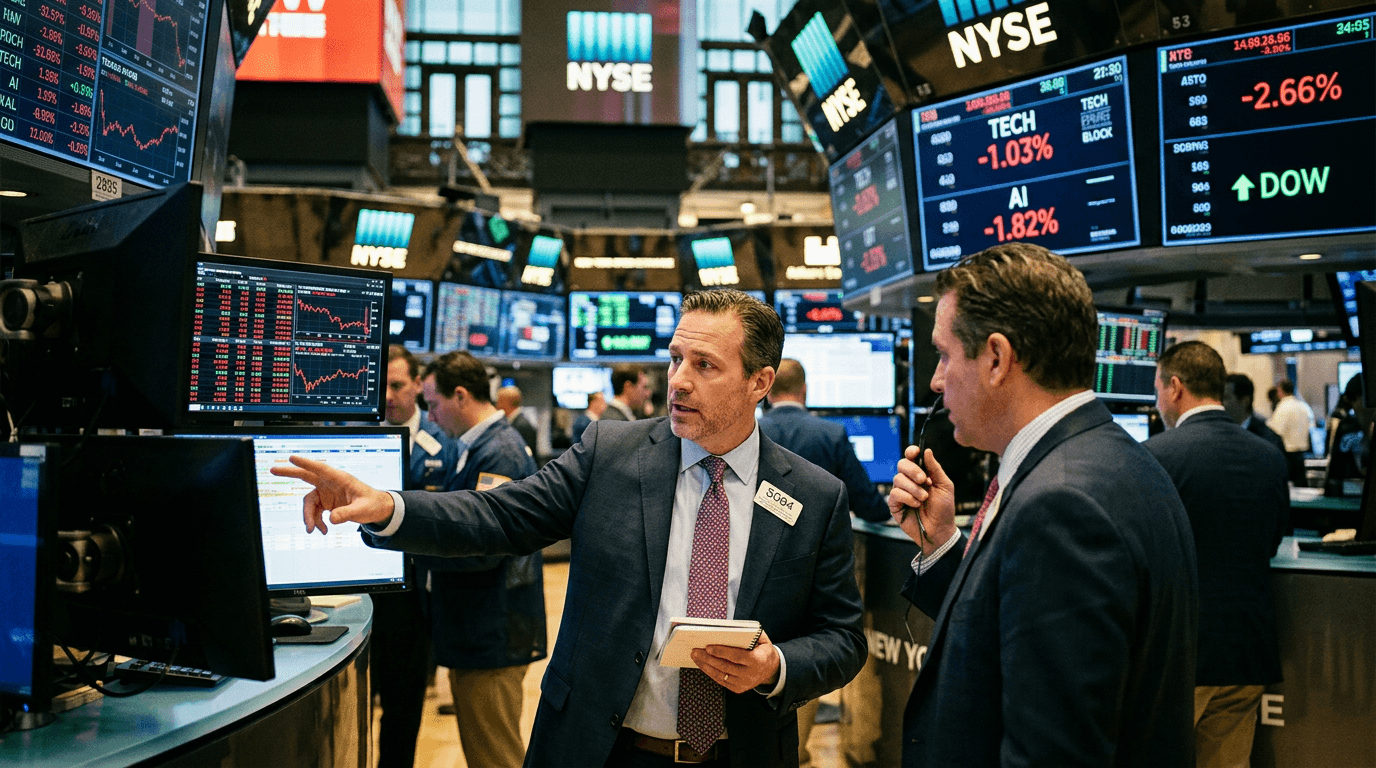
The Dow Jones Industrial Average has surged to fresh record territory, even as many of the tech and AI leaders that powered the last leg of the bull market are stumbling. After first crossing the 50,000 threshold in February 2026[4][7], the index has since pushed on to new closing highs above 53,000[5][8], driven by value, financial, and cyclical names. That strength contrasts sharply with recent weakness in high‑growth technology and AI stocks, highlighting a classic market rotation at a time of higher yields, elevated geopolitical risk, and an important Nasdaq‑100 reshuffle that has introduced SpaceX and added another layer of volatility.
Markets At A Crossroads: Dow Record, Tech Under Pressure
The Dow’s latest push higher underscores how broad the bull market has become, extending beyond the mega‑cap growth stocks that dominated headlines in recent years[5][7]. Historically, the Dow’s major milestones have marked turning points in investor sentiment, and breaching 50,000 in early 2026 reflected confidence in a soft‑landing economic outcome and resilient corporate earnings[5][7].
Yet the current advance is not being led by the usual tech darlings. Instead, investors have been rotating toward more defensive or cash‑generative sectors—such as industrials, financials, and consumer staples—as higher bond yields raise the bar for long‑duration growth assets whose cash flows lie far in the future. At the same time, geopolitical tensions and policy uncertainty are encouraging investors to seek perceived “quality” and value, rather than paying peak multiples for AI‑linked stories whose earnings trajectories may be volatile.
This divergence between the Dow and the more tech‑heavy indices is an important signal: markets are still bullish overall, but leadership is changing. Understanding that shift is critical for traders and investors who have been concentrated in a narrow set of AI and tech names.
What Sector Rotation Really Means
Sector rotation is the process by which market leadership moves from one group of stocks to another as macro conditions, valuations, and sentiment evolve. In recent years, mega‑cap technology and AI‑linked companies disproportionately drove index gains, particularly in the Nasdaq and growth‑tilted benchmarks. As their valuations stretched and rates rose, the market began re‑pricing risk and reward.
In an environment of higher yields, investors can earn more from relatively safe fixed income, so they demand a higher expected return from equities. That tends to hurt long‑duration assets—companies whose cash flows are expected far in the future—such as early‑stage AI platforms, speculative software, and some unprofitable tech names. Value and cyclical stocks, by contrast, often trade on lower multiples and are more sensitive to near‑term economic activity, making them relatively more attractive when growth remains solid but rates are less supportive of speculative stories.
Rotation does not necessarily mean the end of the AI or tech narrative. Instead, it often reflects a recalibration: investors distinguish between companies with proven, monetizable AI business models and those priced purely on future promise. For traders, that creates dispersion—winners and losers within the same theme—which can be a source of opportunity.
INSIDE THE NASDAQ‑100 RESHUFFLE AND THE SPACEX EFFECT
Against this backdrop, the Nasdaq‑100 reshuffle is adding another dynamic layer to price action. Index reconstitutions matter because they force passive vehicles—index funds and ETFs tracking the benchmark—to buy additions and sell deletions, generating meaningful flows around the effective date. A high‑profile inclusion like SpaceX amplifies that effect, given the size and visibility of the company in the broader AI, space, and innovation narrative.
The initial share dip following SpaceX’s inclusion is a reminder that headline‑driven events can produce counter‑intuitive moves. In practice, index changes can:
Create short‑term volatility as traders front‑run or react to passive flows.
Impact sector weights, changing how much technology, industrials, or communications exposure investors get from a single benchmark.
Alter correlations between stocks, as newly added names move more in sync with the index and with each other.
For AI‑linked and tech stocks, the reshuffle may mean some names lose benchmark representation or weight, reducing automatic demand from index investors. That can exacerbate any existing selling pressure from the broader rotation away from high‑multiple growth.
What This Means For Traders And Investors
For market participants, this combination of a record‑high Dow, wobbling tech, and an active index reshuffle delivers several practical lessons.
First, leadership changes, but the trend can remain up. The fact that the Dow is setting new highs while some previous winners correct suggests this is more about rebalancing risk than abandoning equities outright. Traders should therefore focus not only on index levels, but on which sectors and styles are driving those levels.
Second, concentration risk is real. Portfolios heavily skewed to a narrow group of AI and tech names are more vulnerable when the market rotates. Diversification across sectors—industrial, financial, healthcare, and selective consumer names—can help smooth portfolio volatility when leadership shifts.
Third, index events are tradeable moments. The Nasdaq‑100 reshuffle offers both risk and opportunity. Short‑term traders may look for dislocations around inclusion and deletion flows, while longer‑term investors can use volatility to accumulate high‑quality names at better prices, provided their fundamental thesis remains intact.
Finally, macro still matters. Higher yields, geopolitical uncertainty, and evolving regulation around AI and technology are shaping the risk premium investors assign to different themes. Staying tuned into the macro narrative is as important as analyzing individual companies.
How Simulated Finance Can Help You Navigate Rotation
Periods of rotation and index reshuffles are excellent times to practice and refine strategy in a risk‑controlled environment. Simulated finance platforms allow traders to:
Test sector rotation strategies, such as shifting from tech and AI into industrials, financials, or value baskets, without putting real capital at risk.
Experiment with event‑driven trades around index changes, modeling how inclusion or deletion might affect liquidity, volatility, and spreads.
Evaluate portfolio concentration versus diversification, measuring how different sector mixes would have performed as the Dow broke through key psychological milestones and leadership changed.
Because simulated markets mirror live conditions—price action, volatility, and cross‑asset relationships—participants can build muscle memory for managing rotations before deploying capital in live markets. That can be especially valuable when narratives shift quickly, as they are today, from “AI at any price” to “quality AI and resilient cash flows.”
In the current environment, the message is clear: the bull market is alive, but it is evolving. The Dow’s record highs show that investors still believe in the underlying economic and earnings backdrop, yet the underperformance of some tech and AI names, coupled with the Nasdaq‑100 reshuffle, signals that the market is repricing where it wants to take risk. Traders who embrace that nuance—by respecting sector rotation, understanding index mechanics, and practicing their approach in simulated environments—will be better positioned to navigate the next chapter of this cycle.