
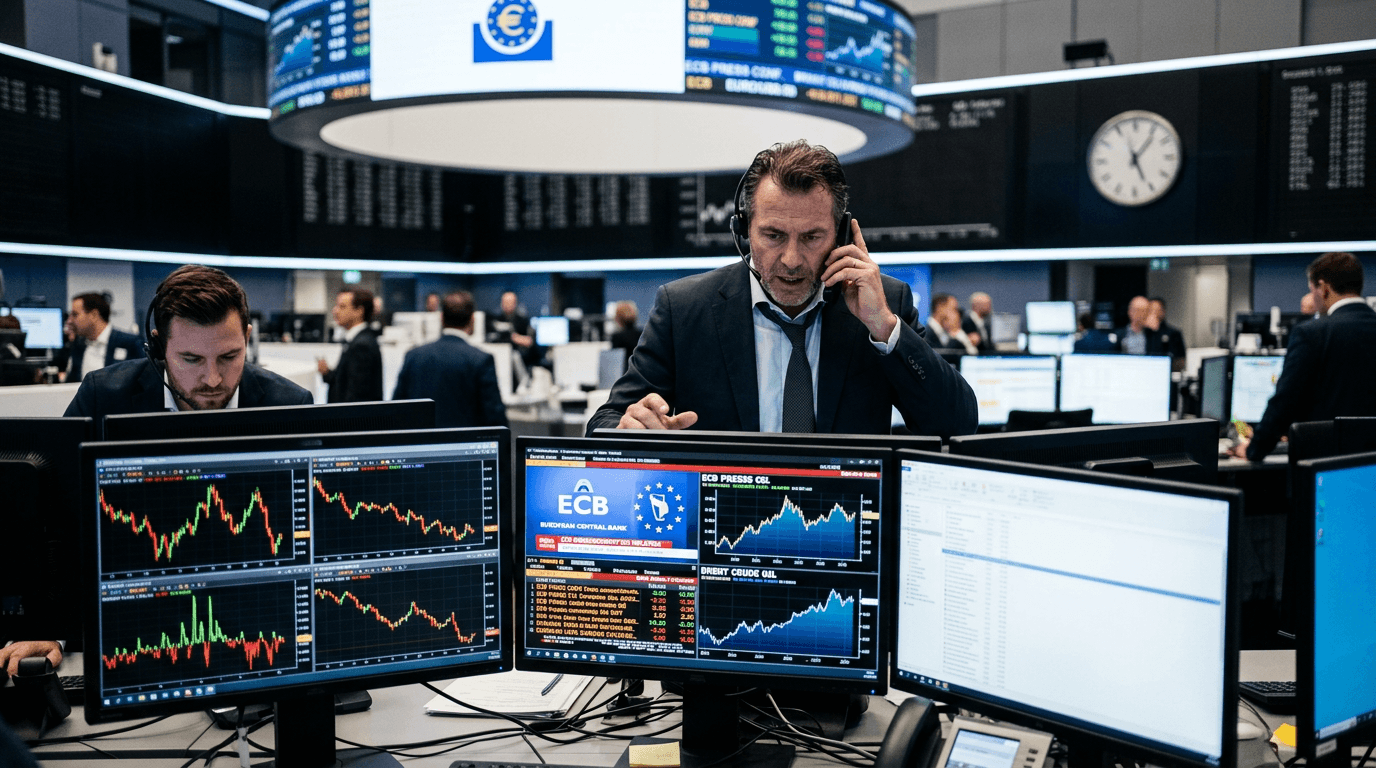
The European Central Bank has chosen to leave interest rates unchanged, but the message to markets is anything but neutral: policymakers are signalling that further hikes remain firmly on the table as the Middle East energy shock raises fresh inflation risks for the euro area.[3][4][5] For traders, this is a classic “hold, but hawkish” meeting – one that can shift currencies, rates and futures pricing even without an actual move in the policy rate.
Ecb Holds Rates But Turns More Hawkish
At its latest meeting, the ECB kept its key rates around just above 2%, maintaining the benchmark deposit facility at roughly the level set in mid-2025.[4][5] This mirrors a broader pattern among major central banks: the Federal Reserve, Bank of England and Bank of Japan also opted to hold, choosing to reassess the impact of the oil shock rather than react immediately with aggressive tightening.[3]
What has changed is the tone. The ECB has warned that the Iran-related conflict and wider Middle East tensions have created “significantly more uncertainty,” with upside risks to inflation and downside risks to growth.[5][8] President Christine Lagarde dropped the usual language that rates are in a “good place” and stressed that the Governing Council is “laser-focused” on the economic fallout from the war.[8] Instead of pre-committing to a steady path, officials have emphasised data dependence and retained the option to tighten further if the shock intensifies.
This message has been reinforced by national central bank governors. Latvian central bank chief Martins Kazāks noted that the ECB’s baseline scenario for the Middle East shock already incorporates two interest rate increases, and that the current situation sits somewhere between this baseline and a more adverse case.[9] In other words, the ECB has not yet triggered its full tightening response – but it has mapped out a path in which additional hikes become likely if energy-driven inflation proves persistent.
Energy Shock: Why The Middle East Matters
The catalyst for this shift in tone is the renewed surge in energy prices. The war in the Middle East, focused on Iran and the surrounding region, has raised the risk of disruptions to oil supply routes and pushed benchmark prices sharply higher.[4][8][13] Brent crude has traded above $85 per barrel at times, and ECB staff projections assume average quarterly oil prices around $90 per barrel in the near term – levels well above pre-conflict norms.[4][9][13]
Higher energy costs tend to lift headline inflation quickly, filtering through to transport, heating and production costs across the euro area.[4][5] The ECB has cautioned that the conflict “could lead to a short-term increase in inflation due to rising energy costs,” even as the longer-term impact on consumer prices and growth remains unclear.[5] That uncertainty is critical: if the shock proves short-lived, inflation could fall back towards target without the need for much tighter policy; if it persists, inflation expectations could drift higher and require a stronger response.
So far, the ECB judges that longer-term inflation expectations remain “well anchored” near its 2% target.[5] Its projections see inflation rising to about 2.6% this year before gradually returning towards 2% in 2027, based on a baseline in which energy prices eventually stabilise.[9] But policymakers are explicit that risks are skewed to the upside on inflation and to the downside on growth.[5][8] That asymmetry is what keeps rate hikes on the table: the cost of doing too little against a renewed inflation spiral is perceived as higher than the cost of tightening slightly more in an already fragile economy.
Market Reaction: Euro, Eur Crosses And Rates
Even without an immediate rate move, a more hawkish ECB can shift market pricing across asset classes. Interest rate swaps and futures have increased the probability of additional 25-basis-point hikes later this year, with some estimates pointing to markets pricing in around two such moves by next spring.[12][13] Expectations for the terminal rate – the peak level of the ECB’s tightening cycle – have nudged higher as traders reassess the energy shock’s persistence.
This repricing feeds directly into the euro and EUR crosses. In FX markets, a central bank that is perceived as willing to tighten further in response to inflation tends to support its currency relative to peers whose reaction functions are more dovish. Combined with the broader “higher-for-longer” rates narrative, the ECB’s stance provides a fundamental backdrop for a firmer euro against currencies where the central bank is closer to cutting.
European equities, by contrast, face a more complicated environment. Higher discount rates and lingering growth concerns are weighing on risk assets, particularly in rate-sensitive sectors.[4][8] Eurozone bond markets are also adjusting: yields on shorter maturities are more tightly linked to policy expectations and can move as traders price in earlier or larger hikes, while longer maturities reflect the tug-of-war between higher inflation risks and weaker growth prospects.
What Traders Should Watch Next
For macro and FX traders, the key question is not whether the ECB has moved today, but what will force its hand at upcoming meetings. Several indicators deserve close attention:
- Energy prices: Sustained oil and gas price increases, especially beyond current projections, would strengthen the case for rate hikes.[4][9][13]
- Inflation data: Headline inflation will react quickly to energy, but core inflation and measures of inflation expectations are critical for judging whether the shock is embedding itself more broadly.[5][8]
- Growth and labour markets: Signs of a sharp slowdown in activity or employment could restrain the ECB from tightening even if inflation is elevated, reviving the dilemma between price stability and supporting the economy.[5][8]
- ECB communication: Changes in forward guidance, language around risks, and comments from Governing Council members can signal shifts in the balance of opinion before decisions are made.[8][9]
The ECB itself has indicated that if energy prices drop back in the coming months as assumed in its baseline, it is likely to leave rates unchanged over the rest of the year.[4] However, analysts note that if energy prices keep rising, the balance of opinion could shift quickly towards “getting on the front foot” with a hike as soon as the next meeting or the one after.[8][12][13] That path dependency makes incoming data and market reaction critical to watch in real time.
Practical Takeaways For Simulated Traders
For traders using simulated finance platforms, this environment is an ideal laboratory for stress-testing strategies. You can model scenarios in which the ECB:
- Holds rates but maintains a hawkish bias, supporting the euro and steepening short-end curves.
- Delivers one or two pre-emptive hikes in response to persistent energy inflation, weighing on European equities and credit.
- Faces a downside growth surprise that forces a more cautious stance, potentially flattening curves and tempering euro strength.
Practical exercises might include trading EUR crosses around ECB meetings, building relative-value positions between European and US rates, or testing how your portfolio reacts to parallel and non-parallel shifts in the yield curve driven by changing hike expectations. You can also explore the correlation between oil prices, European inflation surprises and moves in Bund and BTP futures to refine your macro playbook.
Crucially, simulated environments allow you to practice risk management under macro uncertainty: setting clear invalidation levels when ECB rhetoric shifts, adjusting position sizes around key data releases, and avoiding overconfidence in any single path for energy prices or policy. The ECB’s current stance – cautious in action but firm in its inflation-fighting message – is exactly the kind of regime where scenario thinking and disciplined execution matter most.
By treating this “hold, but hawkish” decision as the start of a new phase in Europe’s monetary narrative rather than a non-event, traders can better prepare for the volatility that may arise as the Middle East energy shock evolves. The path of rates, the euro and European assets will be shaped less by what the ECB did today than by how convincingly it can navigate the balance between inflation control and economic resilience in the months ahead.