
ECB's Critical Decision: Rates Held Steady Amid Rising Inflation Pressures
On March 19, 2026, the European Central Bank (ECB) opted to keep interest rates unchanged, marking a pivotal moment for eurozone monetary policy. Despite the stability implied by holding the deposit rate at 2% and the main refinancing rate at 2.15%, the ECB's updated economic projections and assertive messaging present a more nuanced narrative, with significant implications for traders and investors in the forex and futures markets.
The unanimous decision reveals the ECB's delicate balancing act in an unpredictable environment. Rates remained steady as inflation hovered near the 2% target over the past year, with long-term expectations well-anchored. This stability, coupled with resilient economic activity in recent quarters, supported maintaining the current monetary policy. Nonetheless, future projections indicate a different outlook.
Inflation Upsurge and Forecast Adjustments
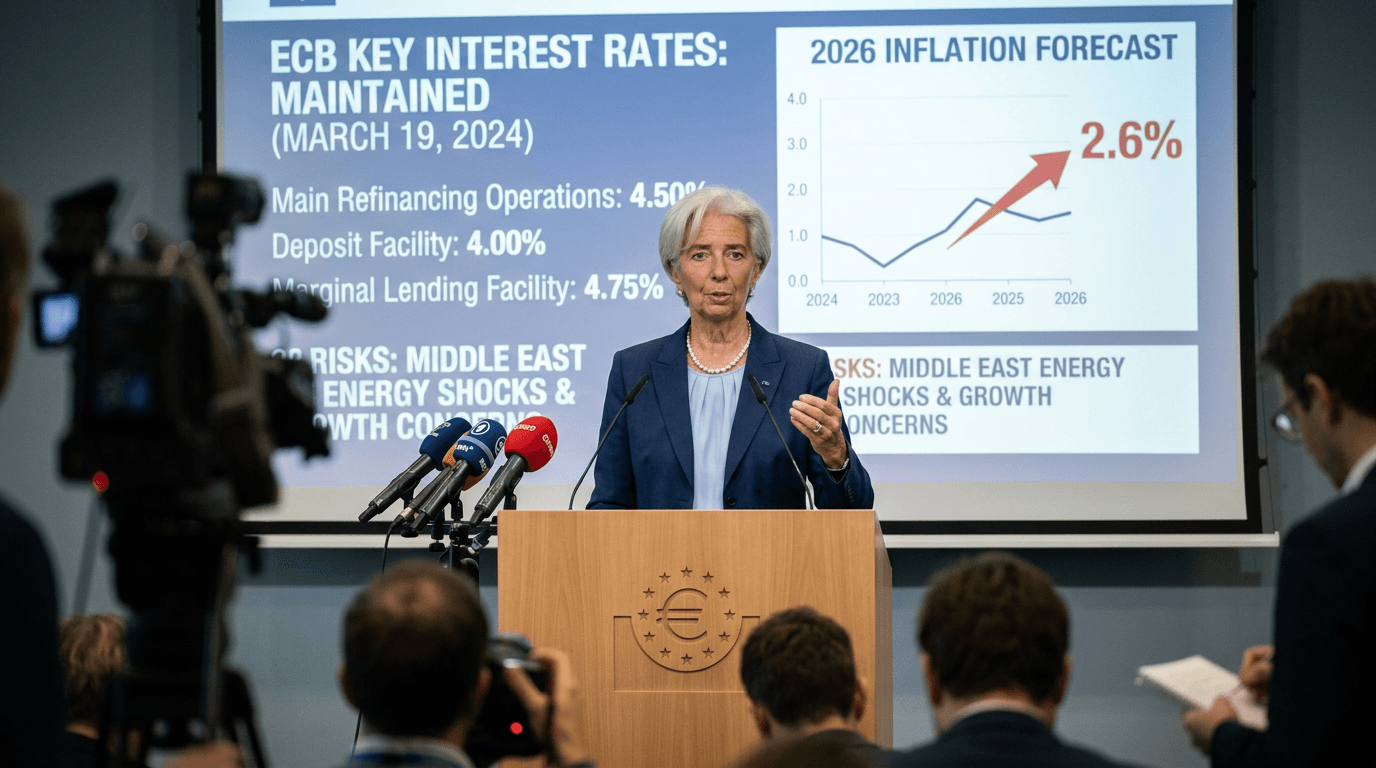
The most notable aspect of the March decision is the upward revision of inflation forecasts, particularly for 2026. The ECB now anticipates headline inflation to average 2.6% in 2026, an increase from December's projections. For 2027 and 2028, inflation is forecasted at 2.0% and 2.1%, respectively. This adjustment is primarily driven by surging energy prices due to escalating Middle East tensions.
Core inflation, excluding energy and food, is projected at 2.3% for 2026, surpassing previous expectations. This detail is crucial for traders as it implies that elevated energy costs are permeating the broader economy, signaling reduced pricing power for consumers and businesses.
The ECB highlighted that energy prices are expected to significantly impact near-term inflation. The medium-term effects will hinge on the Middle East conflict's intensity and duration, alongside how these elevated energy costs influence consumer prices and economic activity. This uncertainty underpins the ECB's decision to adopt a data-dependent, meeting-by-meeting approach instead of committing to a specific rate path.
Growth Concerns and Rate Hike Speculation
Despite inflation concerns, the ECB's growth projections temper expectations for immediate rate hikes. Economic growth is now projected to average just 0.9% in 2026, a notable downgrade from December forecasts. For 2027 and 2028, growth is expected at 1.3% and 1.4%.
This downward revision reflects the global impacts of the Middle East conflict on commodity markets, real incomes, and confidence levels. The ECB acknowledges that the war poses downside risks to growth while simultaneously elevating inflation risks. For traders, this presents a classic stagflationary scenario—slower growth coupled with rising prices—complicating the central bank's policy response.
Offsetting these challenges are structural supports such as low unemployment, solid private sector balance sheets, and robust public spending on defense and infrastructure. While these factors provide some resilience, they may not fully counter the combined drag of higher energy costs and geopolitical uncertainty.
A Hawkish Stance Despite Steady Rates
Although rates remain unchanged, the ECB's messaging is decidedly hawkish. The decision to hold rates signals a commitment to defending the inflation target and confidence in the current policy stance. The ECB's focus on being "well-positioned to navigate this uncertainty" and maintaining a data-driven approach indicates limited need for premature policy easing.
This hawkish positioning has already bolstered the Euro in foreign exchange markets, as investors recognize the ECB's commitment to maintaining elevated rates compared to other major central banks grappling with similar growth concerns. For futures and forex traders, this dynamic significantly affects the performance of euro-denominated assets and currency pairs involving the EUR.
Key Insights for Traders and Investors
Firstly, the combination of rising inflation projections and slowing growth suggests the ECB is walking a tightrope, with future policy hinging entirely on data. Secondly, energy price dynamics are now the critical factor influencing ECB decisions in the medium term. Thirdly, traders should closely monitor data on energy costs, wage pressures, and consumer confidence, as these will determine whether the ECB needs to tighten further or pivot toward easing.
Fourthly, the hawkish hold indicates that expectations for rate cuts should be moderated, at least in the short term. Markets anticipating potential rate cuts later in 2026 should adjust accordingly. Finally, the upward inflation revision combined with unchanged rates presents attractive opportunities for traders focusing on inflation expectations and eurozone financial assets.
The ECB's March decision underscores that central banking in a geopolitically volatile environment requires flexibility, clear communication, and careful calibration of competing risks.
NEWS IMPACT SCORE: 8