
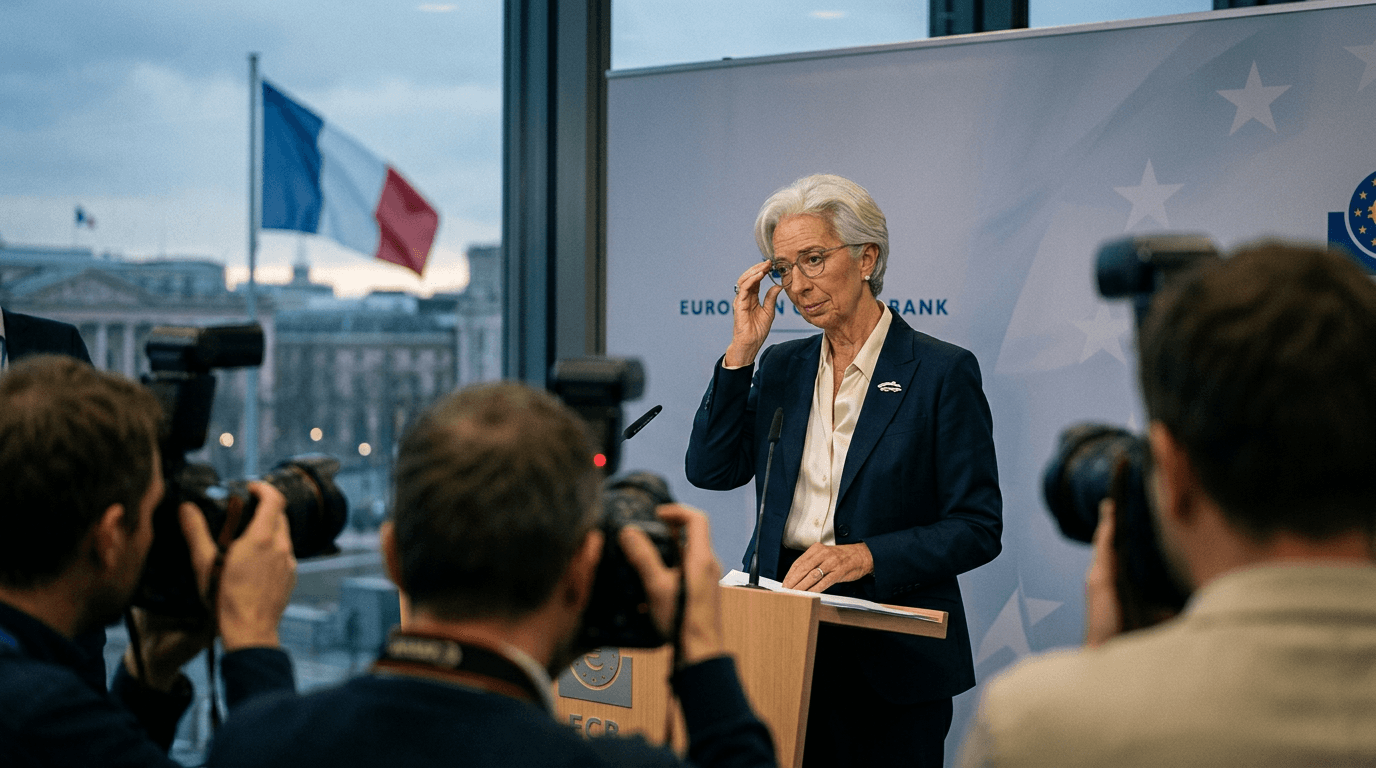
European Central Bank President Christine Lagarde is preparing for an early departure from her leadership role, potentially exiting before her eight-year term concludes in October 2027.[1][2] Recent reports from the Financial Times and Bloomberg have sparked significant speculation about the timing and implications of her departure, particularly given the political landscape in Europe. While the ECB has maintained that Lagarde remains "totally focused on her mission," the carefully worded official response notably stops short of explicitly denying the reports, leaving room for interpretation about what may lie ahead.[2][3]
The Political Timeline And Strategic Reasoning
Lagarde's potential early exit appears intricately tied to France's presidential election scheduled for spring 2027.[1][2] According to sources familiar with her thinking, stepping down before this election would allow current French President Emmanuel Macron and German Chancellor Friedrich Merz to jointly select her replacement, rather than risking that choice falling to a new French government.[2] This strategic timing reflects growing concerns across European institutions about the possibility of a far-right Rassemblement National victory in the French elections, which would fundamentally reshape the eurozone's political landscape.[2]
The coordination between France and Germany in selecting Lagarde's successor underscores a broader pattern among EU member states to advance key institutional decisions before potential political shifts occur.[2] This pre-emptive approach extends beyond the ECB; sources indicate that multiple member states are accelerating discussions on the EU's 2028-2034 budget framework to conclude negotiations while Macron remains in power.[2] Understanding this political context is essential for traders seeking to anticipate policy shifts and institutional changes that could affect market stability and currency valuations.
The Institutional Independence Question
Perhaps the most significant concern surrounding Lagarde's potential departure is the broader question of central bank independence.[1] When a central bank president's exit timing becomes intertwined with electoral cycles and political considerations, it raises legitimate questions about whether monetary policy decisions might be influenced by political rather than purely economic factors. This concern becomes particularly acute in the eurozone, where the ECB's independence from national governments is foundational to its credibility and effectiveness.[1]
The Bloomberg Television commentary highlighted this tension, noting that "institutions and governments may be looking to shore up that institutional independence" even as electoral changes loom in France and elsewhere.[1] The paradox is striking: coordinating Lagarde's replacement before elections could be seen as either protecting ECB independence from a potentially less favorable government, or as allowing current political leaders to consolidate influence before losing power. This ambiguity itself creates uncertainty that markets typically penalize.
The Succession Race: Key Candidates And Implications
Several candidates are widely expected to succeed Lagarde, each bringing different perspectives and political considerations to the role.[2] The leading contenders include two German officials—Isabel Schnabel, who serves on the ECB's executive board, and Joachim Nagel, president of the Bundesbank. However, German candidates face a challenge: Ursula von der Leyen currently serves as president of the European Commission, raising concerns about concentrating too much power in German hands within European institutions.[2]
Two other strong candidates are Klaas Knot, the long-serving and highly respected governor of the Dutch central bank, and Pablo Hernandez de Cos, former governor of the Spanish central bank.[2] Each candidate represents different monetary policy philosophies and approaches to inflation management, which could meaningfully affect ECB policy direction during a period of economic uncertainty. Notably, sources indicate it would be "difficult to imagine another French national succeeding Lagarde," suggesting that France's political influence over the ECB's leadership may temporarily diminish.[2]
For traders and investors, understanding these candidates' policy positions and track records becomes critical. Different successor profiles could lead to divergent approaches to interest rates, quantitative easing, and regulatory policy, ultimately affecting currency markets, bond yields, and equity valuations across the eurozone.
Market Implications And The Euro
The prospect of political influence over ECB leadership selection naturally raises questions about the euro's future trajectory and broader financial stability.[1] While sovereign debt markets have remained largely unmoved by initial reports, the speculation itself introduces a layer of uncertainty that could become destabilizing as the situation develops.[1] Currency traders have particularly focused on how this leadership transition might affect ECB policy consistency and the euro's positioning in global markets.
What Traders Should Monitor
As this situation evolves, market participants should watch several key developments. First, any official announcement from Lagarde about her departure timing would immediately impact FX markets and fixed income instruments. Second, the evolution of French political polling—particularly regarding Rassemblement National's electoral prospects—will likely influence market sentiment and European asset valuations. Third, any statements from potential successor candidates about monetary policy priorities should be carefully analyzed for implications regarding future rate decisions and inflation management.
The intersection of institutional leadership, political cycles, and central bank independence represents a crucial dynamic shaping European financial markets. While the ECB has maintained its official stance that Lagarde remains committed to her mission, the broader institutional and political context suggests significant transitions may be approaching.[2] Understanding these dynamics provides essential context for navigating the coming volatility in FX markets and European financial assets.