
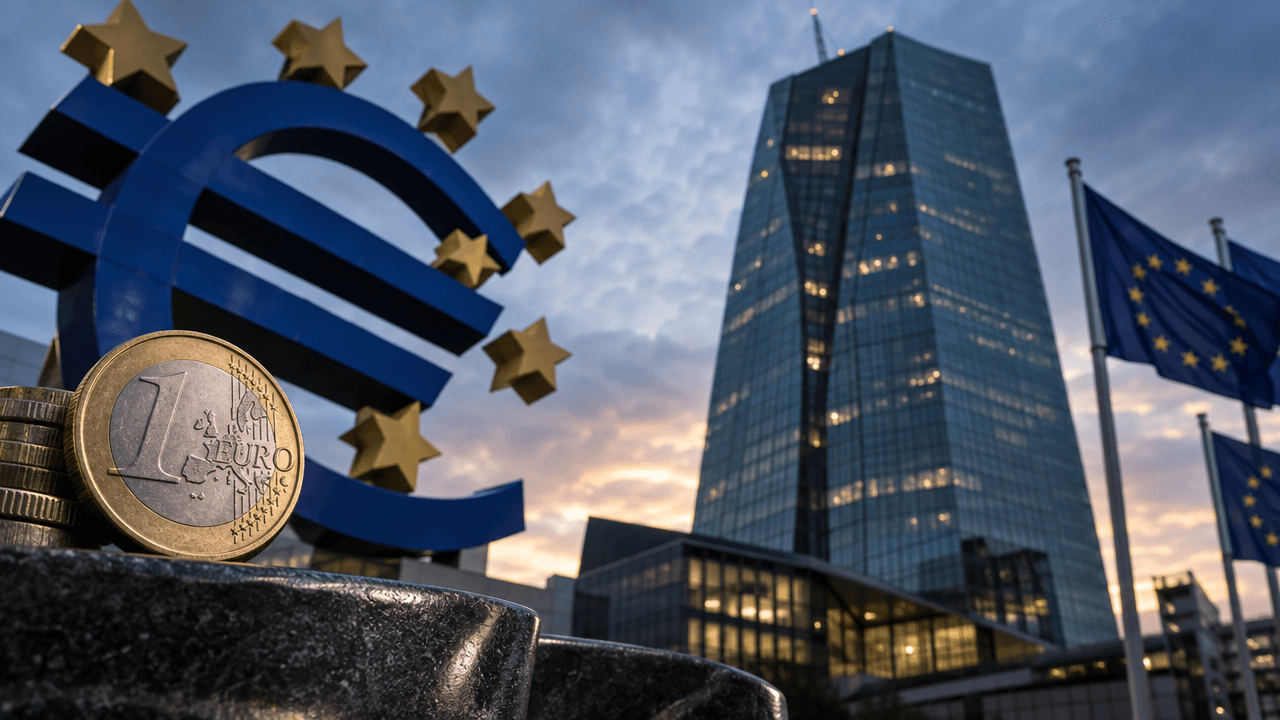
The European Central Bank is sending a deliberately cautious message: a December rate hike is increasingly possible, but it may be followed by an extended pause. That combination creates a complicated policy signal for traders. The ECB appears ready to respond to persistent inflation, particularly energy-related price pressures, while also recognizing that higher borrowing costs and bond yields could weaken economic growth.
For financial markets, the uncertainty may matter as much as the decision itself. Traders are not only asking whether the ECB will raise rates in December. They are also assessing how strongly policymakers will signal future moves, how long restrictive policy might remain in place, and whether economic data will force the central bank to change course.
The Case For A December Hike
The ECB held its key deposit rate at 2.5% in its latest meeting, but the decision was not necessarily a sign that tightening is finished. Several policymakers have publicly indicated that another move may be needed, and reports citing ECB sources suggest that a 25-basis-point increase in December is widely expected. Such a move would take the deposit rate to 2.75%. [1][4]
The principal concern is inflation. Energy costs have risen sharply, creating the risk that higher input prices could spread through transportation, manufacturing, food, and services. Even if the initial shock is temporary, policymakers must consider whether businesses and workers begin adjusting prices and wages in anticipation of prolonged inflation.
Bundesbank President Joachim Nagel has described a December hike as very likely necessary, adding to the growing support for action within the Governing Council. [7] A rate increase would demonstrate that the ECB remains committed to bringing inflation back toward its 2% target rather than allowing an energy shock to become embedded in broader price expectations.
However, a hike is not guaranteed. ECB President Christine Lagarde has emphasized that officials can wait for additional information before deciding. She said incoming indicators between the November and December meetings would help determine whether an increase is warranted. [1][5]
Why A Pause Could Follow
The expected December move appears less like the beginning of an aggressive tightening cycle and more like a final adjustment before policymakers assess the consequences. Rising bond yields have already tightened financial conditions beyond the ECB’s official policy rate.
Higher yields increase financing costs for governments, companies, and households. Mortgage payments can rise, corporate investment may slow, and consumers may reduce discretionary spending. These effects can cool demand and eventually reduce inflation without the ECB needing to raise rates repeatedly.
Reports indicate that internal ECB estimates show the recent increase in bond yields could lower cumulative economic growth by approximately 100 basis points and reduce inflation by around 90 basis points across 2027 and 2028 relative to earlier projections. [4] If those estimates are accurate, the bond market is already doing part of the ECB’s work.
That helps explain the potential sequence: raise rates once more to address inflation risks, then pause to observe how higher borrowing costs affect the economy. A pause would not necessarily mean that the ECB considers inflation problem solved. Instead, it would give policymakers time to evaluate delayed monetary-policy effects.
WHAT IT MEANS FOR EUR/USD
The diverging policy outlook is likely to remain a major source of EUR/USD volatility. Currency prices respond not only to interest-rate decisions, but also to the difference between expected policy paths in Europe and the United States.
A December hike could initially support the euro by making euro-denominated assets more attractive. If traders believe the ECB will continue raising rates while the Federal Reserve is easing or preparing to ease, the euro could receive additional support.
The reaction could be more limited if the ECB pairs a hike with a clear signal that further increases are unlikely. In that scenario, the market may interpret the move as a final step rather than the start of a prolonged tightening cycle. The euro could also weaken if traders focus on the economic damage caused by higher yields or conclude that European growth is deteriorating.
For EUR/USD traders, the key issue is therefore not simply “hike or no hike.” The more important questions are whether the decision is fully priced in, what Lagarde says about future meetings, and how incoming inflation and growth data alter expectations.
Practical Trading Takeaways
First, distinguish between the expected decision and the surprise. If markets already anticipate a 25-basis-point hike, the announcement itself may produce a relatively small move. The larger reaction could come from the ECB’s guidance about what happens afterward.
Second, monitor energy prices and inflation data. A renewed increase in energy costs could strengthen the case for additional tightening, while a sharp decline could make a December hike less urgent. Lagarde has specifically pointed to incoming indicators as important to the decision. [1]
Third, watch euro-area bond yields. A continued rise in yields may tighten financial conditions and increase the likelihood of a pause. Conversely, a rapid decline in yields could ease conditions and potentially encourage the ECB to maintain a more hawkish stance.
Finally, manage event risk carefully. Central-bank decisions can produce fast price swings, widening spreads, and false breakouts. In a SimFi environment, traders can use the event to practice scenario planning: define bullish, bearish, and neutral outcomes before the announcement, then evaluate whether price action confirms or contradicts the initial thesis.
The Bigger Picture
The ECB’s possible December hike followed by a pause reflects the difficult balance between inflation control and economic stability. Policymakers want to prevent energy-driven inflation from becoming persistent, but they also recognize that higher rates and bond yields can slow activity with a delay.
For traders, the most valuable lesson is to focus on the full policy path rather than one meeting. A hike may be euro-positive in isolation, but a cautious outlook afterward could limit the currency’s gains. Conversely, a pause may not be dovish if officials maintain that further action remains possible.
The December decision will be shaped by inflation, energy prices, growth, financial conditions, and the ECB’s communication. Until those signals become clearer, EUR/USD volatility is likely to remain elevated. Traders who combine data analysis with disciplined risk management will be better positioned than those who react to the headline alone.