
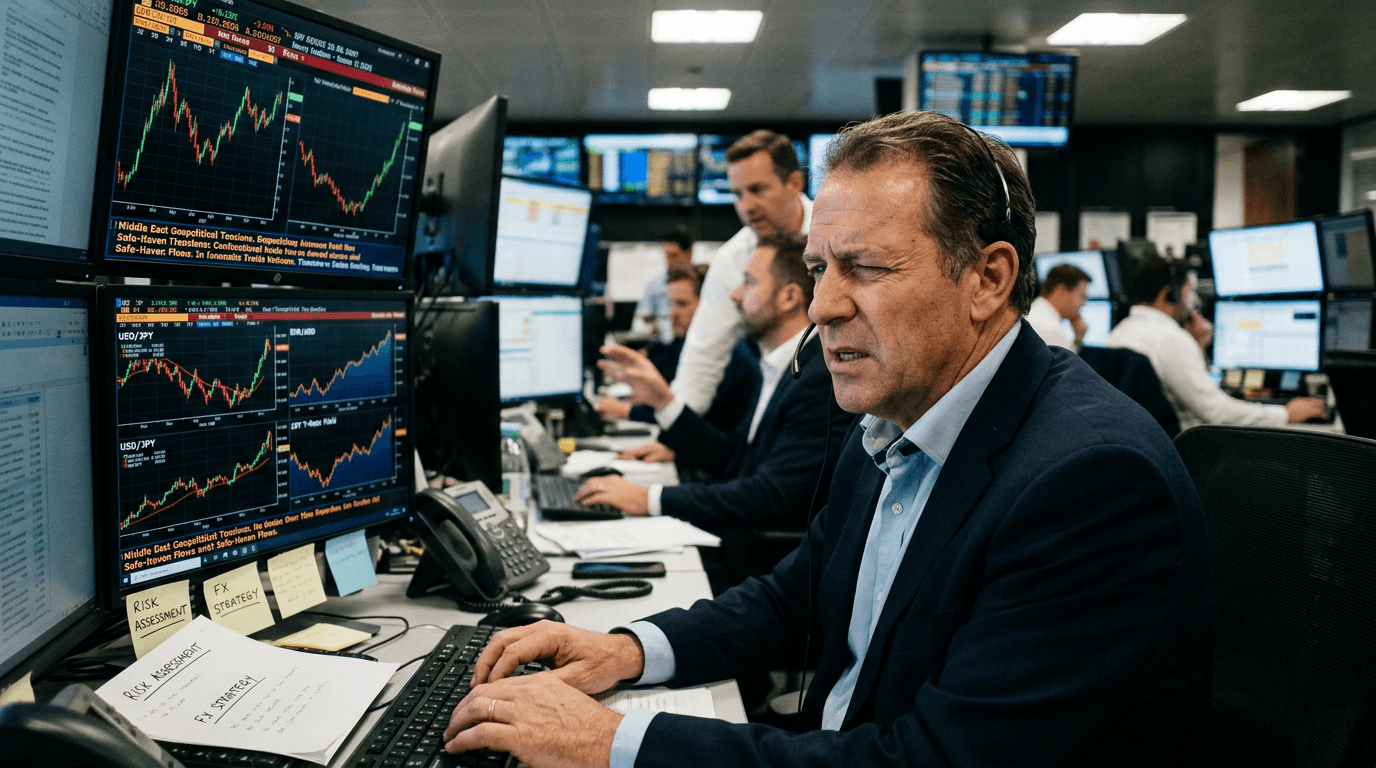
Global bond markets are trading in a tense equilibrium: yields remain elevated even as geopolitical risk drives investors toward traditional safe havens like the US dollar and Japanese yen.[1][3][12][15] For traders, this mix of higher borrowing costs and rising risk aversion is reshaping FX dynamics and rates-linked positioning across USD, JPY and gold.[3][7] Understanding how these forces interact is crucial for building robust strategies in both live and simulated markets.
Global Yields And Geopolitical Risk
Escalating conflict in the Middle East has pushed energy prices higher and revived inflation concerns, keeping global yields near multi-month highs despite intermittent bouts of safe-haven buying in government bonds.[1][3][12] Recent moves in US Treasuries illustrate the tension: after a week-long selloff, yields eased slightly on safe-haven demand, yet both short- and long-dated rates remain on track for higher weekly closes.[1] The benchmark US 10-year yield has oscillated around the mid-4% area, close to the upper end of its three-month range.[1][7][12]
Geopolitical shocks typically encourage investors to buy high-quality government debt, which would normally push yields lower.[3] This time, the inflationary impulse from higher oil prices and the perception that central banks may need to stay hawkish for longer are counteracting that effect.[1][3][12] The result is elevated yield volatility as markets constantly reprice the outlook for growth, inflation and policy rates in response to headline risk.[3][11] For traders, this means the usual “risk-off equals lower yields” playbook is far less reliable than in previous cycles.
Safe-haven Flows Into Usd And Jpy
Against this backdrop, the US dollar has been one of the main beneficiaries of safe-haven flows.[5][12] Episodes of intensified Middle East tensions have seen the dollar index push toward the upper end of its one-year range, as investors seek liquidity, depth and perceived safety in US assets.[7][12] At the same time, expectations that the Federal Reserve will keep rates elevated for longer have reinforced the dollar’s yield advantage over most major currencies.[6][12]
The Japanese yen also retains its reputation as a safe-haven currency, but its behaviour has been more nuanced.[2][10][15] Geopolitical risk has supported yen demand against several Asian and European currencies, reflecting repatriation flows and defensive positioning by Japanese investors.[9][10] However, the wide interest rate differential between the US and Japan—still around three percentage points—continues to attract carry trades that put downward pressure on the yen, particularly versus the dollar.[15] This has allowed USD/JPY to trade near or above historically sensitive levels such as 160, even as safe-haven flows intermittently bolster the yen in other crosses.[9][14][15]
Other defensive assets have also participated in the safe-haven bid. Gold and high-quality government bonds have attracted inflows during periods when Middle East headlines have been most intense, reinforcing the broader risk-off tone.[3][4] Yet just as in fixed income, these moves are not one-way; shifts in expectations for central bank policy or ceasefire prospects can trigger sharp reversals in safe-haven trades.[3][8] The interplay between geopolitics and macro data is therefore central to understanding the persistence of these flows.
Implications For Fx And Rates-linked Futures
For FX traders, elevated yields and safe-haven demand are reshaping relative value and carry opportunities across currencies.[11][15] The strong dollar environment is being driven by both higher US yields and its defensive appeal, making it harder for traditional high-yielders to outperform on carry alone.[11] In contrast, funding currencies like the yen are caught between their safe-haven status and the vulnerability created by ultra-low domestic rates.[2][15] This tension is visible in the volatility of USD/JPY and related crosses during spikes in Middle East risk.[8][9][15]
Rates-linked futures and options are equally affected. Persistent uncertainty around the path of US and global policy rates has boosted interest in hedging strategies using Treasury futures, Eurodollar-style contracts and interest rate options.[1][3][11] Traders are actively exploring curve trades that express views on how front- and back-end yields will respond to shifting geopolitical scenarios and energy prices.[1][3] Meanwhile, gold-linked futures have become a key tool for expressing safe-haven views in a leveraged, liquid format, especially when currency markets are crowded or intervention risk looms.[3][8]
For multi-asset strategies, correlations matter. Periods of intense Middle East tension have tended to see simultaneous strength in the dollar, bouts of support for the yen, and firm gold prices, all alongside choppy but elevated yield levels.[3][5][12] Understanding how these assets move together—rather than in isolation—helps traders avoid overexposure to a single risk theme and better anticipate how portfolios might behave under stress.[3][11]
Practical Takeaways For Simulated Traders
In a SimFi environment, traders can use the current backdrop as a live case study in geopolitics, yields and safe-haven dynamics. By constructing simulated USD and JPY positions alongside rates and gold exposures, they can observe how headlines from the Middle East translate into cross-asset moves in real time.[3][5] Running scenario tests—for example, a further escalation that pushes oil and yields higher, versus a de-escalation that eases risk aversion—helps clarify which strategies rely too heavily on a single narrative.[3][11]
It is especially useful to test the resilience of carry trades funded in yen or other low-yield currencies under different volatility regimes.[2][11][15] Simulated portfolios allow traders to explore how quickly P&L can swing when safe-haven flows collide with rate differentials, as seen in recent USD/JPY price action.[8][9][15] Incorporating gold and high-quality bond exposures into these simulations can further highlight the benefits and limitations of diversification during geopolitical crises.[3][4]
Conclusion: Navigating An Elevated-yield, High-risk World
Global yields are staying higher for longer at precisely the moment when geopolitical risk is back at the forefront of market consciousness.[1][3][12] That combination is driving persistent safe-haven interest in the dollar and a more complex, often two-sided pattern of flows into the yen.[5][9][15] For traders in both live and simulated markets, the key is to recognise that traditional relationships—risk-off equals lower yields, safe-haven equals stronger yen—are being tested by the current mix of inflation risk, policy uncertainty and geopolitical tension.[3][11][15]
By focusing on cross-asset interactions, stress-testing carry trades, and building playbooks that account for multiple scenarios rather than a single path, traders can better navigate this elevated-yield, high-risk environment.[3][11] The present backdrop is not just a source of volatility; it is an opportunity to deepen understanding of how macro fundamentals and geopolitics jointly shape FX and rates markets, and to refine strategies that can withstand the next wave of global uncertainty.[3][7][12]