
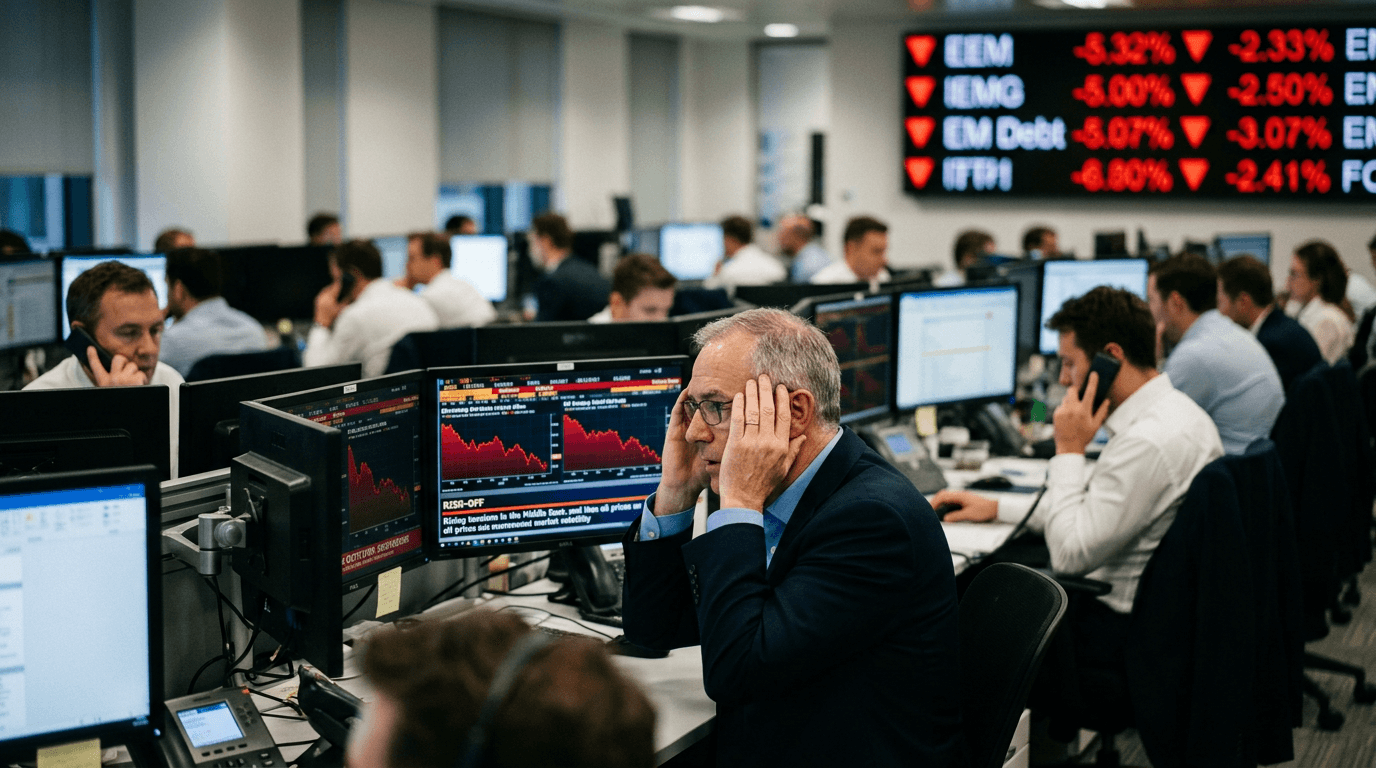
Emerging-market equity funds are facing a sharp wave of selling as investors move decisively into “risk-off” mode in response to the Iran conflict. Funds focused on developing-world stocks have shifted from strong inflows to steep outflows, while benchmark indices have surrendered their year-to-date gains and now rank among the weakest global asset classes.[1][4][5] For traders and investors, this is a live case study in how geopolitical shocks can transmit through flows, prices and cross-asset correlations—and how to navigate that volatility in both real and simulated markets.
Risk-off Wave Hits Em Equities
Weekly data covering roughly 13,000 emerging-market equity funds show inflows slowing sharply to about $5.8 billion, the lowest level in seven weeks, as the Iran conflict intensified and investors cut risk exposure.[1] Separate flow data point to outright outflows from global-mandated emerging-market funds of around $1.1 billion in a single week, a clear reversal from prior strong inflows.[2][9] At the same time, the MSCI Emerging Markets equity index has dropped more than 6% in a recent week, compared with a smaller 2.2% decline in the MSCI World and an even milder 0.7% pullback in the MSCI United States index, underscoring how EM has become a focal point of the selloff.[1]
Looking over the period since the start of coordinated strikes on Iran, the MSCI Emerging Markets index is down about 9.8% in sterling terms, versus a roughly 5.7% drop for the developed-markets-focused MSCI World.[5] The average fund in the IA Global Emerging Markets sector has lost around 9.5% over that span, with none delivering a positive return.[5] Meanwhile, data from the Institute of International Finance show EM equity funds out of favor for eight consecutive weeks, with nearly $2.9 billion in outflows in just one of those weeks.[8] Together, these numbers capture how rapidly sentiment can flip in emerging markets when geopolitical risks rise.
How The Iran Conflict Translates Into Market Stress
The Iran conflict has triggered a classic risk-off reaction, but the transmission mechanism is multifaceted. First, the war has driven a sharp rise in oil prices, fueling concerns about slower global growth and higher inflation, particularly in energy-importing emerging economies.[2][4] This combination of growth risk and inflation pressure narrows policy flexibility and raises uncertainty about earnings trajectories, causing investors to reassess risk premiums.
Second, the shock has arrived in a period when many EM assets had already rallied strongly. Emerging-market stocks had built year-to-date gains exceeding 15% at one point, only to see those gains erased as the conflict and energy crisis hit.[4] For some investors, locking in profits and rotating into safer assets is a rational response to elevated headline risk and the potential for further escalation.
Importantly, several institutional research teams frame this as a price shock rather than a valuation shock: prices have adjusted quickly to geopolitical and commodity risks, but long-term fundamentals for many emerging economies remain intact.[6][7] That distinction helps explain why some investors are repositioning rather than abandoning EM entirely—and why others see dislocation as an opportunity to rebuild exposure at more attractive entry points.[7]
Pressure On Currencies, Debt And Cross-asset Correlations
The risk-off move is not confined to equities. Emerging-market currencies have weakened as investors rotate into safe-haven assets and as rising oil prices and uncertainty weigh on current account expectations.[5] EM sovereign debt funds have also experienced outflows, with global-mandated emerging-market debt funds seeing around $1.1 billion of money exiting over a single week.[9] This simultaneous pressure on currencies, bonds and stocks amplifies volatility and reduces the diversification benefit typically associated with cross-asset portfolios.
Volatility has increased across global cross-asset correlations: assets that often move differently are briefly moving together as investors de-risk broadly rather than discriminate by region or sector.[5] Even U.S. equity funds have seen heavy outflows—about $18 billion in a week—as Israel–Iran tensions and macro worries drive investors to reduce equity risk more generally.[3] For portfolio managers, that means traditional hedges may be less effective in the short term, and risk management has to rely more on overall exposure sizing, liquidity planning and scenario analysis than on static diversification assumptions.
What This Means For Investors And Simulated Traders
For long-term investors, the key challenge is to distinguish between temporary dislocation and structural damage. AllianceBernstein, for example, argues that emerging markets’ stronger underlying fundamentals—better external balances, improved policy frameworks and more resilient corporate balance sheets—should “shine through the noise” once the immediate shock subsides.[6] Rather than treating EM as a single macro trade, they advocate selective allocation across countries and regions, focusing on those with resilient earnings, pricing power and strategic relevance.[6]
For simulated traders on platforms like E8 Markets, this episode is an opportunity to practice navigating a complex, real-world stress scenario without capital at risk. In a SimFi environment, traders can:
- Test how EM equity indices react to geopolitical headlines and oil price spikes.
- Explore the interplay between EM stocks, currencies and sovereign debt during risk-off phases.
- Build and refine volatility management rules—such as dynamic position sizing, stop-loss placement and intraday risk limits—against historically elevated drawdowns.
By observing how equity flows shift from inflows to outflows, and how correlations tighten during stress, simulated traders gain practical insight into the mechanics of contagion and the importance of liquidity and timing.
Strategies To Navigate Em Volatility
Despite the difficult backdrop, a handful of emerging-market equity funds have been relatively resilient. Strategies such as Orbis Emerging Markets Equity, JPM Emerging Markets and Lazard Emerging Markets Equity rank in the top quartile both across 2025 and since the start of the Iran war, even though they still show modest losses of roughly 6–8% over the conflict period.[5] Their ability to limit drawdowns suggests that disciplined stock selection, valuation awareness and sector diversification can add value even when the macro tide is going out.
For investors and simulated traders alike, several practical takeaways stand out:
- Separate fundamentals from short-term sentiment. Geopolitical shocks tend to compress risk appetite quickly but do not necessarily destroy long-term value; that can create entry points for patient capital.[6][7]
- Avoid treating “EM” as a single bet. Country-specific exposures to oil, trade routes, and regional security vary widely; selective allocation and avoidance of the most vulnerable markets can improve risk-adjusted outcomes.[6]
- Manage correlations, not just positions. When stress rises, traditional diversification can break down; scenario-testing portfolios for synchronized selloffs across equities, currencies and bonds is essential.
- Use simulated environments to rehearse crisis playbooks. Practicing how to scale risk, adjust exposure by region, and react to fast-moving headlines in a SimFi setting builds confidence and process discipline before deploying real capital.
As the Iran conflict and associated energy shock continue to reverberate, emerging markets are likely to remain at the center of global risk discussions. Outflows and price swings may persist, but the current episode also highlights the importance of robust fundamentals, selective allocation and prepared trading frameworks. For those willing to look beyond immediate volatility—whether in live markets or simulation—the dislocation in EM assets can be more than just a headline; it can be a valuable learning and positioning opportunity.