
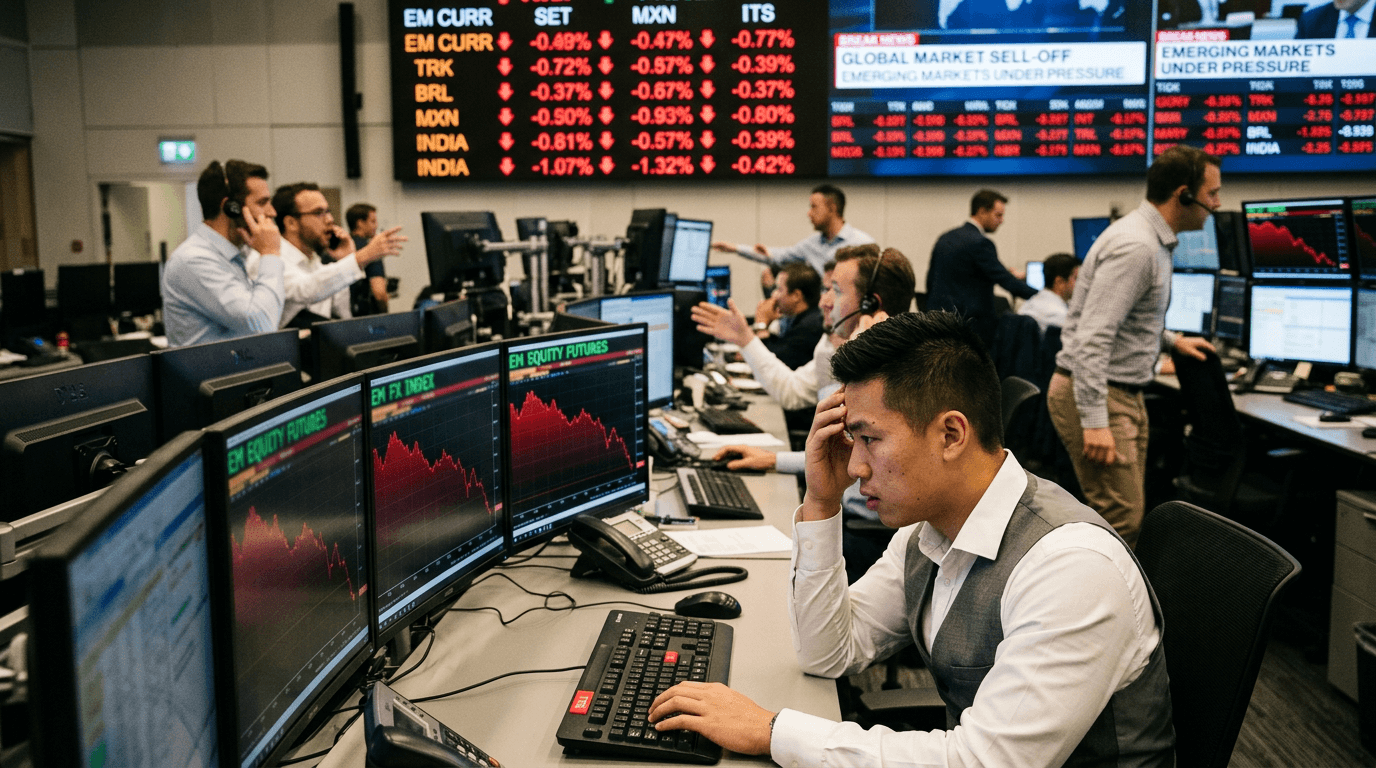
Emerging-market assets are once again in the crosshairs as global investors rush to cut risk, pulling money from EM equity and bond funds and pressuring currencies and futures. A risk-off move linked to heightened Iran-related geopolitical tensions has triggered a sharp rotation back into perceived “safe” assets and away from higher-beta markets, leaving emerging markets among the weakest performers across asset classes.[3][7]
WHAT’S BEHIND THE LATEST EM OUTFLOWS?
When global risk sentiment sours, emerging markets usually feel it first and most intensely. In the latest episode, geopolitical tensions associated with Iran have amplified uncertainty and driven investors to reduce exposure to EM stocks, bonds, and currencies.[3]
Data from global flow trackers show that foreign investors withdrew nearly $27 billion from emerging-market portfolios in a single month recently, reversing part of an earlier rebound in capital flows.[6] At the same time, daily flow measures compiled by international institutions show the 7‑day moving average of EM portfolio flows dropping to some of its lowest levels since previous stress episodes, underscoring how quickly sentiment can flip from optimistic to defensive.[7]
Exchange-traded fund data tell a similar story. While global ETFs as a whole have seen strong inflows, emerging-market debt ETFs have been one of the few areas registering consistent outflows over the past several months, signaling lingering concerns about EM credit risk and interest-rate sensitivity.[5]
In equity markets, EPFR-tracked funds recently recorded sizable weekly outflows, with EM equity funds suffering as investors de-risk and rotate into developed markets and cash.[3][6] Even when outflows “ease” on a week-to-week basis, the cumulative impact on prices and liquidity can be significant.
Why Risk-off Shocks Hit Em Harder
To understand why EM funds see such sharp outflows during risk-off phases, it helps to look at the broader “global financial cycle.” Research on portfolio flows shows that a large share of the variation in EM capital flows can be explained by global risk appetite, funding conditions, and developed-market monetary policy rather than domestic fundamentals alone.[1][8]
A few key mechanisms are at work
- Higher beta: EM assets typically offer higher expected returns but also higher volatility. When volatility spikes, risk models push global investors to cut these higher-beta exposures first.
- Funding and leverage: Many global investors finance EM positions with short-term funding in major currencies. When funding costs rise or risk limits tighten, these positions are often trimmed aggressively.
- Liquidity: EM markets generally have thinner liquidity than large developed markets. During stress, selling pressure can move prices more, reinforcing the perception of risk and triggering further outflows.
- Herding and benchmarks: Many EM funds track or hug benchmark indices. When large players reduce exposure, it quickly transmits through the ecosystem of benchmark-aware managers, ETFs, and derivatives traders.[9]
The result is a feedback loop: risk-off shock → outflows → weaker EM FX and equities → tighter financial conditions locally → more concern about fundamentals, which can justify further outflows.
How This Hits Currencies, Equities, And Index Futures
The current outflow episode has not been confined to cash equity funds. The move has been broad-based, affecting EM currencies, cash equities, bonds, and index futures simultaneously.[3][7]
- Currencies (EM FX): As foreign investors pull money out, they sell local currencies to convert proceeds back into dollars or euros. This can lead to sharp depreciations in EM FX, especially for countries with large external financing needs or shallow FX markets.[7]
- Equities: Forced equity selling to meet redemptions from EM funds can weigh on local stock indices, with financials, commodity-linked names, and domestically focused sectors often hit hardest. Historical data show that even modest flow shocks (e.g., a few percent of AUM in a week) can produce outsized price moves when liquidity is strained.[1]
- Bonds and EM debt funds: EM debt funds have seen sustained outflows in recent months, reflecting concerns about both credit risk and the path of global interest rates.[5] Wider spreads and weaker currencies can quickly tighten financial conditions in local economies and increase refinancing risk.
- Index futures: EM index futures often act as the first line of adjustment. Investors can use futures to quickly hedge or reduce EM exposure intraday, which amplifies volatility in benchmark contracts for major EM indices and contributes to gap moves at the open in cash markets.[3][9]
Lessons For Investors And Simulated Traders
For traders and investors—whether in live markets or on a SimFi platform—the latest EM outflows offer several practical lessons:
1. Flows matter as much as fundamentals Strong macro fundamentals do not immunize a market from global risk-off episodes. Countries with improving growth and reforms can still see their assets sell off when global flows turn negative. Understanding where the big flow channels are (ETFs, active funds, derivatives) can help anticipate pressure points.[1][7][9]
2. Watch the global risk indicators Metrics such as the VIX, credit spreads, dollar strength, and cross-asset correlations often turn before EM selloffs accelerate. When these indicators flash “risk-off,” EM exposures become more vulnerable to sharp moves, regardless of local news.
3. Correlations change in stress Sectors and countries that normally diversify each other can move in lockstep during outflows. Backtests that only consider calm periods may underestimate drawdowns. Using a SimFi environment to stress-test portfolios under different correlation regimes can highlight hidden concentrations of risk.
4. Liquidity is a risk factor In emerging markets, liquidity can disappear quickly. Simulated trading is a useful way to explore how slippage, wider spreads, and gaps might affect execution strategies during stress. Practicing position sizing, staggered entry/exit, and the use of index futures for hedging can build more robust trading habits.
How To Position For The Next Turn In Flows
Periods of heavy outflows are painful, but they also create opportunities. Historically, EM assets have often delivered strong returns in the 12–24 months following large capitulation events, especially when global policy uncertainty recedes and the dollar stabilizes.[1][2][8]
Here are some frameworks to consider
• Distinguish between temporary flow shocks and genuine solvency risks If outflows are driven mainly by global risk sentiment rather than domestic policy mistakes, the resulting price dislocations may be excessive relative to fundamentals. Countries with solid external balances, credible central banks, and manageable debt can become attractive once volatility subsides.
• Use tiers of exposure Instead of treating EM as a monolith, separate it into tiers: higher-quality EM (strong institutions), cyclical/high-beta EM (commodity exporters, politically volatile names), and frontier markets. Allocate risk across tiers based on your macro view and risk tolerance.
• Blend cash markets with derivatives Index futures and options can offer capital-efficient ways to hedge or add exposure during dislocations, but they also amplify leverage and risk. In a simulated environment, traders can experiment with combining spot equities, EM FX, and index futures to manage beta and tail risk more precisely.
• Plan the re-entry before the panic ends By the time headlines turn positive, much of the rebound may already be underway. Using rules-based triggers—such as improvements in flows, stabilization in EM FX, and narrowing spreads—can help define a disciplined framework for scaling back into EM risk rather than reacting emotionally to noise.
For both real and simulated portfolios, the key is to treat emerging-market outflow episodes not just as threats but also as learning opportunities. Understanding how the global financial cycle, investor behavior, and market structure interact in EM can help traders build strategies that are more resilient, more informed, and better prepared for the next shift in risk sentiment.