
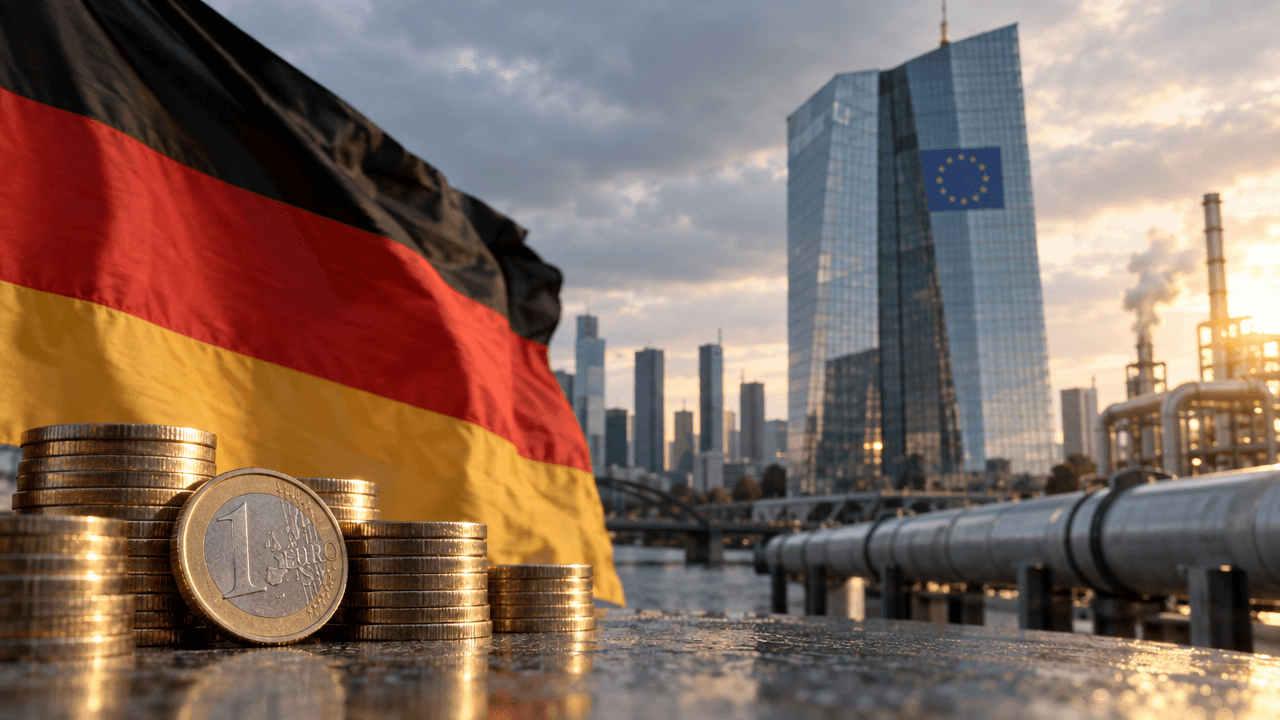
German inflation picked up more than expected in September, reminding markets that the energy shock triggered by the Iran conflict is far from over.[1][3][8] Headline consumer prices rose 3.3% year-on-year, slightly above economists’ forecasts and the highest level since late 2023, driven almost entirely by a renewed surge in energy costs.[1][3][5][8] For traders, this is a classic case study of how geopolitics can quickly reshape macro expectations and market pricing.[4][12][13]
Inflation Surprise In September
Preliminary data from Germany’s Federal Statistical Office show the inflation rate at 3.3% in September 2026, compared with 2.9% in August.[1][11] That beat the market consensus of roughly 3.2% and confirms that the disinflation trend seen earlier in the year has stalled.[3][8] In harmonised terms used by the European Central Bank (ECB), inflation also stood at 3.3%, well above the ECB’s 2% target.[6][8]
Importantly, this upside surprise is not broad-based inflation returning, but a specific energy shock showing up in the CPI basket.[1][3][10] Core inflation, which strips out energy and food, held steady at around 2.4% for the third consecutive month, signaling that underlying price pressures are relatively contained.[1][3][8][9] For macro-focused traders, that distinction between headline and core is critical when assessing the likely policy response.
Energy Prices And The Iran Conflict
The primary driver of September’s inflation acceleration was energy prices, which jumped about 14.9% from a year earlier, up sharply from 10.5% in August and 8.3% in July.[1][3][5][10] That marks the fastest increase in energy costs since early 2023 and reflects renewed stress in global energy markets following the escalation of the conflict involving Iran.[4][11][12][13][15]
German authorities have highlighted how the Iran war and broader Middle East tensions have pushed up crude oil and natural gas prices, feeding directly into higher motor fuel and heating costs for households.[11][12][13][15] Wholesale prices for diesel, petrol, and electricity have risen noticeably, and those moves are now being transmitted to consumer-level inflation.[4][11][15] With energy accounting for roughly 7.4% of the German CPI basket, even a concentrated shock in that segment can materially move headline inflation.[14]
For traders, this is a textbook example of an exogenous supply shock: macro fundamentals inside Germany have not dramatically changed, but external energy markets are altering the inflation outlook.[2][4][11][13] In SimFi environments, this type of scenario allows participants to model how a single volatile component (energy) can dominate short-term inflation dynamics even when core prices remain stable.
Implications For The Ecb And The Euro
Higher-than-expected German inflation has immediate implications for ECB policy expectations, given Germany’s weight in the euro area economy and in the HICP index.[6][8][9] With eurozone inflation still above target, a renewed energy-driven uptick raises questions about whether the ECB can comfortably pause rate hikes or must retain a hawkish bias for longer.[7][8] Markets typically respond by repricing the path of interest rates, adjusting bond yields, and reassessing the euro’s outlook against major currencies.[3][7][9]
If investors interpret the latest data as evidence that inflation risks are re-emerging, they may price in higher terminal rates or a longer period of restrictive policy, supporting the euro in the short term but weighing on growth-sensitive assets.[3][7] Conversely, the fact that core inflation is stable near 2.4% gives the ECB some room to treat the energy shock as temporary, especially if growth indicators remain soft.[1][3][8] The balance between these narratives can create significant intraday volatility, particularly around policy speeches and ECB meeting dates.
In simulated markets, traders can test different policy reaction functions: one scenario where the ECB leans hawkish in response to headline inflation, and another where it focuses on core measures and looks through the energy spike. This helps build intuition about how rate expectations transmit into bond curves, equity sector performance, and FX moves.
What This Means For Traders And Simulated Finance
For discretionary and systematic traders alike, the German inflation release offers several practical lessons. First, macro events cannot be reduced to a single headline number; understanding the component breakdown—energy versus core—is essential for positioning.[1][3][8][10] Second, geopolitically driven supply shocks often create more uncertainty than demand-driven inflation, because they depend on developments that are hard to forecast quantitatively.[4][11][12][13][15]
In a SimFi setting, traders can:
1) Build scenarios where energy inflation remains elevated for several months, testing the impact on bond yields, breakeven inflation, and equity sectors such as utilities, industrials, and consumer discretionary.
2) Model alternative paths for the Iran conflict and associated energy prices, from rapid de-escalation to prolonged disruption, and map those to simulated macro outcomes.
3) Practice reacting to data surprises: entering the CPI print with a baseline expectation, then adjusting simulated positions in rates, FX, and equities when the actual number comes in above consensus.
Because the euro and German Bunds are highly sensitive to inflation data and ECB expectations, September’s print provides a live case study in event risk management.[3][7][9] Traders can experiment with pre-hedging strategies, volatility overlays, and position sizing rules around major macro releases, all within a risk-free simulated environment.
Conclusion: Navigating An Energy-driven Inflation Landscape
German inflation’s slight but meaningful acceleration in September underscores how fragile the disinflation narrative can be when energy markets are disrupted.[1][3][5][8] Headline CPI has moved further above target even as core inflation stays relatively well-behaved, putting the ECB in a delicate position and injecting fresh uncertainty into euro-area assets.[1][3][6][8][9] For traders, the key is not to overreact to a single data point, but to incorporate energy-driven risks into a structured macro framework.
Simulated finance platforms provide an ideal environment to do exactly that—testing how shocks like the Iran conflict propagate through inflation, central bank expectations, and market pricing, without real capital at risk.[4][11][12][13][15] By drilling into the details of the German data and building robust scenario analyses, traders can turn this inflation surprise into a learning opportunity, sharpening their ability to navigate future episodes of volatility in both real and simulated markets.