
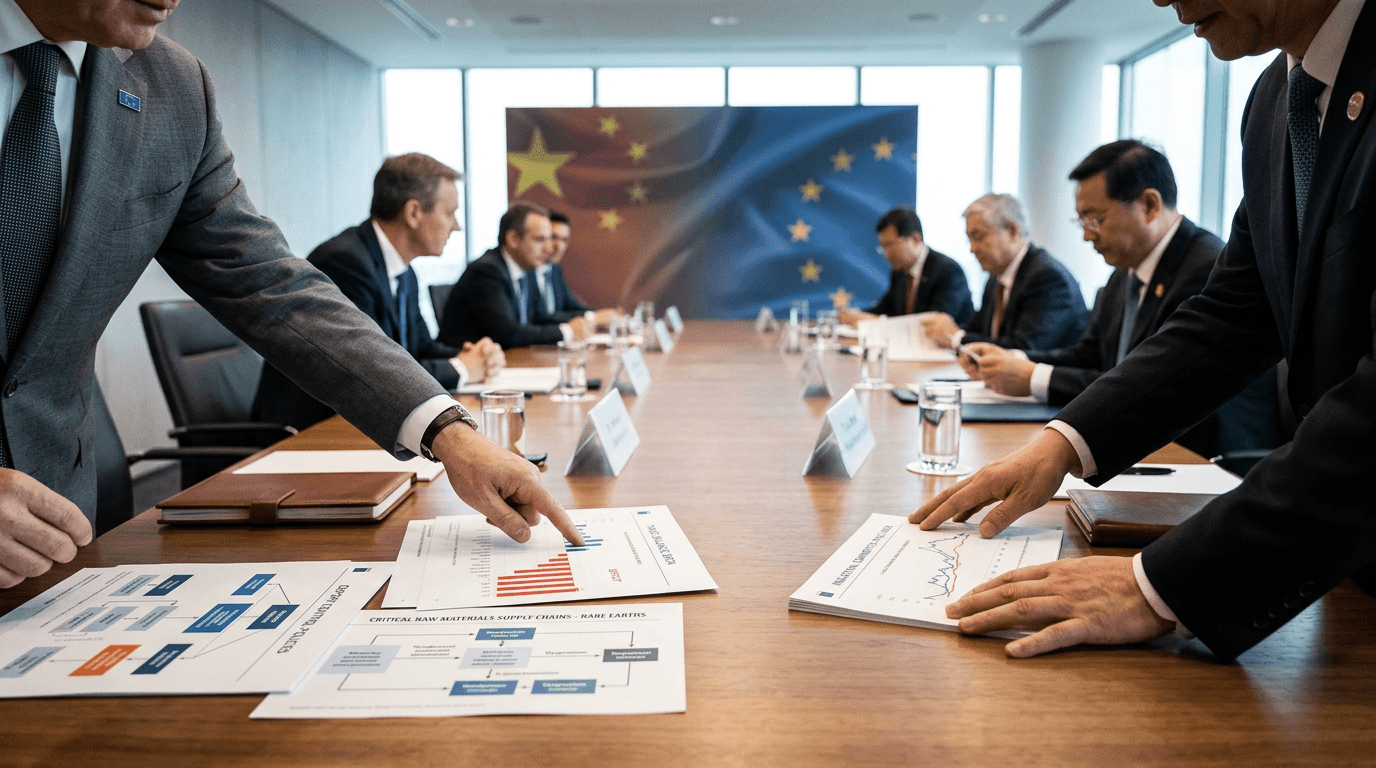
The European Union and China have opened a new chapter in their complex economic relationship by agreeing to establish a trade and investment consultation mechanism aimed at tackling a massive annual trade deficit, growing export controls, and vulnerabilities in critical supply chains.[2][1] For traders and investors, this is more than diplomatic choreography—it is a policy process that could reshape European growth prospects, CNY‑ and EUR‑linked FX, and key industrial commodity markets over the coming months.
New Consultation Mechanism: Resetting The Dialogue
In June, China’s Vice Minister of Commerce Ling Ji met in Brussels with Ditte Juul Jorgensen, the European Commission’s Director‑General for Trade and Economic Security, for in‑depth talks on the new mechanism.[2][1] Both sides agreed to work toward “practical outcomes” from its inaugural meeting, explicitly framing the initiative as a way to stabilize bilateral economic and trade relations and support their sustainable development.[2][6]
Chinese officials and experts have described the mechanism as a tool to ease tensions and reduce fears of a full‑blown “trade war” between the two economies.[1] On the European side, it complements a broader “de‑risking, not decoupling” approach—an effort to manage dependencies and security concerns while keeping China embedded in a rules‑based trading system.[5] Structurally, the mechanism is designed as a regular platform to manage differences on trade and investment rather than relying only on ad‑hoc negotiations or formal WTO dispute procedures.[2][9]
For markets, the key point is that the EU and China are choosing institutionalized dialogue over escalation. That lowers tail‑risk of abrupt, unilateral measures in the near term, even if difficult issues—such as subsidies, industrial overcapacity, and technology controls—remain on the table.[1][5]
Putting The Trade Deficit In Context
Behind the new mechanism lies a striking imbalance. China is the EU’s second‑largest trading partner in goods (after the United States), and bilateral trade in goods reached about €732 billion in 2024.[3] Yet the EU consistently imports far more from China than it exports, resulting in a large goods trade deficit that EU officials now estimate in the hundreds of billions of euros per year.[3][5] One recent analysis notes that despite this deficit—approaching €400 billion—the two sides still trade more than €2 billion in goods every day.[5]
China has become the EU’s biggest partner for imports and its fourth‑largest partner for exports.[3] In 2023, China accounted for roughly 20% of EU goods imports but only 9% of EU goods exports, underscoring the structural nature of the imbalance.[7][3] For Europe, that raises concerns about competitiveness, industrial capacity, and strategic dependencies; for China, the surplus reflects the strength of its manufacturing sector and its role in global supply chains.[5][7]
The consultation mechanism gives the EU a dedicated channel to push for “more balanced and reciprocal economic relations,” a goal repeatedly voiced by European leaders.[5] That could translate into discussions on market access, sector‑specific overcapacity (for example in electric vehicles, batteries, and renewables), and non‑tariff barriers faced by European firms in China.[3][5] Traders should expect periodic headlines as these themes move from rhetoric into concrete proposals and—potentially—sector‑level measures.
Export Controls, Rare Earths And Economic Security
Export controls and rare earth supply chains are set to be among the most sensitive topics on the agenda. Recent commentary around EU‑China talks has highlighted Europe’s reliance on Chinese exports in strategic areas, including rare earth elements used in electronics, defense technologies, and clean‑energy applications.[8] At the same time, China is concerned about tightening European (and broader Western) export restrictions on advanced technologies and critical inputs.[5][7]
The EU has built a toolkit to strengthen its economic security, including foreign direct investment screening, a foreign subsidies regulation, and an anti‑coercion instrument, all of which can influence how it manages trade with China.[5] These measures aim to prevent distortive practices and protect critical sectors, but they also add friction to the relationship if perceived in Beijing as targeting Chinese firms.
Within the new consultation framework, both sides have an incentive to clarify how export controls will be applied and to avoid surprises that could disrupt supply chains.[2][1] For European industry, predictability in access to rare earths and intermediate goods is crucial to investment planning; for China, clear signals on which technologies are off‑limits can inform its own industrial strategy and diversification efforts.[5][8]
For commodity markets, any indication that export controls on rare earths or other strategic materials will be tightened—or relaxed—can quickly feed into price expectations. Traders in industrial metals, specialty chemicals, and renewable‑energy supply chains should therefore treat developments under this mechanism as a leading indicator of future policy moves.
Market Implications: Fx, Equities And Commodities
At the macro level, EU‑China trade dynamics feed directly into currency markets. A persistently large European trade deficit with China reflects net demand for CNY‑denominated exports, which can influence flows between the euro, offshore yuan (CNH), and other major currencies.[5][7] If the consultation mechanism leads to a more balanced trade outcome—through improved European market access or moderated Chinese export growth—some of that structural pressure on EUR could ease over time.[3][5]
Near term, what matters for FX is not just the level of trade, but the perceived trajectory of the relationship. A cooperative, dialogue‑driven path supports risk sentiment, which tends to be positive for cyclical European assets and for carry trades involving CNY‑linked instruments. Conversely, signs that talks are stalling or that new trade barriers are imminent could trigger risk‑off moves, benefiting safe‑haven currencies and weighing on EUR‑ and CNY‑linked pairs.
In equities, European sectors with heavy China exposure—autos, luxury goods, machinery, renewable energy equipment, and semiconductors—are particularly sensitive to news from the consultation process. Clarity on export controls or market access can reprice earnings expectations and cross‑border investment plans.[3][5] On the Chinese side, industries tied to Europe’s green and digital transitions may also see sentiment shifts as investors gauge whether the EU will push harder on anti‑subsidy or anti‑dumping measures.
Commodity markets will be watching the mechanism for clues on future policy around rare earths, battery materials, and broader industrial inputs.[8] A cooperative stance could reduce perceived supply‑disruption risk, compressing some risk premia; a more confrontational tone might do the opposite. Because these are multi‑year themes, even incremental policy signals from Brussels and Beijing can alter long‑term price curves and hedging strategies.
What Traders Should Watch Next
For traders and SimFi participants, the new EU‑China consultation mechanism is best viewed as a process, not a single event. The most actionable approach is to build a framework for monitoring its evolution and mapping that to asset‑class exposures.
First, track official communications from the European Commission, China’s Ministry of Commerce, and high‑level statements by EU and Chinese leaders.[2][1][5] Pay attention to whether language around “stabilizing relations” and “practical outcomes” is maintained, strengthened, or diluted over time.[2][6] Shifts in tone often precede concrete policy moves.
Second, link thematic developments to sector and asset sensitivities. Headlines about rare earths or export controls matter most for industrials, clean‑energy plays, and relevant commodity contracts.[8] Discussions of market access, subsidies, or overcapacity will be particularly important for autos, batteries, and tech hardware.[3][5] For FX, focus on any indication that the EU’s de‑risking agenda is accelerating or slowing, as that shapes medium‑term narratives around EUR and CNY.[5][7]
Third, consider scenario analysis. A constructive scenario—where the mechanism delivers incremental progress on trade balance, clearer rules on export controls, and improved transparency—would likely support European growth expectations, reduce tail risks, and be mildly positive for risk assets. A negative scenario—where talks stall and are followed by new tariffs, anti‑subsidy actions, or retaliatory measures—would raise volatility and could trigger rotation into defensive sectors and safe‑haven currencies.
Finally, integrate this policy story into your broader macro view. EU‑China trade cannot be analyzed in isolation: it interacts with US‑China tensions, global supply‑chain diversification, and Europe’s own industrial and climate policy. Over the coming quarters, the consultation mechanism will be one of the main venues through which those global forces express themselves.
For now, the establishment of a structured EU‑China trade consultation is a signal that both sides prefer negotiation over confrontation. That does not guarantee smooth sailing, but it does offer traders a more transparent roadmap for how one of the world’s most important economic relationships will be managed—and how its outcomes may ripple across currencies, equities, and commodity markets.[2][1][5]