
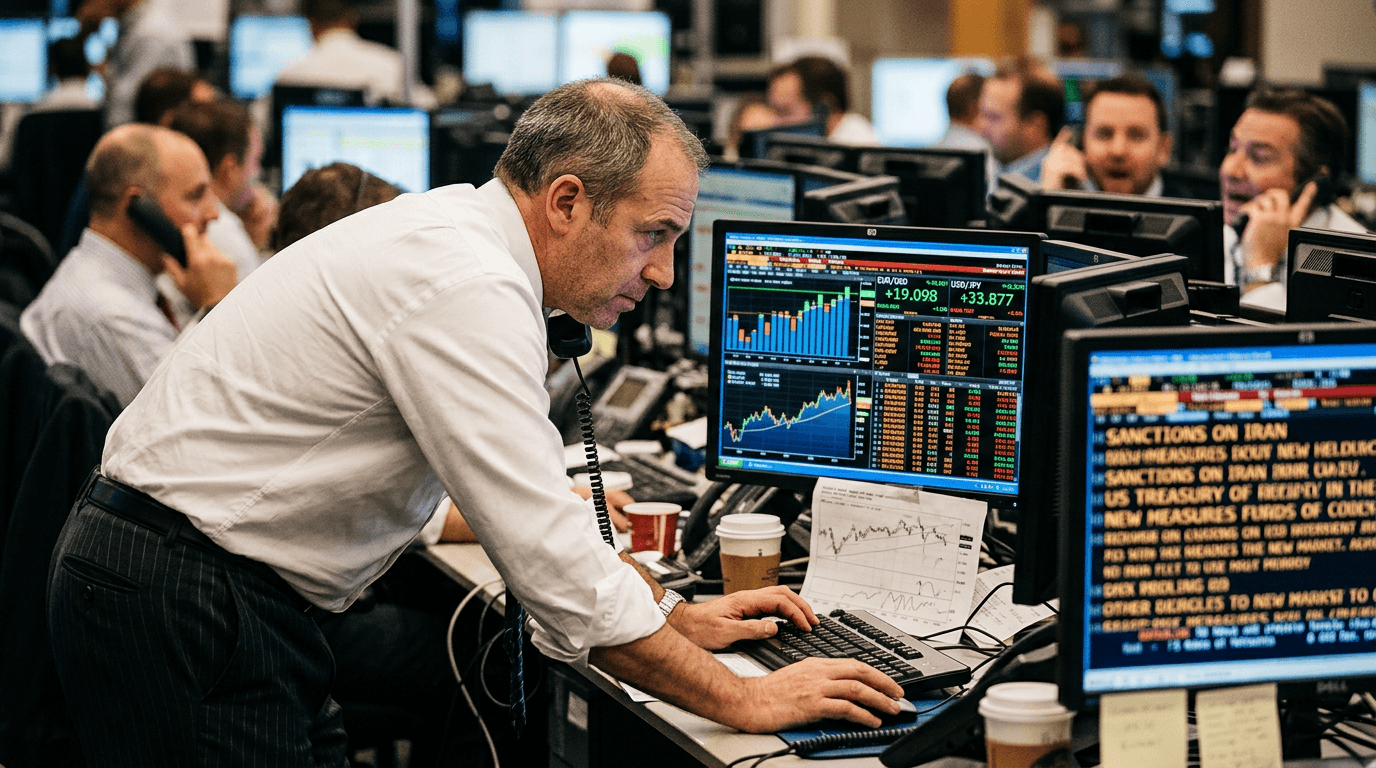
Currency markets are entering a tense, finely balanced phase as the euro and Japanese yen push toward multi‑month highs against the U.S. dollar while traders await details of fresh American sanctions on Iran.[1][2][5] The move underlines how geopolitics, perceived safe havens, and expectations around central bank policy can quickly reshape major FX pairs such as EUR/USD and USD/JPY.[1][2][3] For traders on both live and simulated platforms, this backdrop offers a rich case study in how narrative shifts translate into price action and risk.
Market Snapshot: Euro And Yen At Multi-month Highs
Recent sessions have seen the euro grind higher versus the dollar, with spot levels approaching highs last seen roughly three months ago as investors rotate away from the greenback amid Iran‑related uncertainty.[1][2][13] At the same time, the yen has recovered from prior weakness and is trading in positive territory, a notable shift given how close it recently came to intervention‑sensitive levels near multi‑decade lows.[1][3][12] Reports highlighting U.S. plans to tighten sanctions on Iran’s energy and shipping sectors have intensified focus on Middle East risk, oil supply, and the potential spillover into inflation and growth.[2][4][5]
These developments matter because they add another layer to an already complex macro picture dominated by interest rate differentials and central bank balance sheets.[3][13][14] Even modest moves in the euro and yen can translate into meaningful volatility in EUR/USD and USD/JPY, especially when options positioning and algorithmic trading amplify momentum around headline risk.[1][2][15] For traders, recognizing when geopolitical narratives begin to rival economic data in driving FX markets is a key edge.
Safe-haven Flows And Geopolitical Risk
The yen’s recent strength fits the classic pattern of a safe‑haven currency drawing demand when geopolitical risk rises and uncertainty around policy outcomes grows.[1][2][3] Historically, episodes of heightened tension between the United States and Iran have triggered flight‑to‑quality flows into lower‑yielding but perceived safer assets, including the yen and U.S. Treasuries.[2][4][15] What makes the current episode interesting is that, unlike past crises where the dollar dominated safe‑haven flows, investors appear more willing to diversify into other havens and to trim long‑dollar exposure ahead of the sanctions announcement.[1][3][5]
Energy markets are another channel linking Iran news to FX volatility.[2][4][15] Sanctions that further restrict Iranian oil exports can push crude prices higher, raising inflation risks for import‑dependent economies and complicating central bank reaction functions.[2][4][6] Higher energy prices tend to hurt currencies of large net importers, but they can also strengthen those backed by hawkish central banks seen as more willing to counter the inflation impulse with rate hikes.[3][11][13] As a result, traders are not just reacting to the headline of “sanctions on Iran” but to what that implies for future inflation, growth, and monetary policy across regions.
Euro Story: Policy Expectations And Energy Exposure
The euro’s advance toward a three‑month high reflects a mix of improving rate expectations and the market’s belief that the European Central Bank (ECB) will remain attentive to energy‑driven inflation.[3][11][13] In earlier episodes this year, the euro gained after the ECB delivered its first rate increase in several years, signaling a shift away from ultra‑loose policy as energy prices and war‑related uncertainty pushed up consumer prices.[3][11][13] That backdrop still matters: tighter sanctions on Iran could keep oil prices elevated, reinforcing expectations that Eurozone inflation will stay sticky and that the ECB cannot pivot too quickly toward easing.[3][6][13]
At the same time, the euro benefits from a relative‑value narrative. When the dollar softens on reduced expectations for aggressive Federal Reserve tightening or on political risk, currencies with credible central banks and improving growth stories can outperform.[1][3][15] Recent data from Europe have shown tentative stabilization in manufacturing and services, giving traders a reason to add euro exposure as a diversifier alongside traditional safe havens.[3][11][13] For EUR/USD, this means traders are watching whether the pair can sustainably hold above recent resistance levels or whether the sanctions announcement triggers a reversal.
Yen Story: Safe Haven Meets Intervention Watch
The yen’s move higher toward multi‑month peaks is occurring against a backdrop of intense scrutiny of Japan’s FX policy stance.[1][2][3] Earlier in the year, the currency sank to levels against the dollar not seen in roughly four decades, prompting speculation and episodes of official or quasi‑official intervention to slow the slide.[3][12][14] Each subsequent bout of yen strength, including the current one, is being filtered through the lens of “Is this pure safe‑haven flow, or is the market front‑running potential intervention?”
Reports that Japanese authorities remain sensitive to rapid moves in USD/JPY and are monitoring speculative positioning add to the yen’s appeal as a tactical hedge around major geopolitical dates.[1][2][8] In a scenario where U.S. sanctions on Iran escalate tensions and spark further risk‑off sentiment, the yen could see additional inflows, especially if equity volatility spikes.[2][4][15] The flip side is that if sanctions are perceived as limited or well‑telegraphed, and risk assets stabilize, recent yen gains could fade as carry traders re‑establish long dollar/yen positions.[10][12][14]
TRADING IMPLICATIONS FOR EUR/USD AND USD/JPY
For active traders, the euro‑yen strength ahead of the sanctions announcement translates into clear tactical considerations in EUR/USD and USD/JPY. Historically, major geopolitical headlines linked to Iran have produced short, sharp bursts of volatility followed by a reassessment phase as markets digest the actual policy details.[2][4][15] This pattern suggests a need to manage position size and leverage carefully around the announcement window, with predefined levels for stops and profit‑taking.
In EUR/USD, key questions include whether the pair can hold near multi‑month highs if sanctions intensify energy‑price pressures but also dampen global growth expectations.[2][3][6] A hawkish ECB bias might support the euro, but a broader risk‑off move could still drive renewed demand for the dollar as global reserve currency.[3][11][13] In USD/JPY, traders are balancing three forces: safe‑haven demand for yen, interest rate differentials that still favor the dollar, and the ever‑present possibility of Japanese official intervention should the pair move too quickly or reach politically sensitive levels.[1][3][12] Option structures like straddles or strangles around the announcement are one way some traders seek to monetize the expected volatility while limiting directional risk.
How Simulated Finance Traders Can Leverage This Environment
For participants in SimFi environments such as E8 Markets, this episode is an ideal live‑fire exercise in macro‑driven FX trading—without the capital risk. By building simulated strategies that respond to different sanctions scenarios, traders can test how EUR/USD and USD/JPY react under varying assumptions about oil prices, central bank policy paths, and equity volatility. Running multiple simulations—one where sanctions are very strict, one where they are symbolic, and one where they are delayed—helps traders see how sensitive their P&L is to the quality of their geopolitical and policy assumptions.
Simulated trading also allows for experimentation with risk management techniques around event‑driven volatility. Traders can practice scaling into positions as the announcement approaches, widening or tightening stops based on realized volatility, and adjusting exposure as new information arrives. Over time, this builds an internal “playbook” for handling similar episodes, whether the trigger is Iran sanctions, an unexpected central bank decision, or another geopolitical shock. The goal is not to predict every headline but to develop robust processes that can adapt quickly when narratives change.
Conclusion
The simultaneous strength of the euro and yen ahead of new U.S. sanctions on Iran underscores how interconnected modern FX markets are, blending geopolitics, energy dynamics, and central bank policy expectations into rapid price moves in core pairs.[1][2][3] Traders who understand the drivers behind safe‑haven flows, rate differentials, and intervention risk are better positioned to interpret these moves rather than react to them. Whether operating in live markets or simulated environments, the current backdrop is a powerful reminder that effective FX trading requires both macro awareness and disciplined execution—especially when the next headline can arrive at any moment.