
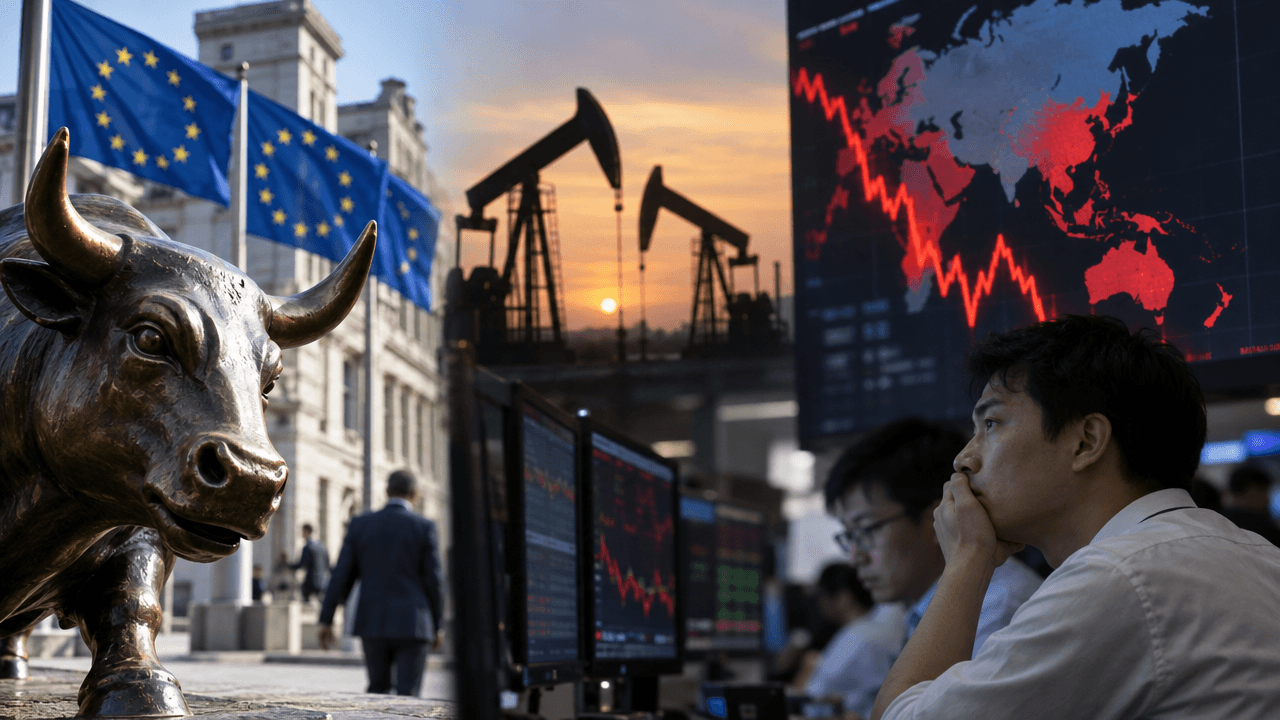
European and Asian markets began the week with sharply different signals, reflecting an investment climate shaped by competing forces. European shares and futures moved modestly higher as crude oil prices retreated from recent highs, while many Asian benchmarks weakened under pressure from technology stocks. The uneven performance shows that investors are not following one clear risk-on or risk-off path. Instead, they are weighing temporary relief in energy markets against persistent concerns about inflation, geopolitical instability and expensive technology valuations. [1][7]
Markets Pull In Different Directions
European equities received some support from falling oil prices. Brent crude declined by roughly 1.9% to around 114.50 dollars per barrel, while West Texas Intermediate also moved lower. The pullback offered relief to European economies that depend heavily on imported energy, because lower fuel costs can reduce pressure on businesses, consumers and inflation expectations. European futures were pointing to a stronger open, with Germany’s DAX and France’s CAC 40 both gaining in early trading. [4][7]
Asian markets were less confident. Japan’s Nikkei 225 fell about 0.8%, South Korea’s KOSPI dropped approximately 1.5%, and China’s CSI 300 declined around 0.3%. Technology and semiconductor shares were especially weak, demonstrating how quickly sentiment can change when investors begin questioning the future returns of large-scale artificial intelligence investment. [9]
This divergence matters for traders because regional indexes have different sensitivities. European markets are currently responding strongly to energy and geopolitical developments, while Asian markets are more exposed to semiconductor demand, export activity and technology-sector valuations.
Oil And Geopolitics Remain Central Risks
Although crude prices eased on Monday, the broader energy picture remains uncomfortable. Brent rose 6.2% during the previous week and reached its highest weekly close since mid-2022, according to market reports. Supply concerns intensified after attacks linked to the Middle East disrupted confidence in regional energy infrastructure. [1][7]
The latest decline in oil prices was partly linked to renewed diplomatic activity. Reports of regional security discussions and efforts to reduce tensions helped ease fears of further supply disruption. However, traders are unlikely to treat one softer session as proof that the energy risk has disappeared. Any escalation could quickly send crude higher again.
For investors, the key issue is the effect of oil on inflation and interest rates. Higher energy prices raise transportation and production costs, potentially slowing the progress of disinflation. They can also reduce household purchasing power and squeeze corporate profit margins. If central banks believe an energy shock could keep inflation elevated, they may maintain restrictive interest rates for longer.
This creates a difficult environment for risk assets. Falling oil prices can support stocks, but only if the decline reflects improving geopolitical conditions rather than weakening global demand.
The Ai Investment Test
Technology valuations are the second major source of uncertainty. Investors are preparing for earnings from Alphabet, Microsoft and Amazon, alongside reports from major chip companies such as Samsung Electronics and SK Hynix. These results should provide new evidence about whether enormous spending on data centers, chips and artificial intelligence infrastructure is producing sustainable revenue and profit growth. [2][5]
The market’s concern is not that artificial intelligence lacks commercial potential. Rather, investors are asking whether current share prices already assume too much success. Companies may be expanding capacity aggressively, but the financial return on that investment could take years to appear. If revenue growth fails to keep pace with capital expenditure, shareholders may begin demanding lower valuations.
This concern has already affected technology-heavy markets. South Korean shares have been particularly sensitive because semiconductor companies sit at the center of the AI supply chain. Strong earnings guidance, healthy chip demand and evidence of pricing power could restore confidence. Conversely, cautious forecasts or rising capital-spending commitments without matching returns could intensify the technology sell-off.
What Traders Should Watch
The coming week is unusually important because corporate earnings and central bank decisions will arrive at the same time. Policymakers are assessing inflation, economic resilience and the impact of energy prices, while investors are using technology earnings to judge whether the AI-led market rally can continue.
Traders should monitor several signals. First, watch whether crude oil remains below its recent peak or begins climbing again. A sustained decline would reduce immediate inflation pressure, while a renewed rally could weigh on bonds and interest-rate-sensitive equities.
Second, compare technology companies’ revenue growth with their capital spending. Large investment budgets are not automatically negative, but markets will want evidence that those investments are creating durable demand and improving long-term profitability.
Third, pay attention to market breadth. If gains remain concentrated in a small group of large companies, underlying risk appetite may be weaker than headline indexes suggest. Broader participation across industrial, financial, consumer and smaller-cap shares would provide a healthier signal.
Finally, position sizing matters. Mixed regional performance and elevated event risk make sharp intraday reversals more likely. Traders may benefit from defining risk before entering a position, reducing excessive leverage and avoiding assumptions that a lower oil price or a strong earnings report will automatically produce a lasting rally.
A Market Balanced Between Relief And Caution
European and Asian markets are sending different messages, but both are responding to the same central question: can economic growth withstand geopolitical stress, higher energy costs and demanding technology valuations? The retreat in crude prices has provided temporary relief, while upcoming earnings and central bank decisions will determine whether that relief develops into a broader recovery.
For now, the most accurate description is cautious and selective risk appetite. Traders should focus less on the direction of a single index and more on the relationships between oil, interest rates, earnings expectations and market breadth. In an environment where sentiment can shift rapidly, disciplined risk management may matter more than trying to predict the next headline move.