
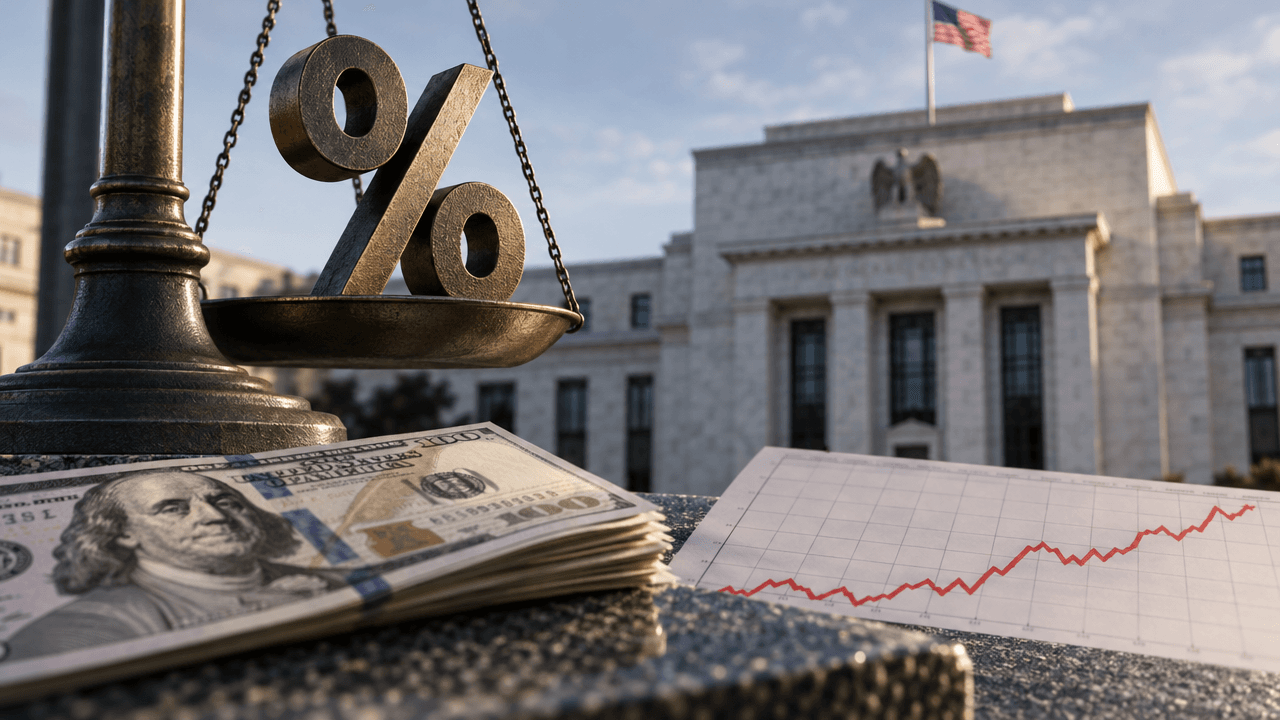
Markets are approaching the Federal Reserve’s interest-rate decision with a familiar question: will policymakers keep rates steady for now, or prepare investors for another increase before the end of the year? The immediate decision is widely expected to be a hold, but September’s stronger-than-expected inflation data has made the policy outlook significantly less certain. Traders are therefore paying close attention not only to the rate announcement, but also to the Fed’s language about December.
The annual Consumer Price Index rose 3.7% in September, accelerating from August’s 3.4% reading and remaining well above the Federal Reserve’s 2% inflation target. Monthly CPI increased 0.6%, with energy costs contributing significantly to the move. [2][14] Although one inflation report does not determine monetary policy, the data reinforce concerns that price pressures may be proving more persistent than policymakers would prefer.
The Expected Rate Decision
Financial markets have largely priced in no change at the current federal funds target range of 3.75% to 4%. Fed funds futures recently indicated roughly a 90% probability of an October hold, reflecting expectations that policymakers would prefer to wait for additional information rather than react immediately to one hot inflation report. [10][13]
A pause does not necessarily mean the tightening cycle is over. Central banks often leave rates unchanged while assessing whether previous increases are slowing demand. Higher borrowing costs can take months to affect household spending, business investment, housing activity, and employment. Holding rates steady can therefore be a deliberate strategy rather than a sign that the Fed has become comfortable with inflation.
The key issue is whether the Fed characterizes the current stance as sufficiently restrictive. If officials emphasize that inflation remains elevated and that policy must stay tight, markets could interpret the announcement as a warning that another hike is likely. If they focus more heavily on economic risks or signs of slowing demand, expectations for future increases could weaken.
Why December Matters
The December meeting has become the central point of focus because September’s CPI report increased expectations for another rate hike later in the year. Some market pricing pointed to better-than-80% odds of a December increase, although estimates varied by source and changed as traders processed new information. [7][12]
For investors, the distinction between an October pause and a completed tightening cycle is crucial. A pause followed by a December increase would suggest that the Fed is spacing out policy moves while waiting for confirmation that inflation is not cooling quickly enough. By contrast, a pause followed by a prolonged hold could indicate that officials believe existing rates will eventually bring inflation lower.
The Fed must balance two competing risks. Keeping rates high for too long could weaken employment and economic growth. Cutting or pausing too soon could allow inflation expectations to become entrenched. With CPI still substantially above target, policymakers have a strong reason to preserve flexibility.
THE DOLLAR’S STRENGTH
The US dollar has benefited from the prospect of higher-for-longer interest rates. The dollar index, which measures the currency against a basket of major currencies, rose approximately 0.3% to 102.40 and reached its highest level in about two weeks before the decision. [5] Broader market reports also described the dollar as strengthening by roughly 0.4% against major currencies.
Higher US interest rates can make dollar-denominated assets more attractive because investors may receive greater returns on Treasury securities and other investments. Expectations matter as much as the current rate itself. If traders believe the Fed will keep rates elevated while other central banks are more likely to ease, demand for the dollar can increase.
A stronger dollar can help reduce the cost of imported goods and may ease some inflation pressure in the United States. However, it can also create challenges for multinational companies whose overseas earnings become less valuable when converted back into dollars. Emerging-market economies with dollar-denominated debt may face additional pressure as well, because their repayment costs rise in local-currency terms.
What Traders Should Watch
The headline rate decision is only the first piece of information. Traders should monitor several additional signals:
1. The statement’s description of inflation. Words such as persistent, elevated, or broad-based could support expectations for another hike.
2. References to employment and economic growth. A greater emphasis on labor-market weakness could limit expectations for further tightening.
3. Any updated projections or comments from policymakers. These may reveal whether December is viewed as a likely policy meeting or simply one possibility.
4. Market reactions across multiple assets. A hawkish message could lift Treasury yields and the dollar while pressuring equities, commodities, and rate-sensitive sectors.
For SimFi traders, the event offers a useful exercise in scenario planning. Rather than predicting one outcome, build separate plans for a hawkish hold, a neutral hold, and a surprise hike. Define entry levels, invalidation points, position size, and maximum loss before volatility increases. Avoid treating a strong initial price move as confirmation that the market’s first interpretation is correct; reversals are common when traders digest the full statement and press conference.
A disciplined approach also means avoiding excessive leverage. Central-bank announcements can generate sharp movements in currencies, indices, gold, and bond-linked instruments within seconds. Simulated environments provide an ideal setting to test whether a strategy can withstand slippage, volatility, and rapid changes in market direction without putting real capital at risk.
The Bigger Picture
The Fed’s decision is important, but the broader message will likely matter more than the immediate rate level. Markets are trying to determine whether September’s inflation increase was temporary or evidence of a more durable trend. Until that question becomes clearer, the dollar may remain supported and interest-rate volatility may stay elevated.
The most constructive response for traders is to remain flexible. A widely expected hold can still produce a major market reaction if the accompanying guidance changes expectations for December. By focusing on the policy path rather than a single announcement, traders can better separate genuine changes in economic conditions from short-term market noise.