
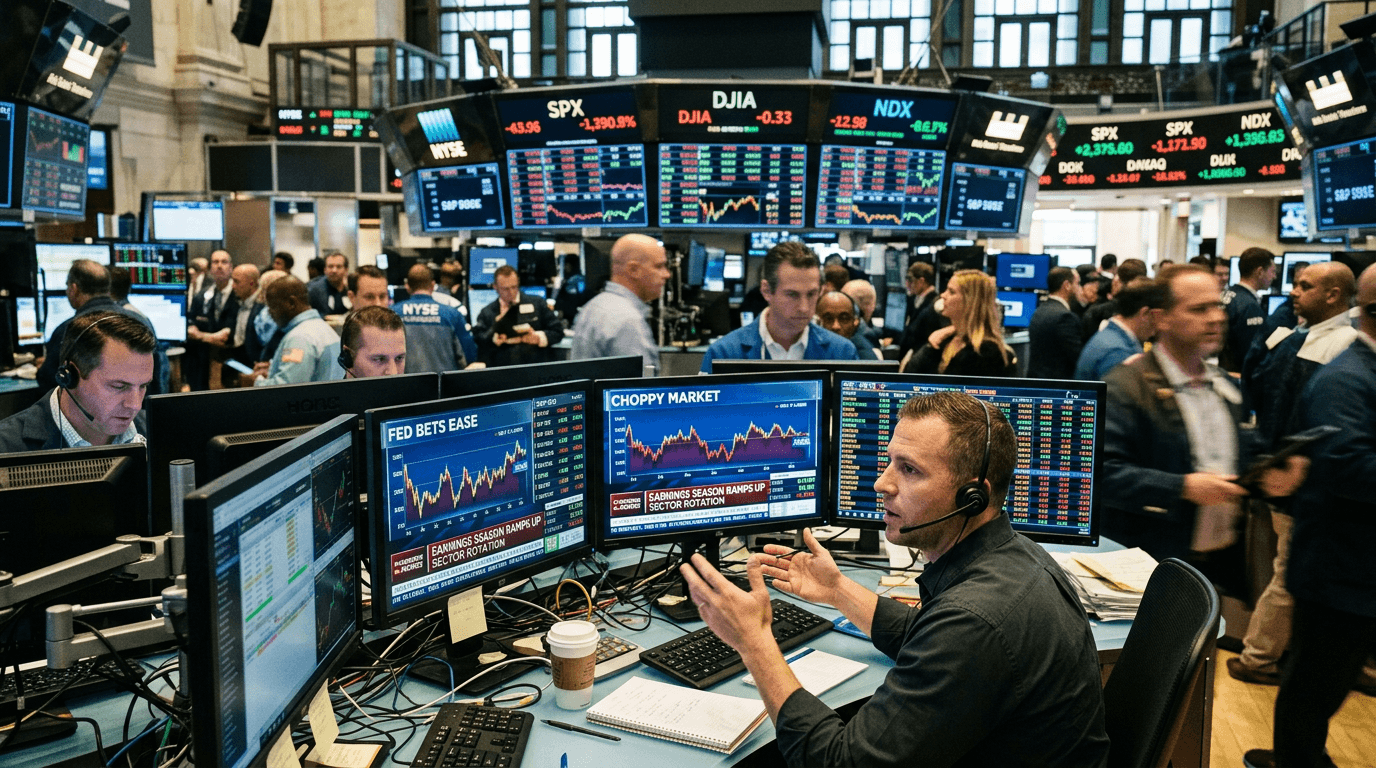
US stocks are struggling to pick a clear direction as two powerful forces collide: fading expectations for further aggressive Federal Reserve rate hikes and the launch of Q2 earnings season. The Dow sits near record levels, but beneath the surface markets are choppy, sector leadership is rotating, and equity-index futures and volatility are being repriced almost daily.
Market Overview: Fed Expectations Meet Earnings Reality
Easing Fed-hike bets effectively mean traders are dialing back how many additional rate increases they expect, or how long they think rates will stay at restrictive levels. When the market prices in a softer rate path, bond yields tend to slip, financial conditions loosen at the margin, and risk assets such as equities usually find support—especially long-duration growth stocks that are more sensitive to interest-rate moves.
Yet that backdrop does not automatically translate into a straight-line rally. When indices like the Dow hover near record highs, investors become more sensitive to any sign that good news is already in the price. A modest shift in Fed expectations can then cause outsized swings as traders rebalance exposure across styles and sectors, using futures markets to quickly adjust risk at the index level. Periods like this are often characterized by intraday reversals, gaps between futures and cash open, and abrupt changes in leadership between value and growth, or cyclical and defensive names.
From a volatility perspective, a calmer Fed outlook can compress implied volatility over time, but the start of earnings season pulls in the opposite direction. Each corporate report is an event that can trigger sharp individual stock moves, and as the number of reports ramps up, the potential for index-level surprises grows as well. The result is a push–pull between macro calm and micro uncertainty.
Why Q2 Earnings Season Matters Now
Earnings season is the several-week window when most publicly traded companies report their quarterly results, usually starting in early to mid-January, April, July, and October.[6][7] Q2 reporting typically ramps up in the second full week of July and runs for about six weeks.[6][7] That makes the current period one of the most information-dense stretches of the year for equity markets.
Historically, earnings season is when the narrative about the economy and corporate health either gets confirmed or challenged. Analysts and investors don’t react only to the absolute numbers, but to how those numbers compare with expectations. In recent Q2 reporting periods, companies have generally surprised to the upside: one analysis found S&P 500 earnings up around 12% year-on-year for Q2 with roughly 79% of companies beating revenue estimates and more than 80% beating earnings forecasts.[3] Another dataset showed total S&P 500 earnings in a past Q2 rising about 24% from the prior year on roughly 11% higher revenues.[1]
Looking ahead to the current Q2 2026 season, some strategists expect another strong quarter, with estimates pointing to around 22% year-on-year earnings growth for the S&P 500, which would mark a second straight quarter of robust expansion.[4] If that kind of growth is delivered—or exceeded—it supports the idea that the US equity market’s strength is underpinned by fundamentals rather than just liquidity or sentiment.
For traders, earnings season also matters because it can reset the forward narrative. Management guidance about margins, pricing power, wage costs, and capital spending can influence how investors think about inflation, productivity, and the broader macro path. That, in turn, can feed back into Fed expectations, creating a loop where earnings and rates continually inform each other.
Sector Rotation, Style Shifts, And Volatility
A key feature of the current environment is rapid sector rotation. When the market senses the Fed is less likely to hike aggressively, high-growth and interest-rate-sensitive sectors such as technology and communication services often benefit, as lower discount rates increase the present value of their future cash flows. At the same time, financials can be pulled in two directions: lower long-term yields can pressure net interest margins, but a more stable growth outlook can support loan demand and credit quality.
Cyclical sectors—industrials, materials, consumer discretionary—tend to trade more on the earnings narrative. If Q2 results and guidance suggest solid demand and resilient margins, these areas can attract flows, particularly if they’ve lagged the mega-cap growth leaders. In some recent quarters, upside earnings surprises have been especially strong in financials and consumer discretionary, underscoring how quickly leadership can flip when the data come in better than feared.[2]
Volatility often rises at the single-stock level as companies report, even if index volatility remains contained. Traders may see sharp moves in options implied volatility around individual earnings dates, followed by quick “vol crush” once the event passes. At the index level, volatility indices can oscillate as the market digests clusters of large-cap reports that heavily influence benchmarks like the S&P 500 and Nasdaq.
How Traders Can Navigate A Wobbly Market
For both live and simulated traders, this kind of environment rewards preparation, discipline, and a clear framework.
First, build an integrated calendar that combines macro and micro events. Earnings season starts a couple of weeks after quarter-end and is busiest in January, April, July, and October, with reports concentrated over roughly four weeks.[5][7] Overlay that with key economic data and Fed communications to see when risk is most likely to spike.
Second, focus on expectations as much as outcomes. Research from market educators emphasizes three things to watch during earnings season: whether results broadly match or beat expectations, how bellwether companies in key sectors are performing, and where the biggest individual earnings surprises occur.[6] A company “missing” estimates with otherwise decent numbers can sell off sharply, while a low-expectation name that just clears a low bar can rally hard.
Third, adapt position sizing and risk management around event risk. Many traders reduce size or avoid holding large directional positions into high-volatility events, instead looking to trade the post-earnings reaction once more information is available. Others may use options strategies—like defined-risk spreads—to express views while capping downside. In a simulated environment, this is an ideal time to practice playbooks: how you trade gap opens, trend days following big reports, or mean-reversion setups after exaggerated moves.
Fourth, think in scenarios rather than predictions. For example: - If earnings broadly beat and Fed hike expectations continue to ease, growth and quality factors may lead, and indices could grind higher despite occasional shakeouts. - If earnings disappoint while the Fed still sounds cautious on inflation, valuations may compress, and defensive sectors (utilities, consumer staples, health care) could outperform. - If earnings are mixed but guidance skews positive, markets could remain range-bound with frequent rotations—an environment where relative-value and sector-rotation strategies thrive.
Key Takeaways For Traders
The current “wobble” in US stocks is less a sign of breakdown and more a reflection of markets repricing two critical variables at once: the path of Fed policy and the trajectory of corporate earnings. Easing Fed-hike bets offer a supportive backdrop, but they also raise the bar for companies to justify stretched valuations with real profit growth.
Earnings season concentrates both information and volatility into a short window. Traders who treat this period as an opportunity to systematically observe how expectations, results, and price reactions interact can develop an edge that lasts well beyond a single quarter. Using tools like earnings calendars, sector dashboards, and simulated trading environments can help translate this macro and micro understanding into a repeatable process.
In the weeks ahead, expect more choppy sessions, sharp moves around major reports, and continued rotation under the hood of the headline indices. For prepared traders, that mix of uncertainty and opportunity is exactly where skill development—and potential performance—can accelerate.