
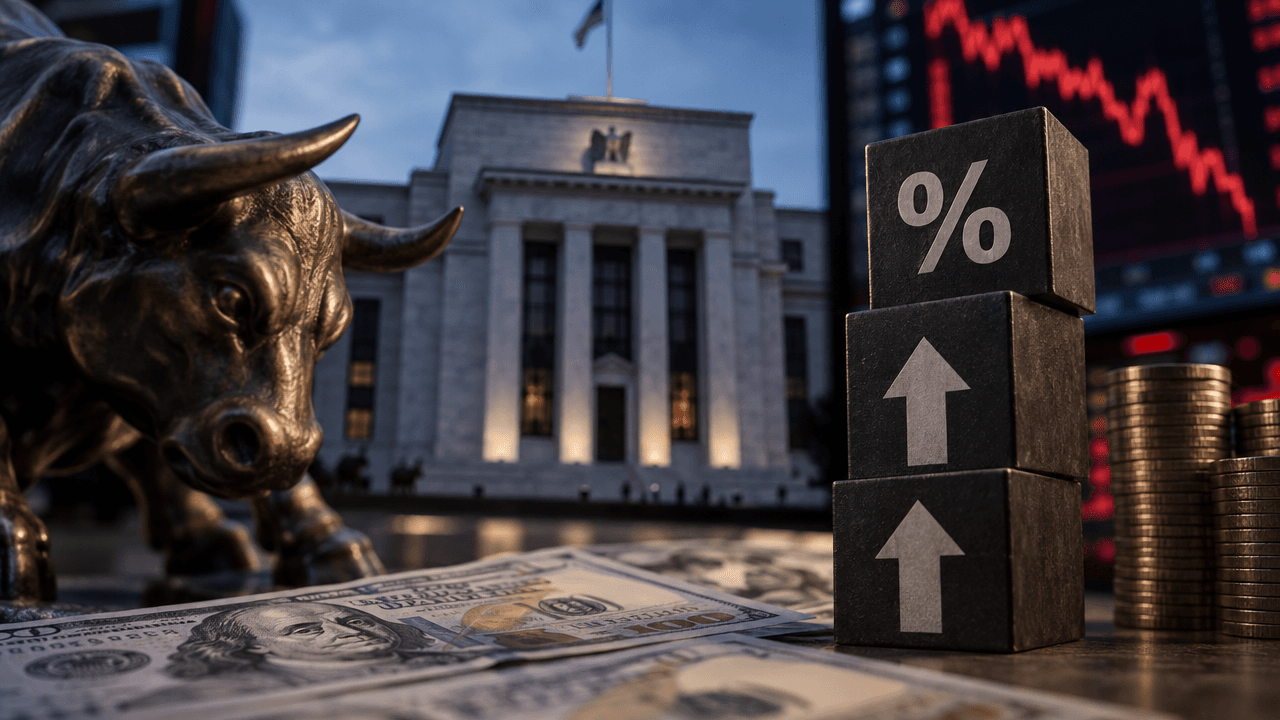
Markets are entering the Fed’s September meeting with nerves on edge, as expectations for a fresh rate hike have firmed and rippled across currencies, bonds, and equities. A stronger U.S. dollar, higher Treasury yields, and softer risk assets are all telling the same story: traders are bracing for a more hawkish Federal Reserve and a higher-for-longer interest-rate path.[1][2][5]
Fed Meeting: What Markets Are Pricing
The September 15–16 Federal Open Market Committee (FOMC) meeting is widely seen as a live event, with futures markets and major global banks converging around the call for a 25 basis point increase in the federal funds rate.[1][2][7] That would lift the target range from roughly 3.50%–3.75% to 3.75%–4.00%, marking the first hike since mid‑2023 and reinforcing the message that inflation is still too high for comfort.[2][4][11]
Recent inflation and labor-market data have pushed the implied probability of a September hike into the 80%–90% zone, up from lower levels earlier in the summer.[1][2][12] Several large brokerages now expect not just a single move, but at least one additional hike by December, with some forecasting rates in the 4.00%–4.25% or even 4.25%–4.50% range by year-end.[2][7][10]
Beyond the headline rate decision, markets are acutely focused on the new dot plot and economic projections. If the median forecast for the terminal policy rate shifts higher, or the dots show fewer cuts projected in 2027, that would validate the recent repricing and could further support the dollar while pressuring risk assets. Conversely, a softer path in the dots could spark a relief rally, especially in equities and high‑beta currencies.
For traders—real or simulated—the key is to treat the decision and the dots as separate event risks. The rate move may be largely priced; the bigger swing could come from changes in the Fed’s forward guidance and its reaction function to inflation and employment.
The Stronger Dollar And Fx Positioning
One of the clearest market expressions of rising Fed hike expectations is the U.S. dollar. The dollar index (DXY) has been holding close to the 99.5 area, near the upper end of its recent trading range and modestly higher on the month.[6][14][15] This resilience reflects not just the prospect of higher short‑term rates, but also relative growth and yield advantages versus other major economies.
In FX, traders have been positioning for a stronger dollar against both developed and emerging currencies, with particular focus on pairs like EUR/USD and AUD/USD.[1][8] A hawkish Fed path tends to weigh on currencies tied to weaker growth or more dovish central banks, while offering carry support to the dollar itself. Emerging‑market FX is especially sensitive, as higher U.S. yields can trigger outflows from local bond markets and force some EM central banks to tighten more aggressively to defend their currencies.[1][12]
For SimFi traders, this environment is ideal for testing scenarios around dollar strength and cross‑asset correlations. Examples include:
Running simulated strategies that short EUR/USD or AUD/USD on hawkish surprises, while modeling tighter stop‑losses due to event‑driven volatility.
Exploring relative‑value trades, such as being long USD against a basket of EM currencies, combined with hedges in local‑currency bond futures to manage rate risk.
Examining how a pullback in the dollar might play out under a dovish surprise, particularly if the Fed signals that September is a one‑and‑done hike.
Treasury Yields And Pressure On Risk Assets
U.S. Treasury yields have climbed into the meeting, with the 10‑year yield approaching 5%, its highest level since late 2023, and shorter maturities also pushing higher in anticipation of tighter policy.[5][13] The move reflects both higher term premia and a reassessment of how long policy will remain restrictive as the Fed continues to prioritize its 2% inflation target.[1][5]
Higher benchmark yields raise the discount rate applied to future cash flows, which makes equities—especially growth stocks with long‑duration earnings—less attractive on a relative basis. This helps explain the softer tone in equity index futures heading into the meeting, as investors trim risk exposure and rebalance toward cash and short‑duration instruments.[1][5]
Credit markets feel the strain as well. Wider spreads and higher all‑in yields can pressure high‑yield bonds and leveraged loans, sectors that tend to underperform when the Fed is actively tightening. At the same time, higher front‑end yields boost the appeal of holding cash-like instruments, making risk premia in equities and credit work harder to justify themselves.
On a SimFi platform, these dynamics can be turned into learning opportunities:
Stress‑test equity portfolios against parallel shifts in the yield curve, observing how valuation metrics and sector performance change.
Model the impact of a 25–50 bp shift in risk‑free rates on discounted cash‑flow valuations for growth versus value stocks.
Simulate portfolio rotations from high‑beta tech into financials and energy, which may respond differently to higher rates and a steeper curve.
What This Means For Traders On Simulated Finance Platforms
For traders using simulated environments like E8 Markets, the looming Fed decision is less about prediction and more about preparation. The event offers a real‑time laboratory to observe how macro shocks propagate across FX, rates, equities, and credit, without the capital risk of live trading.
Ahead of the announcement, traders can design and test playbooks for different scenarios:
Hawkish surprise: Fed hikes and lifts the dots, signaling more tightening to come. In simulations, this might translate into stronger USD, higher yields, weaker equities, and wider credit spreads.
Balanced outcome: Fed hikes but signals data dependence and keeps the terminal rate roughly unchanged. Markets may see a brief spike in volatility, followed by consolidation as existing positions are validated.
Dovish surprise: Fed stays on hold or lowers the expected peak rate. In this case, simulations might show a weaker dollar, rallying risk assets, and a bull‑steepening in the yield curve.
By analyzing how hypothetical portfolios respond under each scenario, traders improve their understanding of macro risk, position sizing, and the importance of event‑driven risk management. This kind of practice is invaluable when transitioning to live markets, where execution discipline and emotional control matter as much as the trade idea itself.
Key Takeaways Before The Decision
First, the core message from markets is clear: a 25 bp Fed hike is the base case, and the risk skew leans toward a higher‑for‑longer policy stance.[1][2][7] Second, that stance is supporting the dollar, keeping DXY near recent highs and pressuring EUR, AUD, and EM FX.[6][8][12] Third, higher Treasury yields are tightening financial conditions and weighing on equities and other risk assets.[5][13]
For traders, the priority now is less about calling the exact outcome and more about managing exposure, planning scenarios, and respecting the potential for sharp intraday moves when the statement, projections, and press conference hit the tape. Simulated finance provides a safe space to rehearse these situations, but the lessons—about macro linkages, volatility, and discipline—translate directly into real‑world trading.