
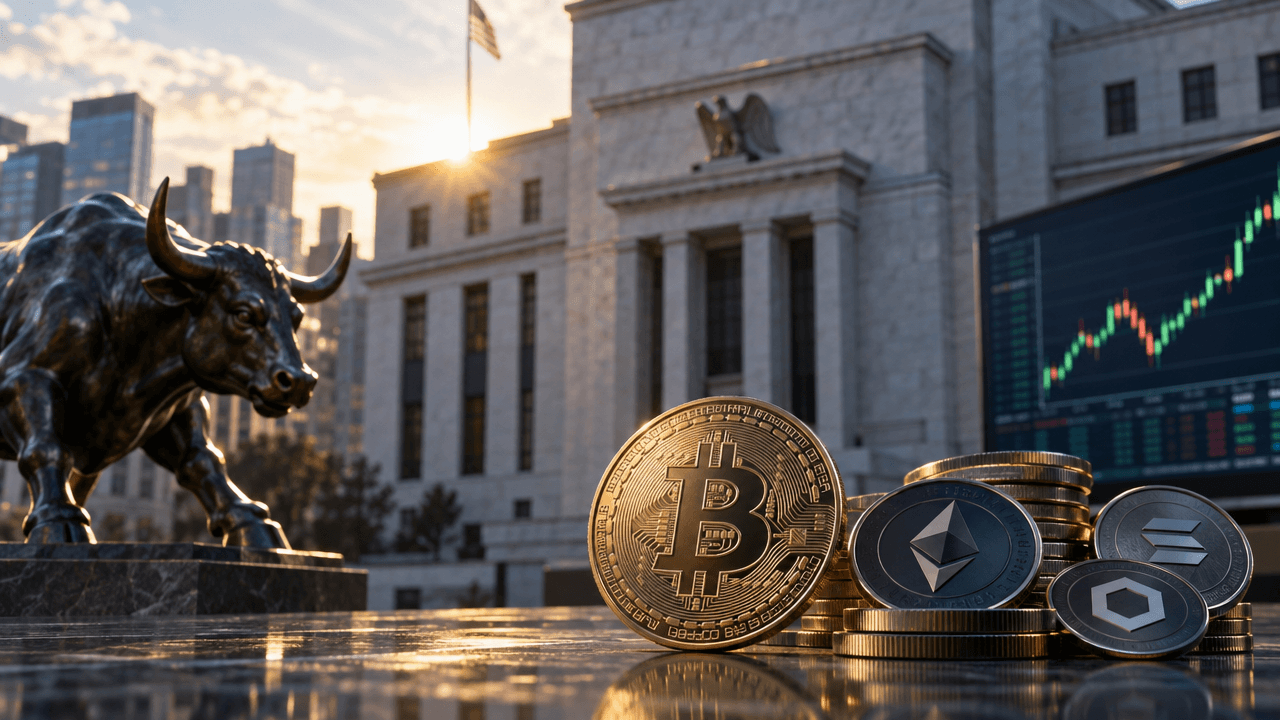
The Federal Reserve’s first interest rate hike since 2023, a 25 basis point move to a 3.75%–4.00% target range, might normally signal tighter financial conditions and pressure on speculative assets, yet markets largely treated it as a confirmation that the expansion remains intact.[3][11][12] Instead of a broad risk-off move, the decision underpinned a relief rally that pushed Bitcoin back above $80,000 and lifted total value locked (TVL) in DeFi protocols beyond $93 billion, reshaping how traders across FX, rates and digital assets read the Fed’s tolerance for innovation and risk-taking.[1][9][10]
MACRO BACKDROP: A “HAWKISH BUT ORDERLY” FED
The September hike came after more than two years of stable policy, marking the first increase since mid-2023 and signaling the Fed’s renewed commitment to steering inflation back toward its 2% objective.[3][12] Elevated price pressures, driven partly by higher energy costs, kept real rates relatively low despite previous tightening, leaving policymakers room to nudge nominal rates higher without deliberately choking off growth.[3][4] The unanimous 12–0 vote within the FOMC reinforced the message of a coordinated, methodical approach rather than an emergency response, an important distinction for traders wary of abrupt regime shifts.[11][15]
Market reaction in traditional assets reflected this “hawkish but orderly” narrative. Two‑year Treasury yields, highly sensitive to policy expectations, rose to their highest levels in more than two years as investors priced in at least one additional hike and a slower path to future cuts.[4] The dollar strengthened broadly, particularly against lower‑yielding currencies, highlighting a renewed carry advantage and reinforcing the US as a yield destination.[4][8] Yet US equities proved more resilient than many feared: the S&P 500 and Nasdaq remained in positive territory, posting gains of roughly 0.4% and 0.8% on the day of the decision, suggesting equity investors see higher rates as compatible with continued earnings growth.[11]
For traders, the macro message is subtle but powerful: the Fed is tightening, but not panicking. Growth remains positive, inflation is a problem but manageable, and policy continues to move in incremental steps—conditions that often support selective risk‑taking rather than a blanket exit from speculative positions.[3][11]
Risk Assets Respond: From Fear To Relief
Heading into the meeting, consensus expectations leaned toward a risk‑off event: higher policy rates, stronger dollar and rising short‑end yields typically compress valuations for growth stocks and high‑beta assets.[4][8] Yet the actual reaction flipped that script. After a brief period of consolidation around the announcement, Bitcoin moved sharply higher, with spot prices pushing back above $80,000 for the first time since earlier in the month.[1][9][10] This rally coincided with a rebound across major altcoins and a renewed bid in digital asset indices, indicating broad participation rather than a single‑asset squeeze.[1][9]
The response in crypto mirrored a more nuanced pattern seen in equities and volatility markets. While some commentators warned of potential 10% corrections in the S&P 500 around the hike, realized moves were far more modest.[5][11] Equity volatility stayed contained, and risk sentiment shifted toward a “policy clarity” narrative: with the path of rates better understood, investors felt more confident allocating to higher‑beta exposures, including FX carry trades, growth sectors and digital assets.[2][5][8]
For active traders, the key takeaway is that positioning and expectations often matter more than the headline itself. When markets lean heavily into a “rate‑hike‑equals‑risk‑off” consensus, a measured move that matches guidance can generate a relief rally as shorts cover and sidelined capital re‑engages.[2][5] Simulated trading environments can be particularly useful in exploring these dynamics—testing how different pre‑meeting positioning shapes post‑meeting price action across asset classes without the capital risk.
DEFI’S RESURGENCE AND ON‑CHAIN SIGNALS
Perhaps the most striking data point from the post‑Fed environment is the renewed strength in decentralized finance. DeFi TVL climbed above $93 billion in the days following the hike, reversing prior outflows and signaling fresh demand for on‑chain yield and liquidity provisioning.[1] This move came alongside rising activity in leading DeFi ecosystems and protocols focused on trading, lending and structured products, many of which benefit from elevated volatility and renewed risk appetite.[1][9]
Several forces underpin this DeFi resurgence. First, higher benchmark rates in TradFi sharpen the focus on risk‑adjusted yield, pushing both institutional and sophisticated retail investors to compare bank deposits, bond yields and on‑chain returns.[3][4] Second, the perception that US policy is becoming more predictable—even if somewhat restrictive—reduces regulatory tail‑risk premiums priced into crypto assets, particularly when complemented by legislative and regulatory developments that acknowledge digital finance infrastructure.[1][9] Finally, DeFi has increasingly integrated with centralized venues, meaning rising spot volumes and derivatives open interest in Bitcoin and major altcoins can quickly translate into deeper liquidity and more attractive returns in DeFi pools.[1][9][10]
For DeFi participants and DeFi‑focused SimFi traders, this backdrop offers an opportunity to study how macro catalysts propagate through on‑chain metrics: TVL changes, stablecoin flows, protocol revenue and governance token performance. Simulated strategies can also model how a combination of rate moves, FX trends and crypto volatility might impact cross‑margin portfolios that bridge TradFi and DeFi exposures.
Implications For Fx, Rates And Simulated Trading
In FX, the stronger dollar and higher front‑end yields revive classic carry strategies, particularly against currencies where central banks are slower to tighten or already signaling cuts.[4][8] This environment encourages relative‑value trades: long USD versus lower‑yielding peers, or selective exposure to currencies backed by commodity strength and credible tightening paths. For rates traders, the key question now shifts from “if” to “how many” additional hikes follow, with the curve increasingly sensitive to inflation data and Fed communication.[3][11]
Simulated finance platforms can turn this uncertainty into a learning advantage. By building and stress‑testing macro‑driven portfolios—mixing US duration shorts, FX carry trades, and crypto beta—traders can explore scenarios such as “one more hike then pause” versus “extended tightening,” without risking real capital. They can examine how a shock to inflation expectations or a growth downside surprise would ripple through bonds, equities and digital assets, and refine risk‑management rules accordingly.
On the crypto side, the relief rally highlights how quickly sentiment can pivot from fear to FOMO when macro risks are partially priced and the actual decision matches guidance. For discretionary and systematic traders alike, that reinforces the importance of monitoring positioning data, volatility surfaces and funding rates, rather than reacting solely to headline events. SimFi environments allow traders to rehearse those reactions—testing rule‑based entries, exits and hedges around scheduled macro catalysts like Fed meetings.
Key Takeaways For Traders
First, the Fed’s 25 bp hike to 3.75%–4.00% confirms a gradual tightening path aimed at containing inflation while preserving growth, a mix that can still support risk assets when expectations are well‑anchored.[3][11][12] Second, the relief rally in Bitcoin above $80,000 and DeFi TVL above $93 billion shows that speculative assets can trade positively off policy clarity, especially when fears of a harsher regime prove overstated.[1][9][10] Third, DeFi’s bounce underscores the increasing sensitivity of on‑chain finance to macro signals, reinforcing the need to integrate rates, FX and crypto views into a unified risk framework.[1][4]
For traders using simulated environments, this episode is a case study in how macro catalysts, positioning and sentiment interact. Building playbooks around central bank meetings—complete with scenario analysis, cross‑asset hedging and post‑event review—can significantly improve real‑world readiness. As the Fed navigates the final stages of its inflation fight, the intersection of policy, innovation and digital markets will remain a critical arena for both learning and opportunity.