
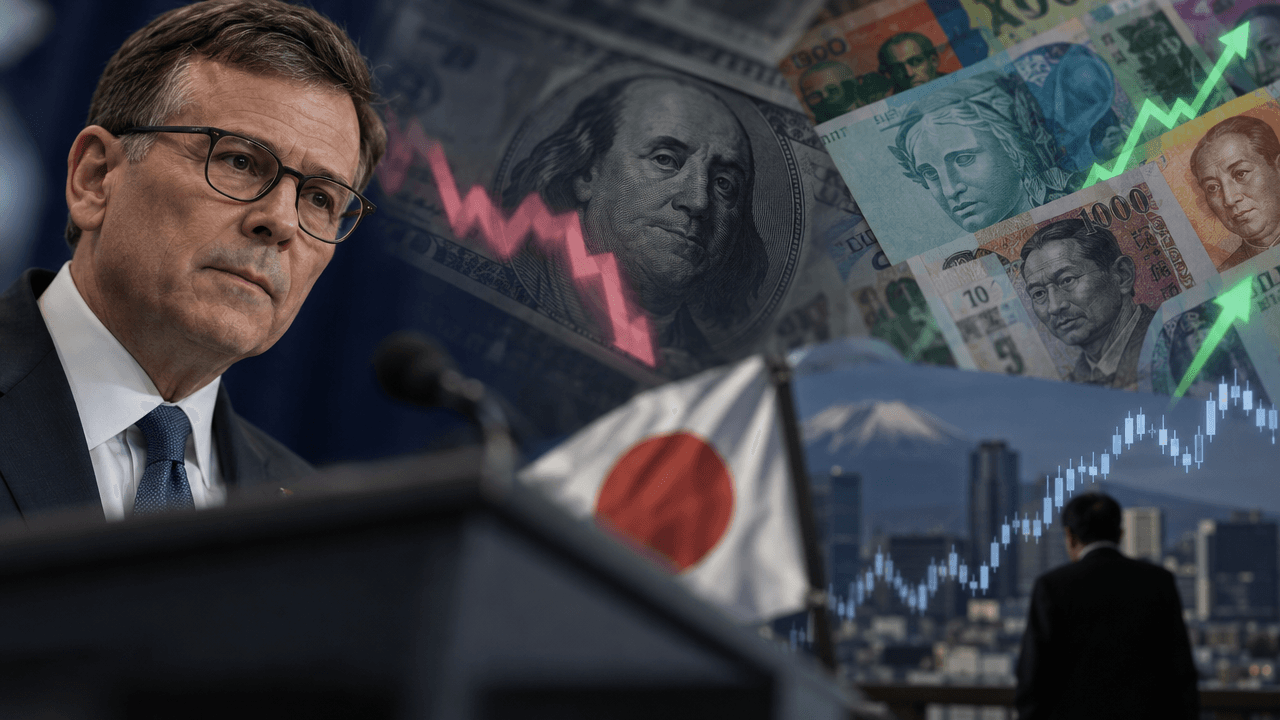
The dollar began the week under pressure as investors interpreted Federal Reserve Chair Kevin Warsh’s latest comments as reducing the likelihood of an interest-rate hike at the Fed’s October meeting. Warsh declined to preview the central bank’s decision, saying he does not prejudge policy meetings, but his measured tone offered no fresh support to traders expecting tighter policy. As a result, markets increased their preference for a hold, weighing on the dollar and giving emerging-market currencies additional room to recover.
The reaction highlights an important feature of foreign exchange markets: currencies often move not on what policymakers announce, but on what they leave unsaid. In this case, investors had been watching recent inflation data and previous Fed guidance for evidence that another rate increase could come soon. Warsh’s refusal to reinforce that view was interpreted as a less hawkish signal.
Markets Reassess The October Fed Decision
The Federal Reserve raised its benchmark interest-rate range by 25 basis points in September to 3.75%–4%, its first increase since 2023. That move removed some monetary accommodation, but it also left traders debating whether another hike would arrive before the end of the year.
Warsh emphasized that the Fed remains focused on restoring price stability and acknowledged that inflation continues to pose a challenge. However, he also said that he would not indicate what he might do at the October or December meetings. Following his comments, market pricing shifted more decisively toward an October pause. Goldman Sachs economists said the remarks, alongside comments from other Federal Open Market Committee participants, pointed toward a hold at the October meeting. [2]
Options and futures markets now reflect a much lower probability of an October increase than traders had assigned earlier in the month. One market assessment placed the odds of an unchanged decision at approximately 73%, up from 53% a month earlier. [5] Expectations for a December hike remain relevant, but the immediate policy risk has moved away from an imminent tightening surprise.
For currency traders, this distinction matters. A rate hike can make dollar-denominated assets more attractive by increasing their yield advantage. When the timing of that hike is pushed further into the future, the dollar’s support from interest-rate expectations can weaken even if the Fed remains concerned about inflation.
Why The Dollar Is Losing Momentum
The dollar’s recent weakness is best understood as a repricing of expectations rather than a complete change in the Federal Reserve’s policy direction. Warsh did not signal that the Fed was preparing to ease policy. Instead, investors concluded that the central bank was less likely to tighten immediately.
That adjustment can affect several markets at once. Treasury yields may soften as traders reduce expectations for near-term policy rates. Lower yields can reduce demand for the dollar, especially against currencies whose central banks are also maintaining restrictive policies. The dollar index fell 0.2% after Warsh’s remarks, recording its sharpest weekly decline since early September. [5]
The dollar also faces a more challenging global backdrop. Warsh noted that central banks around the world had broadly engaged in synchronized tightening, meaning the United States does not enjoy an unlimited policy advantage. If other economies can maintain credible anti-inflation policies while their growth outlooks improve, investors may become more willing to diversify away from the dollar.
For emerging markets, a softer dollar can be especially helpful. Many governments and companies in developing economies have debt or trade obligations denominated in U.S. dollars. When the dollar declines, the local-currency cost of servicing those obligations may ease. A weaker dollar can also encourage capital flows toward emerging-market bonds, equities, and currencies, although those gains remain vulnerable to renewed inflation or risk aversion.
The Yen Remains A Special Case
The dollar was also slightly lower against the yen near 157.75, but the pair remains highly sensitive to official intervention concerns. USD/JPY was recently trading around 157.79, while Japanese officials warned that they were prepared to act again if necessary. Market participants increasingly view the area near 160 as a level where the probability of intervention rises sharply. [17]
This creates a complicated dynamic. A wide interest-rate gap between the United States and Japan continues to support the dollar against the yen. Yet every move toward the 158–160 region increases the risk that Japanese authorities could respond verbally or through direct market operations. As a result, traders may be reluctant to chase dollar-yen gains even when underlying yield differentials remain favorable.
For SimFi traders, USD/JPY illustrates why technical levels should not be analyzed in isolation. A chart resistance zone can become more powerful when it overlaps with a known policy risk. Stops placed too close to such levels may be vulnerable to sudden volatility, while oversized positions can suffer when intervention headlines trigger a rapid reversal.
What Traders Should Watch Next
The dollar’s next major moves will depend on whether incoming data confirms or challenges the market’s current interpretation of the Fed. Inflation, employment, consumer spending, and economic-growth figures will all influence the debate over whether the October pause is temporary or part of a longer wait-and-see approach.
Traders should also monitor Treasury yields, Fed speakers, and the pricing of December contracts. A stronger-than-expected inflation report could revive rate-hike expectations and restore dollar demand. Conversely, softer data may reinforce the view that the Fed can remain on hold while assessing the impact of its September increase.
Risk management is particularly important during this period because expectations are compressed. When markets broadly agree that a central bank will hold rates, a surprising data release or policy comment can generate a sharp adjustment. Rather than treating the dollar’s decline as a one-way trend, traders should identify the economic evidence that would invalidate their view.
Practical Takeaways
First, distinguish between a policy pause and a policy pivot. The Fed may hold rates in October without abandoning its commitment to price stability.
Second, track interest-rate expectations alongside price charts. Currency momentum often changes before the policy decision itself as futures markets adjust.
Third, treat emerging-market strength as conditional. A weaker dollar can support these currencies, but global risk sentiment, commodity prices, and local political developments still matter.
Finally, respect intervention risk in USD/JPY. Near 157.75, the yen remains vulnerable to wider moves, but official warnings can limit the dollar’s upside and accelerate reversals.
Conclusion
Fed hold expectations are weighing on the dollar because markets no longer see an October rate hike as the most likely near-term outcome. Warsh’s cautious, noncommittal message did not eliminate the possibility of future tightening, but it removed an important source of immediate dollar support. That shift has helped emerging-market currencies and placed renewed attention on the yen, where intervention concerns remain significant.
The broader lesson is that currency markets respond to changing probabilities, not just completed policy decisions. Until the Fed meets, every inflation report, yield move, and official comment can reshape the outlook. For traders, flexibility and disciplined position sizing may be more valuable than making an aggressive directional forecast.