
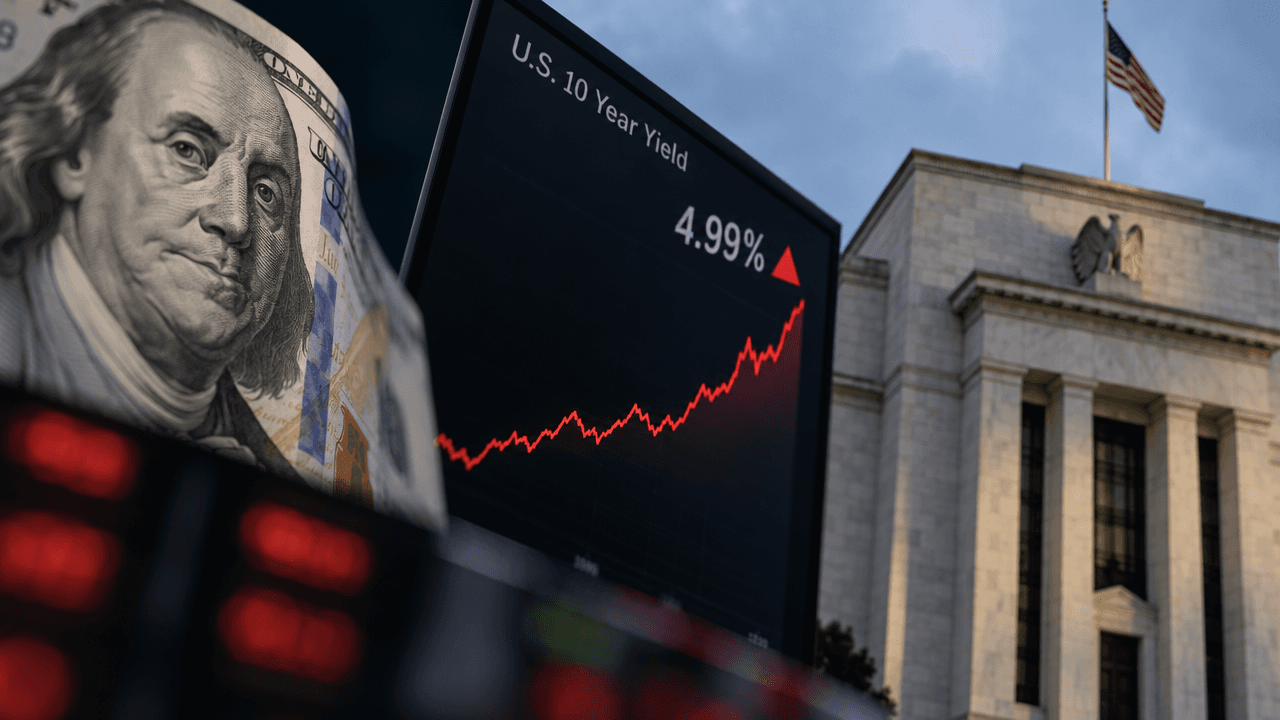
Bond markets have seized the spotlight as the U.S. 10-year Treasury yield climbs to around 5% on the eve of the Federal Reserve’s latest policy decision, shaking equities and underpinning the U.S. dollar.[2][5][12] For traders on both live and simulated platforms, this combination of higher long-term rates and central-bank uncertainty is creating one of the most important short-term trading environments of the year.[2][5][9]
MARKET BACKDROP: YIELDS NEAR 5%, FED IN FOCUS
The 10-year Treasury yield has pushed to roughly 5%, a level not seen on a sustained basis since the mid-2000s and only briefly touched during the bond selloff of 2023.[1][6][12] Recent prints around 5.0–5.01% mark a clear break higher from the 4–4.5% range that dominated earlier in the year, signalling tighter financial conditions across the economy.[2][5][7]
This move is not happening in a vacuum. It comes just one day before the Fed’s rate announcement, where futures markets are pricing in a widely expected 25 basis point hike.[2][9] With the hike largely discounted, attention is shifting to the new dot plot and the press conference from Fed Chair Warsh, which will shape expectations for how long policy stays restrictive.[2][9]
At the same time, the U.S. dollar index is hovering near 99.6, reflecting renewed demand for dollar assets as investors seek higher yields and relative safety ahead of the meeting.[2][9] The combination of a firm dollar and rising yields is tightening global financial conditions, a key variable for risk assets and cross-border capital flows.[2][4][9]
WHY 5% ON THE 10-YEAR MATTERS
The 10-year Treasury acts as the reference rate for a wide swath of borrowing costs, from mortgages and corporate bonds to auto and student loans.[1][4][10] When this benchmark jumps toward 5%, the entire curve of market-based borrowing rates shifts higher, raising the hurdle rate for investment and dampening risk appetite.[1][4][10]
Historically, moves to 5% on the 10-year have coincided with periods of stress in equities and housing, as investors reassess valuations against a safer asset paying much more than in recent years.[1][5][10] Analysts point out that this level is a psychological threshold: once breached, it can trigger rebalancing away from stocks and into bonds, especially among yield-sensitive investors.[5][15]
For traders, the significance is twofold. First, higher long-term yields push up discount rates used in valuation models, hitting long-duration assets such as growth stocks and speculative plays hardest.[5][10][15] Second, the 10-year yield is a key input into expectations for the “neutral” rate, influencing how far and how long the Fed may need to keep policy tight to control inflation.[4][5][6]
Stocks Under Pressure As Discount Rates Rise
Unsurprisingly, equity indices have been under pressure as the 10-year pushes toward 5%, with investors rotating out of risk and into cash-like or fixed-income exposures.[5][15] Higher yields reduce the relative appeal of equities by offering a more attractive risk-free return, particularly for conservative portfolios.[5][10]
Rate-sensitive sectors such as technology, real estate, and small caps often feel the impact first, as their valuations rely heavily on future earnings and cheaper financing.[5][10][15] In contrast, some financials and income-oriented names may find support if they can benefit from higher lending margins or pass through increased borrowing costs.[1][5]
Volatility also tends to rise around inflection points in yields, as systematic and options-based strategies adjust exposure.[5][14] For SimFi traders on platforms like E8 Markets, this creates an environment rich in short-term opportunities but demanding disciplined risk management, particularly around key levels such as 5% on the 10-year and recent lows in major indices.[5][12][14]
Dollar Strength And Global Ripple Effects
The climb in U.S. yields has supported the dollar, keeping the U.S. dollar index near the high-90s and reinforcing a bid for dollar-denominated assets.[2][9] Higher Treasury yields improve the relative return for holding dollars versus other major currencies, encouraging capital flows into U.S. markets.[2][4][9]
For global investors, a stronger dollar and higher U.S. yields can pressure emerging-market currencies and dollar borrowers, raising the cost of servicing existing debt.[4][5] Export-focused economies may face tighter conditions as their currencies weaken and dollar funding becomes more expensive, potentially feeding back into risk sentiment worldwide.[4][5][12]
FX markets are particularly sensitive around Fed meetings, and with yields already elevated, any hawkish surprise in the dot plot or guidance could trigger sharp moves in dollar pairs.[2][9] Conversely, hints that the current hiking cycle is nearing its end could cap yields and take some steam out of the dollar, offering relief to risk assets.[2][4]
Trading Playbook For The Fed Meeting
With a 25 bp hike largely priced in, the real market-moving variables over the next 24 hours will be the Fed’s rate projections, language around inflation and growth, and Chair Warsh’s tone in the press conference.[2][9] Traders will be watching for clues on three fronts: how many more hikes are likely, how long rates may stay elevated, and whether the Fed sees any financial-stability risks from the jump in long-term yields.[4][5]
Short-term rates and FX markets are poised for outsized reactions because positioning is already skewed toward higher yields and a stronger dollar.[2][9] If the Fed leans more dovish than expected—acknowledging tighter financial conditions from the 10-year’s surge—markets could see a relief rally in stocks and a pullback in the dollar.[4][5] A more hawkish stance, emphasizing persistent inflation risks, would likely reinforce the current trend of higher yields, weaker equities, and a firmer dollar.[2][4][5]
SimFi traders have a unique advantage in this type of environment: the ability to test scenarios without real capital at risk, while still experiencing live market conditions and slippage.[5][12] Practicing around the decision with simulated positions in indices, Treasuries, and major FX pairs can help traders refine playbooks for future high-volatility events.[5][12][14]
Conclusion: Stay Nimble Around A Critical Inflection Point
The convergence of a 10-year yield near 5%, a stronger dollar, and a pivotal Fed meeting puts markets at a critical inflection point where small changes in guidance can drive large price swings.[2][5][9] For traders, the key is to respect the impact of higher long-term rates on valuations and liquidity, while remaining flexible enough to adjust if the Fed’s tone shifts the narrative.[4][5]
Whether trading live or in a SimFi environment, the next 24–48 hours are an opportunity to observe how bonds, stocks, and FX interact when the world’s most important benchmark yield tests a multi-decade threshold.[1][5][12] Staying focused on levels, understanding the macro drivers, and using risk tools effectively can turn this period of uncertainty into a valuable learning and trading experience.