
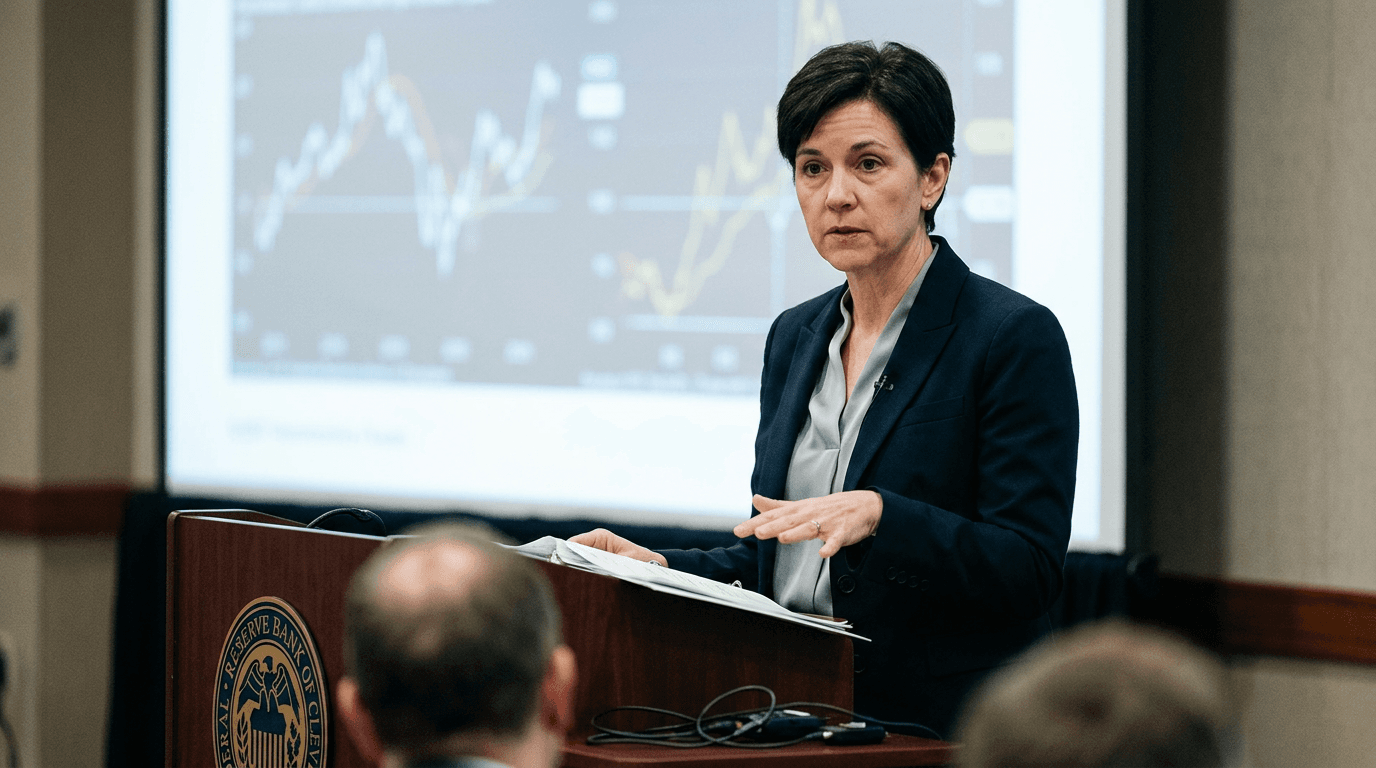
When a sitting Federal Reserve regional president says inflation is still “too high” and that policy may not be restrictive enough, markets listen closely.[1][2] Cleveland Fed President Beth Hammack’s latest comments reinforce the idea that US interest rates are likely to stay on hold at elevated levels for longer than many traders had hoped, with a non-trivial risk that the next move could even be a hike if inflation fails to cool.[1][3][6][7] That stance supports the US dollar and puts ongoing pressure on risk assets and rate-sensitive futures as investors reprice the path of monetary policy.[4]
What Hammack Actually Said
Hammack framed the current environment as a “challenging time for monetary policy,” driven by the tension between resilient employment and stubbornly high inflation.[4] She argued that, given uncertainties around the outlook, it is “reasonable to keep rates steady” for now, rather than rushing into cuts or hikes.[2][3]
Crucially, her concern is clearly skewed toward inflation risks. She noted that inflation has been above the Fed’s 2% target for more than five years and is, in her words, “too high and moving higher.”[1][3] In public remarks, she has suggested inflation is likely to remain above target for another one to two years, with price growth only returning to around 2% by late 2027 or early 2028.[4]
That persistent overshoot leads her to question whether current policy is restrictive enough. Hammack warned that if inflation pressures continue to mount, “it may soon be appropriate to act,” which in context means considering additional rate increases rather than cuts.[1][2][6][7] The message is clear: cuts are off the table near term, and hikes are not completely ruled out.
Higher-for-longer: What It Means For Markets
The phrase “higher for longer” has become shorthand for a world in which policy rates stay elevated well beyond the typical post-tightening cycle, and Hammack’s comments fit that narrative.[3][4][6] For fixed income markets, this means:
- Short-term yields anchored at restrictive levels, keeping the front end of the curve elevated.
- Reduced probability of near-term rate cuts priced into futures and swaps curves.
- Ongoing pressure on longer-maturity bonds as investors demand compensation for extended tight policy.
Equity markets, especially growth and high-duration sectors, tend to feel the strain as higher discount rates compress valuations. Risk assets generally struggle when the cost of capital is both high and uncertain. Hammack’s emphasis on inflation risk over labor-market softness reinforces the idea that the Fed is willing to tolerate some cooling in activity to ensure inflation returns to target.[1][3][6][7]
The US dollar, meanwhile, typically benefits from elevated real yields and a central bank signaling a firm stance against inflation. Expectations of prolonged high rates and a potential hike bias can attract capital into dollar-denominated assets, supporting the currency against peers and tightening global financial conditions.[4]
Impact On Rate-sensitive Futures And Simulated Trading
For traders in rate-sensitive futures – such as Fed funds, Eurodollar-like instruments, Treasury futures, and equity index futures – Hammack’s message is a direct input into pricing. If the market shifts from expecting cuts to pricing a long plateau or even modest upside in rates, several dynamics follow:
- Fed funds futures and similar contracts reprice the expected policy path, pushing implied rates higher across near and intermediate maturities.
- Treasury futures may see increased volatility as traders reassess duration risk under a stickier inflation scenario.
- Equity index futures can come under pressure as higher discount rates and slower disinflation weigh on earnings multiples.
In a SimFi environment like E8 Markets, these macro signals become powerful educational tools. Simulated trading allows participants to model multiple scenarios: a steady-rate baseline, an upside inflation surprise leading to a hike, or a downside growth shock forcing the Fed to pivot later than anticipated. By testing strategies across these paths, traders can better understand how macro communication from the Fed translates into price action in futures markets.
For example, a trader might construct a simulated position that benefits from a further steepening of the yield curve if short-end rate expectations move up while long-end yields lag. Another might explore hedging equity exposure via index futures in anticipation of a risk-off move triggered by renewed rate hike fears.
HOW TRADERS CAN RESPOND TO A “NO HURRY TO CUT” FED
Hammack’s comments do not guarantee further tightening, but they do push back firmly against the idea of imminent easing.[1][2][3][6][7] Traders can respond in several practical ways:
- Revisit assumptions: If your strategy implicitly relies on a quick succession of rate cuts, stress-test it under a scenario where rates remain at current levels into 2027.
- Focus on real rates: With inflation expected to stay above target for some time, monitoring the interaction between nominal yields and inflation expectations becomes crucial for assessing the true stance of policy.
- Watch data closely: Hammack explicitly tied her stance to incoming data, especially inflation metrics. Surprises in CPI, PCE inflation, and wage growth could quickly shift market expectations for the Fed’s next move.
- Manage duration and leverage: In a higher-for-longer environment, duration risk and leveraged positions in rate-sensitive assets can amplify losses if yields grind higher. Simulated trading can help calibrate appropriate position sizes.
On platforms offering simulated environments, traders can practice adapting portfolios to evolving Fed narratives without real capital at risk. That experience can be invaluable when translating views into live markets, where reactions to central bank commentary are often swift and unforgiving.
Key Takeaways For Simfi Participants
Several key lessons emerge from Hammack’s remarks for anyone learning or trading in a SimFi framework:
- Fed communication is itself a market driver. Even without a formal policy move, a clear signal that rates will stay high can move currencies, bonds, equities, and futures.
- The inflation narrative is central. As long as inflation is described as “too high” and forecast to remain above target for years, the Fed’s bias will lean toward maintaining or increasing restriction.[1][3][4][6][7]
- Scenario thinking is essential. Traders should build and test strategies across multiple policy paths rather than anchoring on a single forecast.
- Risk management matters more when policy is uncertain. Elevated rates and shifting expectations increase volatility, making position sizing, diversification, and hedging critical skills.
By internalizing how a single Fed official’s nuanced stance can ripple through asset prices, traders deepen their understanding of macro-driven markets. Hammack’s higher-for-longer message underscores that, in the current cycle, patience and discipline – both in central banking and in trading – remain essential.