
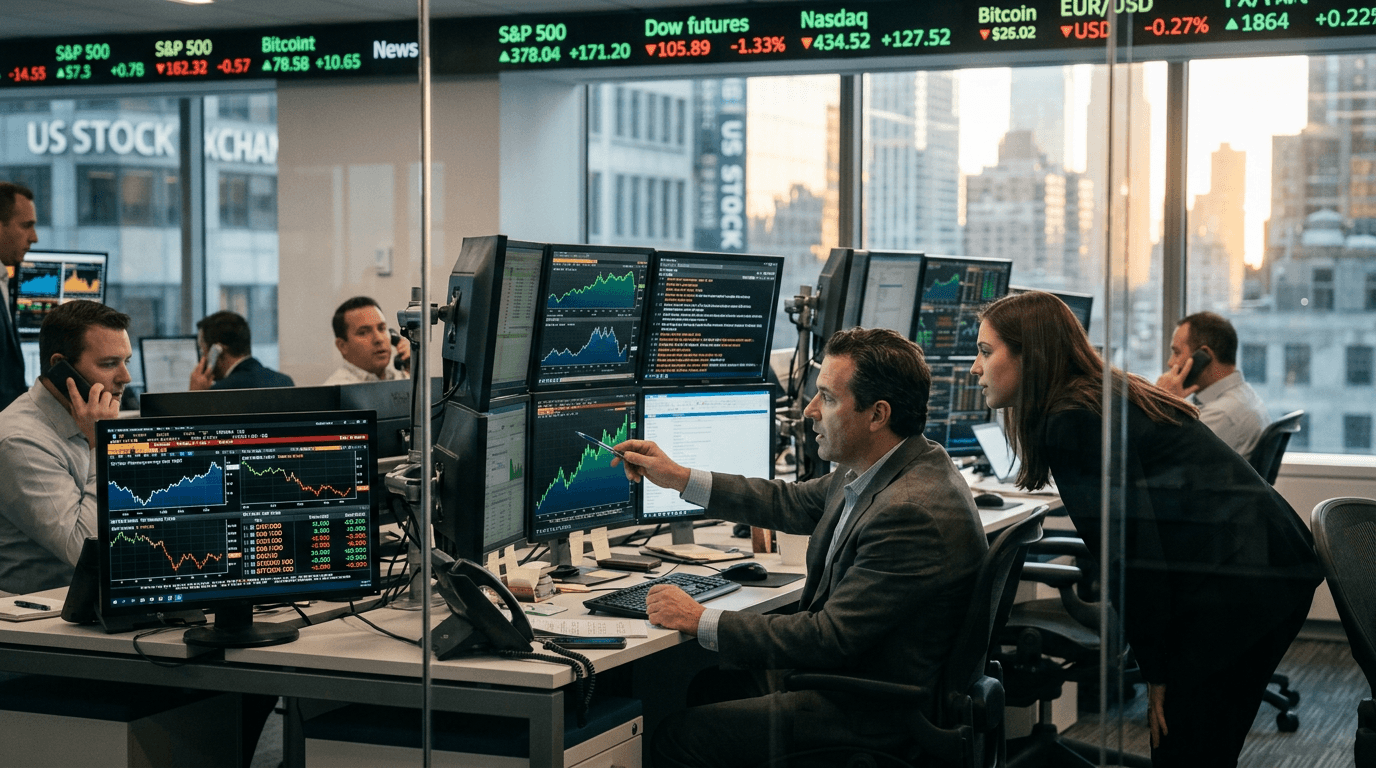
U.S. stock futures are starting the day on a firmer footing, as traders breathe a little easier about the prospect of more interest-rate hikes from the Federal Reserve.[1][2] E-mini S&P 500 contracts are inching higher, with Nasdaq futures outperforming, reflecting renewed appetite for growth and tech exposure as bond-market pressure cools.[1][8] Beneath the modest moves is a bigger story: shifting expectations about the Fed, the cost of money, and how those expectations ripple through every major asset class.
Why Rate-hike Fears Matter
When investors talk about “rate-hike fears,” they are really talking about the discount rate that underpins almost every valuation model in modern finance.[20] Higher policy rates from the Fed typically mean higher yields on government and corporate bonds, raising the hurdle rate for equities and compressing valuation multiples, especially for long-duration growth stocks.[3][8]
Recent softer U.S. labor data and a weaker-than-expected jobs report have challenged the narrative that the Fed still needs to tighten aggressively.[1][2][5] July payrolls posted a surprise decline, and wage growth cooled, both of which reduce the urgency for additional hikes.[1][8] As a result, interest-rate futures now assign a lower probability to near-term hikes, with some traders betting the Fed can stay on hold at upcoming meetings.[5]
For equity markets, this matters because lower perceived terminal rates increase the present value of future earnings, especially in cyclical and growth sectors. For traders, the question is not just “Will the Fed hike?” but “How does the probability distribution around that decision shift day by day?”
WHAT “FIRMER” FUTURES SIGNAL
Stock index futures are the market’s 24-hour barometer of equity sentiment. When S&P 500, Dow, and Nasdaq futures trade modestly higher before the cash open, it signals that investors are incrementally more willing to take risk, but not yet in full “risk-on” mode.[1][8][18]
Today’s firm tone is driven by a combination of:
- Softer jobs and wage data, pointing to reduced pressure on the Fed to tighten.[1][2][8]
- Recent inflation prints that show price pressures cooling from earlier peaks.[3][4]
- A Fed that has opted to keep its policy rate range unchanged at 3.50% to 3.75%, reinforcing the “wait and see” stance.[15]
In this environment, equity futures tend to lead the way higher, with tech-heavy indices like the Nasdaq gaining more as long-duration assets benefit from lower rate expectations.[1][8] A modest uptick in futures is not a guarantee of a strong cash-session rally, but it does reveal the directional bias: traders are more concerned with “how much” rates might rise than “whether” they will rise at all.
For simulated traders working in platforms like SimFi environments, watching how futures respond to each new data release—jobs, CPI, PMI—builds an intuitive feel for macro sensitivity, without the capital risk of trading live.
Cross-asset Ripple Effects: Fx, Crypto, Bonds
Rate expectations are the anchor not just for stocks, but for the entire cross-asset complex. When fears of further hikes ease, the first mechanical reaction is often in the bond market: yields tend to fall as investors price in a lower path for policy rates.[8] Lower yields, in turn, can weaken the U.S. dollar relative to other currencies, especially if foreign central banks are perceived as more hawkish.[20]
For FX traders, a softer rate-hike narrative often translates into:
- Potential downside pressure on the dollar versus higher-yielding or risk-sensitive currencies.
- Renewed interest in carry trades if volatility stays contained.
Crypto markets also feel the impact. Lower real yields and a less aggressive Fed can support risk appetite, making cryptocurrencies and other speculative assets more attractive on a relative basis. While crypto has its own idiosyncratic drivers, liquidity and macro sentiment still matter: when markets believe money will remain cheaper for longer, the search for return tends to move further out the risk curve.
This is why futures pricing in equities often feeds directly into FX and crypto sentiment: the same macro narrative—less tightening, more policy stability—gets translated into different instruments in different ways.
How Traders Can Position In A Cooling Rate-hike Narrative
Moderately firmer futures, driven by easing rate fears, call for nuance rather than extremes. Traders can think in terms of scenarios rather than a single forecast:
- Base case: The Fed holds rates steady while monitoring inflation and employment, keeping optionality for a future hike but not committing.[12][15]
- Upside case for risk assets: Data continues to soften just enough to keep the Fed sidelined, without tipping the economy into recession, supporting equities and credit.
- Downside case: Inflation surprises higher again, reviving talk of additional hikes and pushing yields and volatility up.
In practice, some tactical ideas often considered in a cooling rate-hike environment include:
- Tilting toward quality growth and technology, which are sensitive to rate expectations but supported by earnings momentum.[3][17]
- Maintaining diversification with defensives and value, in case inflation or geopolitical risks re-emerge.[4][8]
- Using futures and options to express macro views with defined risk—such as spread trades between indices, or hedges against renewed rate volatility.
In a simulated trading context, this is an ideal backdrop to test:
- How your strategies perform under different interest-rate paths.
- The sensitivity of your portfolio to changes in yields and volatility.
- Cross-asset relationships—for example, how your equity positions behave when bond yields move 25–50 basis points on a surprise data release.
Practical Lessons For Simulated And Real Markets
The key lesson from firmer U.S. stock futures as rate-hike fears ease is that markets are probabilistic, not binary. The Fed did not suddenly become dovish; rather, the incoming data nudged the odds away from imminent tightening and toward a more patient stance.[1][2][5][15] Prices adjust to those odds in real time.
For traders—whether in live markets or SimFi environments—this highlights several skills worth practicing:
- Reading macro data in context: A single jobs report is part of a broader trend, not a standalone signal.
- Tracking expectations via futures: Equity index futures, interest-rate futures, and volatility indices collectively show how the market’s narrative is evolving.[5][8]
- Managing risk around events: Data releases can rapidly reprice rate expectations; using simulated trades allows you to rehearse sizing, hedging, and timing without financial stress.
As conditions shift, it is the traders who understand how central bank expectations flow through futures, FX, crypto, and volatility that are best placed to adapt. Today’s firmer futures are a reminder that when the cost of money looks a little less likely to rise, the appetite for risk tends to follow.