
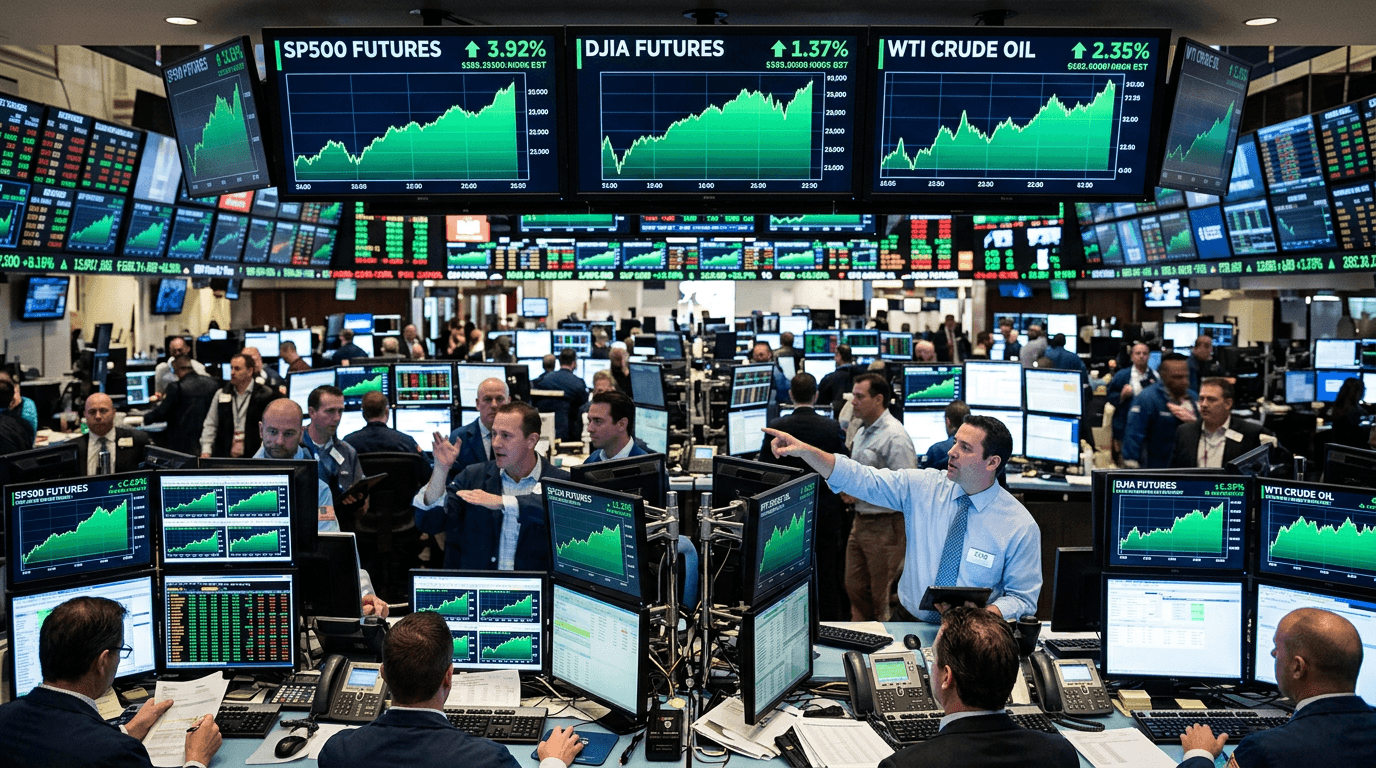
The first thing markets did as reports emerged of easing tensions between the U.S. and Iran was exhale. U.S. stock-index futures ticked higher, and oil prices also moved up, signaling a collective reassessment of risk. Futures traders were not celebrating a resolved conflict so much as pricing out the worst-case scenarios that had been hanging over the market.
Markets React To Easing Tensions
Equity futures often act as the market’s early-warning system, reflecting how traders expect cash markets to open once regular trading begins. When headlines suggest that the immediate risk of military escalation is receding, futures typically adjust quickly to reflect lower perceived “tail risk” – those low-probability but high-impact outcomes that can upend portfolios.
In this case, reports that the U.S. and Iran had agreed to halt attacks removed, at least temporarily, the risk of broader regional conflict spilling into energy supply routes or prompting a larger geopolitical crisis. With those extreme scenarios less likely, index futures such as the S&P 500 and Nasdaq-100 had room to move higher as investors reassessed the risk premium embedded in prices.
Importantly, the upward move in futures does not mean all geopolitical risk has disappeared. Rather, traders are signaling that the most acute concerns have softened, allowing them to refocus on fundamentals like earnings, growth, and central bank policy. That shift in focus can itself be a catalyst for risk assets to grind higher.
Why Geopolitical Risk Matters For Futures
Geopolitical events affect markets through several channels, and futures markets tend to price these channels quickly because they trade nearly around the clock.
First, there is the direct impact on sentiment. When tensions rise, investors demand a higher risk premium, often expressed as lower equity prices and higher volatility. Headlines about missile strikes, sanctions, or military escalation can trigger rapid risk-off moves, especially in futures where leverage and speed magnify reactions.
Second, geopolitics can influence macro fundamentals. For example, conflict in energy-producing regions raises the risk of supply disruptions, which can push oil prices higher. Higher energy costs filter into inflation data, shaping expectations for interest-rate policy. That is why traders pay close attention not just to the geopolitical story itself, but to its likely knock-on effects on commodities and inflation-sensitive sectors.
Finally, geopolitical risk interacts with existing market narratives. If investors are already concerned about slowing growth or sticky inflation, a flare-up in tensions can reinforce those fears. Conversely, a de-escalation can give markets permission to resume an existing trend, such as a rally driven by strong corporate earnings or optimism about policy support.
Oil, Inflation And Sector Rotation
The move in oil prices alongside rising U.S. stock futures is a crucial part of this story. Easing tensions reduced the probability of a severe supply shock, yet crude prices still moved higher, reflecting the ongoing risk premium associated with the region and the market’s reassessment of demand and supply expectations.
For equity traders, oil and inflation are joined at the hip. Higher energy prices feed directly into headline inflation and indirectly into core measures via transportation and production costs. That matters for sectors such as consumer discretionary, industrials, and small caps, which tend to be more sensitive to cost pressures and changes in household spending power.
Conversely, energy-sector stocks often benefit from higher crude prices, as do some parts of the materials and infrastructure ecosystem. When oil rises on easing geopolitical stress rather than on clear demand weakness, the market may interpret it as a manageable inflation impulse rather than a threat to growth, encouraging a rotation into cyclicals and value stocks rather than a flight to defensives.
Traders will watch how inflation-sensitive sectors respond in the days ahead. If bond yields remain anchored and inflation expectations stable, modestly higher oil could be seen as a tailwind for energy and a neutral factor for broader equities. If yields and inflation expectations start to climb, the same oil move could be interpreted very differently.
How Traders Can Navigate Geopolitical Headlines
For many market participants, geopolitical shocks are among the most difficult events to trade. They are unpredictable, information is often incomplete, and the range of possible outcomes is wide. Yet they are a reality of modern markets, so having a framework matters.
One practical approach is to separate three layers of analysis:
1) Headline risk: What is the immediate market reaction to the news? This includes the initial moves in futures, oil, gold, and safe-haven currencies.
2) Scenario risk: What are the plausible next steps? Traders should map out best-case, base-case, and worst-case scenarios, assigning rough probabilities and considering which assets would be most affected under each.
3) Policy and macro impact: How might the event influence central bank decisions, fiscal policy, or global trade? This layer often determines whether a geopolitical shock remains a short-lived volatility spike or becomes a lasting macro theme.
Simulated trading environments can be particularly useful for practicing this framework. By replaying historical episodes of geopolitical stress and simulating responses to new headlines, traders can learn how different strategies perform under various scenarios without risking real capital. This type of “stress rehearsal” helps build discipline and reduces the temptation to trade every headline on emotion.
WHAT THIS EPISODE SAYS ABOUT TODAY’S MARKET
The positive reaction in U.S. stock-index futures to reported easing in U.S.-Iran tensions highlights several broader characteristics of today’s market environment.
First, risk assets remain highly sensitive to geopolitical tail risks, even when underlying economic data is relatively stable. Markets may be comfortable with the trend, but they still demand a premium for the possibility of sudden shocks.
Second, the interplay between oil, inflation, and equities remains central. Traders are quick to connect moves in energy prices to broader macro narratives, which in turn influence sector leadership and style factors like growth versus value.
Third, markets continue to differentiate between temporary stress and structural change. A halt in attacks reduces near-term shock risk, allowing futures to rise, but it does not necessarily alter the longer-term strategic relationship between the U.S. and Iran. Traders must distinguish between tactical relief rallies and moves driven by durable shifts in fundamentals.
For investors and aspiring traders, the key takeaway is that geopolitical events rarely move markets in isolation. They are filtered through expectations, narratives, and positioning. Understanding those layers – and practicing responses in a low-risk, simulated setting – can turn headline-driven volatility from a source of anxiety into an opportunity to refine strategy.