
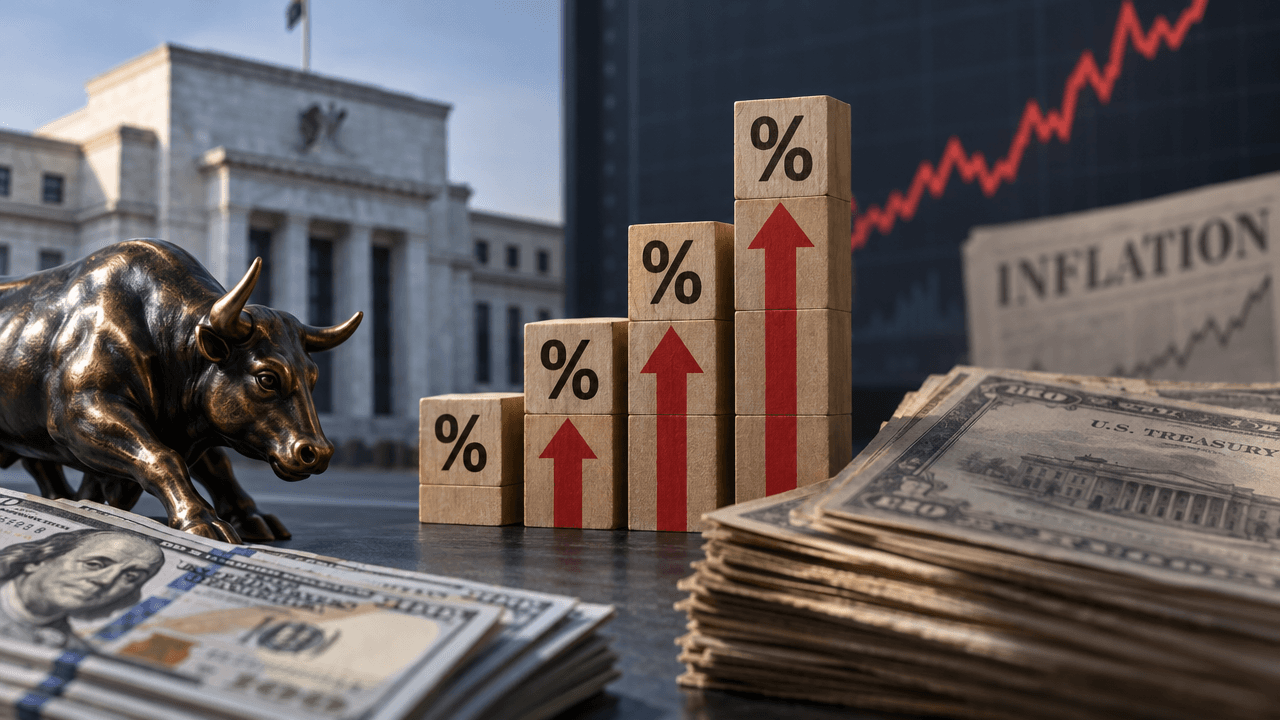
Futures markets are sending a clear message: investors expect the Federal Reserve to keep monetary policy restrictive for longer. Federal-funds futures are pricing roughly 3.6 quarter-point rate hikes over the next 12 months, including approximately 2.6 hikes within the next six months. That outlook reflects renewed concern that inflation is proving difficult to control and has important consequences for bonds, currencies, equities, commodities, and simulated trading strategies. [2]
The Market Is Pricing A Higher-rate Path
Interest-rate futures are not a promise of what the Federal Reserve will do. They are market-based estimates of where traders believe short-term interest rates will be in the future. When futures imply 3.6 quarter-point increases, the market is effectively pricing about 90 basis points of additional tightening over the next year.
The signal has become more hawkish following inflation data that exceeded expectations. Consumer prices increased 0.4% in October, while core inflation rose 0.3% for the third consecutive month. Those figures suggested that underlying price pressures remain persistent rather than continuing smoothly toward the Fed’s 2% objective. [8]
Federal Reserve officials have also reinforced the message. Governor Christopher Waller said he supported a 25-basis-point increase at the December meeting and argued that policy should become sufficiently restrictive to return inflation to target. Futures subsequently placed very high odds on a December hike, with markets also assigning some probability to a larger 50-basis-point move. [13][10]
The result is a market focused less on whether rates will rise once and more on how long the tightening cycle may continue.
Why Inflation Is Driving The Outlook
Inflation matters because central banks respond not only to current price growth but also to expectations about future inflation. If households and businesses believe prices will remain elevated, wage demands, service costs, and pricing decisions can reinforce the problem.
That is why the Fed may continue raising rates even if economic growth remains resilient. A strong labor market and healthy consumer demand can give policymakers room to prioritize price stability. In this environment, a gradual series of quarter-point hikes may be viewed as preferable to waiting until inflation requires a more aggressive response.
The futures curve suggests traders expect the Fed to move relatively quickly at first, with most of the anticipated tightening arriving within six months. This front-loaded pricing can change rapidly if inflation cools, employment weakens, or financial conditions deteriorate. It can also become more aggressive if monthly inflation readings remain unexpectedly strong.
For traders, the key lesson is that every major inflation release can alter the expected path of policy. The market reaction may be larger than the data point itself because traders are constantly recalculating the probability of future decisions.
Bonds Face Pressure, Especially At The Long End
A restrictive Fed path is generally bearish for bonds, but the effect is not always uniform across maturities. Short-duration Treasury yields tend to respond directly to expected changes in the federal-funds rate. Longer-duration bonds are influenced by both future short-term rates and expectations for inflation, economic growth, and government borrowing.
When traders expect rates to remain elevated, bond prices typically fall and yields rise. Longer-duration securities can experience larger price swings because their cash flows extend further into the future. A bond with a longer duration is more sensitive to a change in yields than a short-term note.
This creates a challenging environment for investors seeking capital gains from long-duration bonds. However, higher yields can improve the income available to investors who hold bonds to maturity or use shorter-duration instruments. The risk-reward balance therefore depends on time horizon, duration exposure, and expectations for the eventual end of the tightening cycle.
A useful scenario for SimFi traders is to compare how a two-year Treasury and a 10-year Treasury respond to the same hawkish policy surprise. The two-year note may react more immediately to a rate-hike repricing, while the 10-year yield could rise by less if investors believe tighter policy will eventually slow growth and inflation.
The Dollar May Benefit, But Volatility Remains
Higher expected US interest rates can support the dollar by making dollar-denominated assets more attractive relative to assets in countries with lower expected yields. The currency market often responds to changes in interest-rate differentials, particularly when the Federal Reserve appears more hawkish than other major central banks.
A stronger dollar can affect several markets at once. It may weigh on commodities priced in dollars because they become more expensive for international buyers. It can also pressure multinational companies by reducing the value of overseas earnings when converted back into dollars. Emerging-market assets may face additional challenges if dollar strength increases debt-servicing costs or encourages capital to move toward US assets.
Still, a higher-rate outlook does not guarantee a one-way dollar rally. Currency prices also reflect economic growth, fiscal policy, geopolitical risk, and expectations for other central banks. If markets begin to believe that restrictive policy will trigger a sharp US slowdown, the dollar’s safe-haven appeal and interest-rate support could move in opposite directions.
Practical Takeaways For Simfi Traders
First, treat futures pricing as a probability distribution rather than a certainty. A projected 3.6 hikes can change after one inflation report, employment release, or Federal Reserve communication.
Second, monitor the relationship between policy-sensitive assets. Rising two-year yields, a stronger dollar, and falling Treasury futures together would generally confirm a hawkish repricing. Divergence between those markets may signal that traders are questioning the sustainability of the move.
Third, manage duration and leverage carefully. Rate-sensitive positions can move quickly when markets shift from a quarter-point expectation to a larger hike or when projected cuts are removed from the curve.
Finally, build scenarios before entering a trade. Consider what could happen if inflation remains hot, if inflation cools faster than expected, or if growth suddenly weakens. A disciplined scenario plan is more useful than relying on a single forecast.
Conclusion
Futures markets are pricing a restrictive Federal Reserve path because inflation remains above target and economic activity has not yet weakened enough to eliminate the need for further tightening. The immediate implications are higher expected short-term rates, pressure on longer-duration bonds, and potential support for the dollar.
For SimFi participants, the opportunity is not simply to predict the next Fed decision. It is to understand how policy expectations flow through multiple markets, identify confirmation or divergence, and control risk when volatility rises. The most important question is no longer whether rates can move higher, but whether the economy can absorb a prolonged period of restrictive policy without a sharper slowdown.