
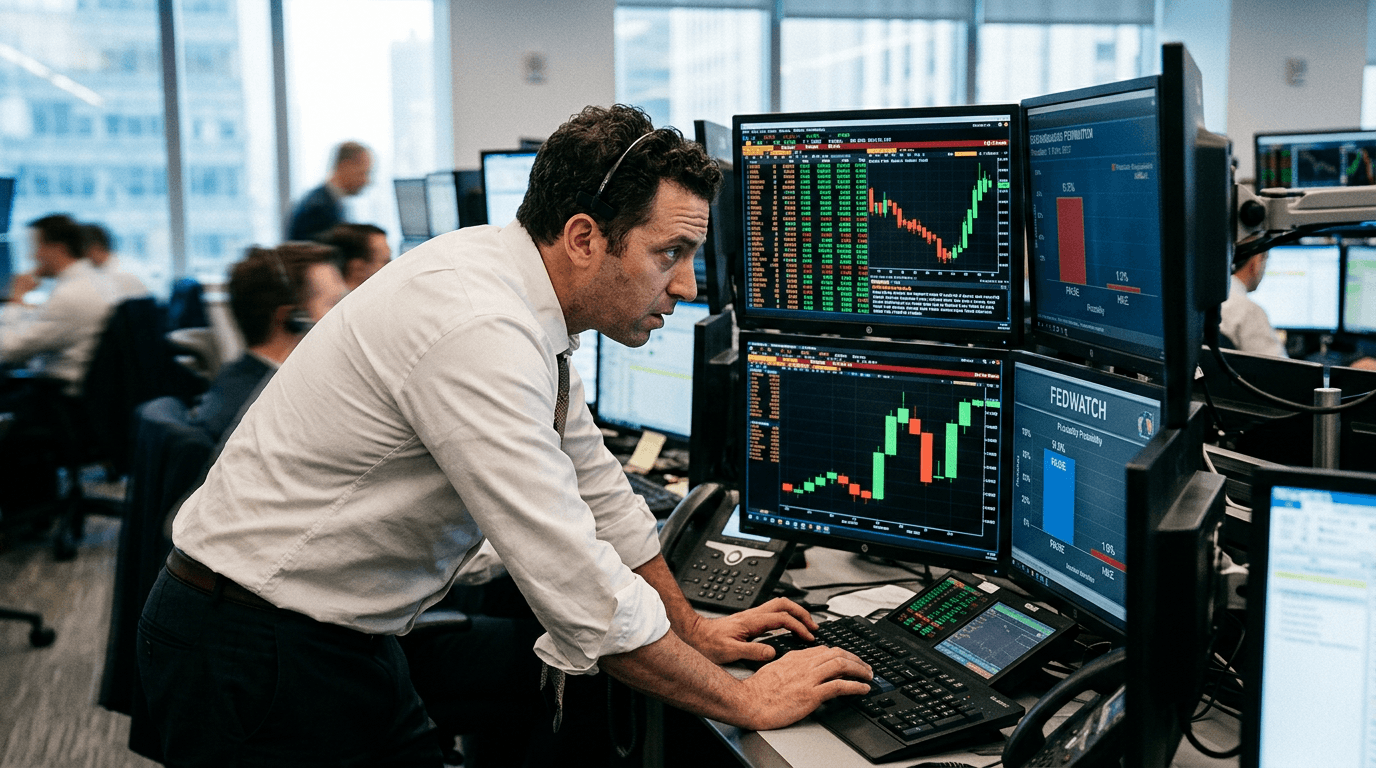
The futures market is sending a clear signal: after softer U.S. inflation data, traders are increasingly betting that the Federal Reserve will keep interest rates on hold rather than push through another hike in the near term.[7][15][6] Recent CPI and PPI readings have cooled more than many participants expected, giving the Fed “breathing room” and prompting a rapid repricing of policy odds across CME Fed funds futures and prediction markets.[11][15] That shift matters for every major asset class, from equities to FX and commodities.[7][6]
What The Futures Market Is Really Saying
Fed funds futures and tools like CME’s FedWatch translate market prices into implied probabilities for upcoming Fed decisions.[1][4] After the latest tepid CPI report, those probabilities swung toward a pause: futures now assign a higher chance that the target range stays at 3.50%-3.75%, with the odds of a hike declining compared with prior days.[15][6] In one recent episode, the probability of a December hike fell to around 18%, while the odds of a hold climbed above 74%.[6] Traders are, in effect, voting that policy is restrictive enough for now.[13]
This repricing is not binary. Reuters reported that traders still see roughly a one‑in‑three chance of a near‑term hike, even as the “no change” camp has grown stronger after softer inflation prints.[7] In other words, the market now leans toward a hold, but with meaningful tail risk of further tightening if inflation reaccelerates. For active traders, those probabilities are not forecasts; they are tradable inputs into risk management, scenario analysis, and position sizing.[4][5]
Why Weaker Inflation Data Shifted Expectations
The catalyst for this move has been a sequence of inflation releases showing cooling pressures rather than renewed acceleration.[7][11] One recent report put headline CPI at 3.5% year‑over‑year, below the 3.8% consensus and down sharply from 4.2% in the prior reading.[11] PPI has also moderated, suggesting easing pipeline pressures for goods prices and corporate input costs.[11] Softer data reduces the urgency for the Fed to tighten further in the short term, even if inflation remains above the 2% target.[7][11]
CNBC noted that the “tepid” CPI print gave the Fed more breathing room to keep rates unchanged at the upcoming meeting, which was reflected almost immediately in futures prices and prediction markets.[15] On platforms such as Kalshi, the probability of the Fed holding steady rose toward 70%, echoing the message from CME’s FedWatch tool.[15] This is a classic example of how a single data release can trigger a broad reassessment of the expected policy path, especially when it confirms an emerging trend of moderating inflation.[7][11][15]
Impact On Equities And Rates
For equities, lower odds of a near‑term hike tend to support risk appetite, particularly in rate‑sensitive segments such as growth stocks, small caps, and high‑beta sectors. A perceived “pause” reduces the discount rate applied to future earnings and alleviates fears of an overly aggressive Fed tightening into a slowing economy. At the same time, softer inflation can signal weaker nominal growth, which may weigh on cyclical sectors that depend on strong demand rather than lower rates. The net effect is often a rotation rather than a one‑direction rally.
In fixed income, futures repricing usually shows up first in the front end of the curve. As traders trim hike odds, short‑maturity Treasury yields tend to drift lower, while expectations for cuts further out remain constrained by the Fed’s desire to keep policy restrictive for longer.[6][13] That can produce subtle changes in curve shape—such as a modest steepening if the front end falls more than the long end—as markets balance softer inflation against lingering concerns about long‑term fiscal risks and term premium. For rates traders, spread trades (like 2s/10s steepeners) and options structures become attractive tools to express views on the evolving policy path.
Fx And Commodities: Repricing The Policy Path
In currency markets, a lower perceived probability of Fed hikes generally reduces support for the U.S. dollar versus peers whose central banks are either still tightening or seen as closer to cutting.[13] When inflation surprises on the downside and futures lean toward a pause, the interest‑rate differential story becomes less favorable for dollar bulls, particularly in pairs where carry has been a major driver of flows. That can spur repositioning in popular trades such as USD/JPY and USD‑linked carry baskets.
Commodities feel the impact through both the rates channel and the growth channel. Gold often benefits from lower real‑rate expectations and a perception that the Fed is less likely to tighten aggressively, supporting its role as a store of value amid policy uncertainty. Energy markets, on the other hand, react more to the growth signal embedded in inflation and activity data: softer price pressures can hint at cooling demand, which may cap upside for crude unless supply factors dominate. For traders across macro and commodities, the key is to separate the “rate story” from the “growth story” when interpreting inflation surprises.
How Traders Can Use Simulated Finance To Prepare
The rapid shift in futures‑implied Fed odds after the latest inflation data highlights why it is risky to trade macro events without a tested playbook. On a SimFi platform like E8 Markets, traders can rehearse their response to different inflation scenarios—hot, tepid, or outright disinflation—without putting real capital at risk. By building and stress‑testing strategies around scheduled data releases, traders can learn how their portfolios behave when probabilities for hikes, holds, or cuts swing in one direction or the other.
Practical ways to use a simulated environment include running scenario trees tied to upcoming CPI and PPI dates, testing cross‑asset views (equities, rates, FX, and commodities) under different Fed paths, and tracking P&L across simulated “policy cycles” as futures repricing unfolds. Over time, this helps traders distinguish between knee‑jerk reactions and more durable trends in policy expectations, refining their risk management and timing. When the real data hits and the futures market trims or adds hike odds again, a well‑rehearsed strategy can be the difference between reactive trading and disciplined execution.
Conclusion
Weaker inflation data have meaningfully shifted the futures market’s view of the Fed’s near‑term path, tilting the odds toward a pause while keeping some probability of further tightening alive.[7][11][15] That repricing is not just a rates story; it cascades through equities, FX, and commodities, reshaping opportunities and risks across the board.[6][13] For traders, the lesson is clear: treat futures‑implied probabilities as dynamic inputs, not fixed forecasts, and use tools—real and simulated—to prepare for the next round of data‑driven policy shifts.