
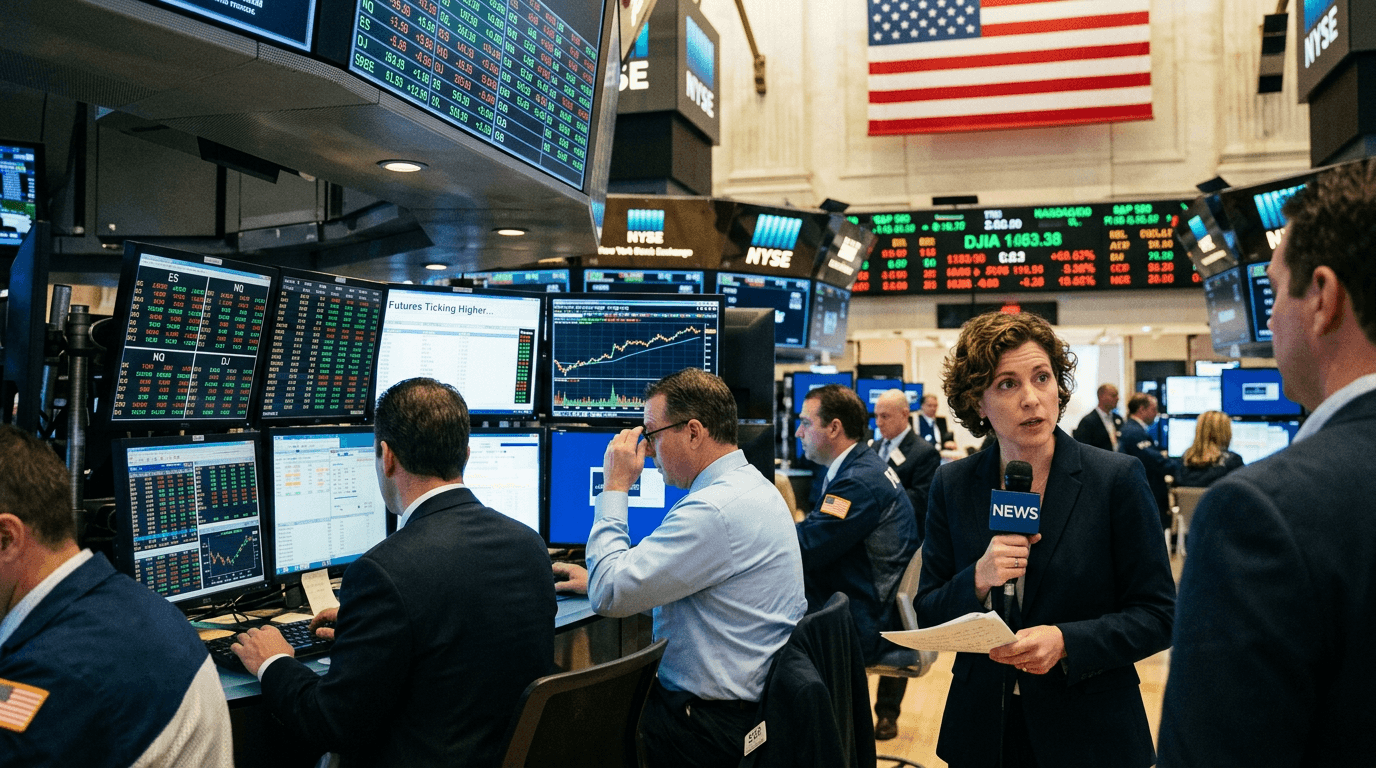
U.S. stock index futures are pointing modestly higher as traders line up for a one-two punch of inflation data and a fresh wave of corporate earnings, hinting at a potentially active session across equities, bonds, and the dollar.[5][2] Reuters notes that futures on the major indices have edged up as investors brace for producer price figures and more company results, underscoring how sensitive markets remain to any signal on growth and inflation.[5] This pre-market move doesn’t guarantee a strong cash session, but it does tell you where risk appetite is leaning as the data hits.
Markets Ease Higher Ahead Of Inflation And Earnings
According to recent reports, S&P 500, Dow, and Nasdaq futures have been ticking higher in early trade when investors expect key inflation prints and major earnings in the same window.[2][4] This pattern has repeated around both consumer (CPI) and producer (PPI) inflation releases, as traders try to front-run how the data might reshape expectations for Federal Reserve policy and corporate margins.[13][15]
On days like this, even a move of 0.2%–0.4% in the futures can matter because it often reflects shifts in positioning by large institutions, not just retail sentiment.[2][5] A gentle grind higher suggests a cautiously optimistic market: investors are willing to add risk, but they are not fully convinced that the inflation story is solved or that earnings will be uniformly strong.
The wrinkle today is that inflation data and earnings can point in different directions. Softer inflation tends to support higher valuations by lowering rate expectations, while disappointing results or guidance from bellwether companies can quickly erase that macro tailwind.[7][15] That tension is what makes sessions like this so potentially volatile.
Why Producer Inflation Matters For Stocks And Futures
Today’s focus on producer prices (PPI) is not just an academic exercise. Producer inflation feeds directly into companies’ cost structures, which then flow through into margins, pricing decisions, and ultimately consumer inflation (CPI) and the Fed’s reaction function.[15] When PPI and CPI have come in cooler than expected in recent months, U.S. stocks have generally rallied as markets scaled back the odds of further tightening and embraced the prospect of lower-for-longer rates.[3][7][15]
The mechanics are straightforward: - Softer inflation → lower expected policy rates → lower bond yields → higher present value of future earnings → support for growth and tech stocks.[7][15] - Hotter inflation → risk of more hikes or delayed cuts → higher yields → pressure on richly valued sectors and more support for the dollar.[6][13]
Futures markets react first because they trade nearly around the clock and offer a liquid way for investors to adjust exposure ahead of the cash open. When inflation data surprises, index futures can swing sharply, dragging implied volatility higher and setting the tone for the rest of the day’s trading across asset classes.
Earnings Season: Micro Stories Inside The Macro
Layered on top of the macro narrative is earnings season, which often drives sharp moves at the sector and single-stock level even when the indices move only modestly.[4][8] Recent sessions have shown how strong results from mega-cap tech or banks can lift the broader market, while disappointments from major names can weigh heavily on indices like the Nasdaq 100.[4][7]
Reuters reports that markets are now bracing for a new wave of corporate results, with individual stories such as a surge in PayPal shares on takeover speculation highlighting how idiosyncratic risk can spike during this period.[5] At the same time, solid earnings combined with cooler inflation have recently boosted risk appetite, allowing the S&P 500 and Nasdaq to advance even against a backdrop of geopolitical tension.[3][16]
For traders, this mix means: - Index direction is being driven by macro (inflation, rates, growth expectations). - Within the index, there is wide dispersion as winners and losers react to earnings, guidance, and sector-specific news.[4][7][5]
On earnings-heavy days, futures can sometimes understate how violent the moves will be within specific sectors or individual names once the cash market opens.
What Futures Are Signaling For Equities, Bonds, And The Dollar
When index futures edge higher ahead of inflation and earnings, they are effectively pricing a higher probability of a “benign” outcome: inflation roughly in line or slightly cooler than expected, and earnings that are good enough to sustain the current narrative.[5][13][14] This usually aligns with modestly softer Treasury yields and a slightly weaker dollar as markets bet on a less aggressive Fed.[2][7][15]
But the path from pre-market optimism to closing prices is rarely linear. A few common intraday scenarios:
1. Goldilocks surprise Inflation comes in cooler than expected, earnings are solid, and futures extend their gains into the cash session. Growth stocks and longer-duration names outperform as yields drift lower.[3][7][15]
2. Mixed signals Inflation is benign, but a few key companies miss or guide lower. Index-level gains may fade, even as yields fall and the dollar softens. Sector rotation becomes the dominant intraday theme.[4][7]
3. Negative surprise Inflation runs hot, or a major earnings miss hits sentiment. Futures can reverse sharply, yields jump, and the dollar strengthens as traders price in tighter policy and weaker risk appetite.[6][13]
Pre-market futures are therefore best viewed as a probability-weighted starting point, not a forecast. They indicate how positioned the market is going into the event and where the pain trade might be if the data meaningfully surprises.
Practical Playbook For Traders And Simulated Traders
For both live and simulated traders, days when futures rise into key inflation data and earnings are ideal environments to test and refine a structured playbook.
A practical approach
1. Define the macro scenarios in advance Before the data hits, map out three ranges: cooler, in line, and hotter-than-expected inflation. For each, pre-define your directional bias for indices, yields, and the dollar, as well as which sectors might benefit or suffer.[13][15]
2. Watch the first reaction, then the second The initial futures spike after the release often reflects algos trading the headline. The more important move is the second reaction, once traders have digested details like core vs. headline inflation, revisions, and company guidance.
3. Use volatility, not just direction Options markets tend to price higher implied volatility into major data and earnings. Even in a simulated environment, tracking how realized volatility compares to what was implied teaches valuable lessons about risk, position sizing, and event premium.
4. Separate index views from stock selection You might be bullish the S&P 500 on cooler inflation but still cautious on a sector facing earnings risk that day. Decoupling macro and micro views can help avoid overconcentrated bets.
5. Review the session after the close High-information days are some of the best for learning. A post-session review of your playbook versus actual market behavior can rapidly improve your process, especially in a SimFi environment where you can iterate without capital at risk.
When U.S. stock index futures rise ahead of inflation and earnings, the message is subtle but important: markets are leaning toward optimism, but the real test is still in front of them.[5][2][14] For active traders and those practicing in simulated markets, this is precisely the kind of backdrop where preparation, discipline, and a clear framework can turn market noise into meaningful opportunity.